As governments tighten climate regulations and businesses accelerate their net-zero commitments, carbon credits have become one of the most valuable instruments in the global sustainability economy.
At the same time, carbon capture technologies are rapidly evolving from experimental concepts into commercially viable solutions capable of removing carbon dioxide (CO₂) from industrial emissions and even directly from the atmosphere.
This raises an important question for businesses:
Can Carbon Capture Generate Carbon Credits?
Yes. Carbon capture projects can generate carbon credits when the captured or removed carbon dioxide is measurable, verifiable, additional, and meets the requirements of recognized carbon standards and registries.
For organizations seeking to reduce emissions, improve ESG performance, and unlock new revenue opportunities, carbon capture and carbon credits represent a powerful combination.
This guide explains how carbon capture projects generate carbon credits, the opportunities available to businesses, and what the future of the carbon market looks like.
What Is Carbon Capture?
Carbon capture refers to technologies and biological systems that remove carbon dioxide from industrial emissions or directly from the atmosphere before it contributes to climate change.
The captured carbon can then be:
- Stored permanently
- Converted into useful products
- Utilized in industrial processes
- Sequestered through biological systems
Carbon capture technologies are becoming increasingly important as industries seek practical solutions to reduce greenhouse gas emissions while maintaining productivity.
Types of Carbon Capture Technologies
Industrial Carbon Capture
Industrial carbon capture systems collect CO₂ from:
- Power plants
- Cement manufacturing
- Steel production
- Chemical industries
- Refineries
These systems prevent emissions from entering the atmosphere.
Direct Air Capture (DAC)
Direct Air Capture removes carbon dioxide directly from ambient air using specialized filters and chemical processes.
Biological Carbon Capture
Nature-based systems absorb atmospheric carbon through biological processes.
Examples include:
- Forests
- Mangroves
- Wetlands
- Soil carbon projects
- Microalgae cultivation systems
What Are Carbon Credits?
A carbon credit represents the reduction, avoidance, or removal of one metric tonne of carbon dioxide equivalent (tCO₂e).
Organizations purchase carbon credits to:
- Offset emissions
- Meet sustainability goals
- Achieve net-zero targets
- Support climate projects
Carbon credits are traded in carbon markets worldwide.
Compliance Carbon Markets
Compliance markets are regulated by governments.
Examples include:
- European Union Emissions Trading System (EU ETS)
- California Cap-and-Trade Program
- UK Emissions Trading Scheme
Organizations are legally required to reduce or compensate for emissions.
Voluntary Carbon Markets
Voluntary carbon markets allow businesses to purchase credits voluntarily.
These markets are growing rapidly as corporations seek to achieve net-zero commitments and improve ESG performance.
Can Carbon Capture Projects Generate Carbon Credits?
The answer is yes, provided the project meets strict requirements established by carbon registries and verification agencies.
To qualify for carbon credits, a carbon capture project must demonstrate:
Additionality
The project must remove or prevent emissions beyond what would have occurred naturally or through existing regulations.
Measurability
The amount of carbon captured must be accurately measured.
Verification
Independent third-party auditors must verify project performance.
Permanence
Captured carbon must remain stored or removed for a defined period.
Monitoring
Continuous monitoring is required to ensure integrity and transparency.
When these requirements are met, carbon capture projects can generate verified carbon credits that can be sold in carbon markets.
Types of Carbon Capture Projects Eligible for Carbon Credits
Direct Air Capture (DAC)
Direct Air Capture is increasingly recognized as one of the most promising carbon removal technologies.
Benefits
- Removes historical emissions
- Highly measurable
- Strong verification capability
- Attractive to corporate buyers
Challenges
- High operational costs
- Energy-intensive processes
- Large infrastructure requirements
Carbon Credit Potential
DAC-generated credits often command premium prices because they represent genuine carbon removal.
Industrial Carbon Capture
Industrial facilities can install carbon capture systems to reduce emissions from production processes.
Suitable Industries
- Cement
- Steel
- Petrochemicals
- Power generation
- Waste-to-energy plants
Benefits
- Immediate emissions reduction
- Supports regulatory compliance
- Potential revenue from carbon credits
Nature-Based Carbon Removal
Nature-based solutions remain among the most common carbon credit projects globally.
Examples include:
- Reforestation
- Afforestation
- Mangrove restoration
- Soil carbon enhancement
These projects provide additional biodiversity and ecosystem benefits.
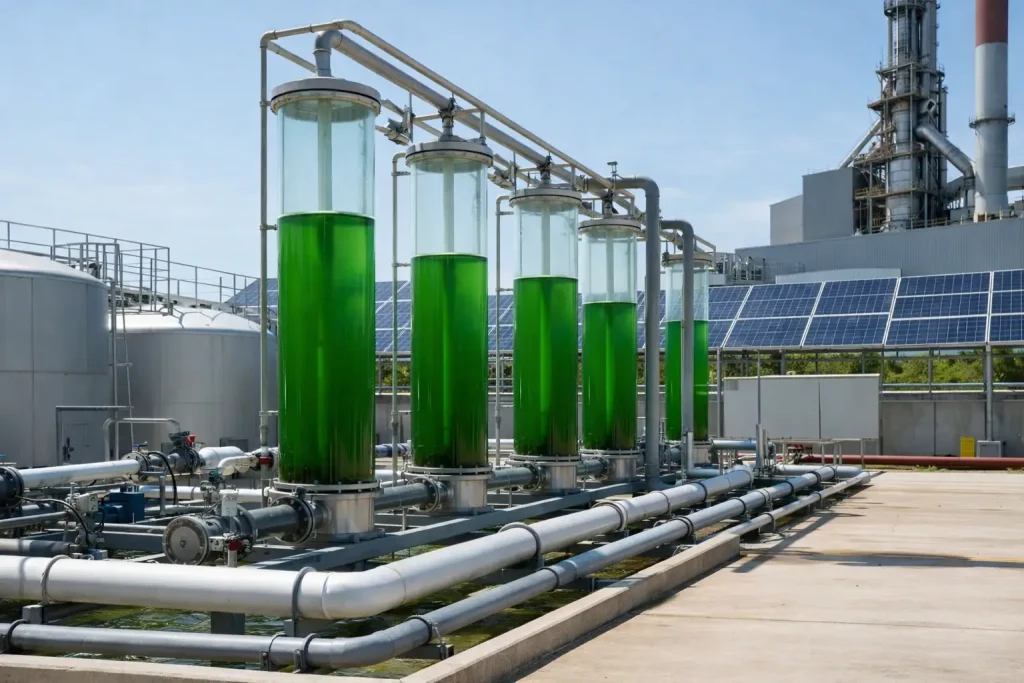
Microalgae Carbon Capture
Microalgae represent one of the most exciting emerging carbon capture technologies.
Microalgae naturally absorb carbon dioxide through photosynthesis and convert it into biomass.
Advantages of Microalgae Carbon Capture
- Rapid growth rates
- High carbon absorption efficiency
- Minimal land requirements
- Continuous carbon capture
- Biomass utilization opportunities
- Real-time monitoring capabilities
Compared to traditional forestry projects, microalgae systems can capture carbon much faster and operate in controlled environments.
As carbon accounting methodologies mature, microalgae-based carbon capture projects are expected to play an increasingly important role in carbon credit generation.
How Carbon Credits Are Generated from Carbon Capture Projects
The process generally follows seven stages.
1. Baseline Assessment
Organizations evaluate current emissions and establish a reference scenario.
2. Project Design
A carbon capture system is designed and implemented.
3. Monitoring
Data is continuously collected regarding carbon capture performance.
4. Verification
Independent auditors review project data.
5. Credit Issuance
Verified reductions are converted into carbon credits.
6. Registry Listing
Credits are registered with approved carbon standards.
7. Trading and Revenue Generation
Credits are sold to organizations seeking emission reductions.
The Critical Role of MRV
What Is MRV?
MRV stands for:
- Monitoring
- Reporting
- Verification
MRV ensures that carbon credits represent real and measurable climate impact.
Without reliable MRV systems, carbon credits lose credibility and market value.
Why MRV Matters
MRV helps businesses:
- Track carbon capture performance
- Improve transparency
- Support audits
- Maintain compliance
- Build investor confidence
Emerging Trends
Modern carbon capture projects increasingly utilize:
- IoT sensors
- AI-driven analytics
- Digital twins
- Automated reporting platforms
- Real-time environmental monitoring
These technologies improve accuracy and reduce verification costs.
Carbon Capture and the Voluntary Carbon Market
The voluntary carbon market is experiencing significant growth.
Corporations worldwide are investing in carbon removal projects to:
- Meet net-zero commitments
- Improve ESG ratings
- Address residual emissions
- Strengthen sustainability leadership
Carbon removal credits generated through technologies such as Direct Air Capture and advanced biological systems often attract premium pricing due to their measurable impact.
As climate regulations expand globally, demand for high-quality carbon removal credits is expected to increase substantially.
Revenue Potential of Carbon Capture Carbon Credits
Carbon credits are becoming a strategic revenue stream for businesses investing in carbon capture infrastructure.
Revenue depends on:
- Project scale
- Carbon removal efficiency
- Verification quality
- Market demand
- Carbon registry standards
Organizations with robust monitoring systems and high-quality removal methodologies often achieve stronger market valuations.
In addition to credit sales, businesses may benefit from:
- ESG advantages
- Sustainability-linked financing
- Green branding
- Regulatory preparedness
- Investor interest
Carbon Capture vs Carbon Offsetting
| Carbon Capture | Carbon Offsetting |
|---|---|
| Removes or prevents emissions | Compensates for emissions |
| Direct climate impact | Indirect climate impact |
| Measurable carbon removal | Often project-based compensation |
| Higher verification requirements | Generally easier implementation |
| Premium carbon credits | Standard offset credits |
| Supports long-term decarbonization | Supports short-term mitigation |
Organizations increasingly prefer carbon removal strategies because they deliver measurable climate benefits and stronger ESG outcomes.
Challenges in Carbon Credit Generation
While opportunities are significant, businesses should also understand key challenges.
Verification Costs
Third-party audits can be expensive.
Regulatory Changes
Carbon market rules continue to evolve globally.
Permanence Concerns
Projects must demonstrate long-term carbon storage.
Market Volatility
Carbon credit prices fluctuate based on supply and demand.
Data Requirements
Accurate monitoring systems are essential.
The Future of Carbon Capture Carbon Credits
Several trends are shaping the future of the market.
AI-Powered Carbon Monitoring
Artificial intelligence is improving MRV accuracy.
Real-Time Carbon Accounting
Digital platforms are enabling continuous emissions tracking.
Blockchain Verification
Distributed ledger systems may improve transparency and traceability.
Carbon Removal Premiums
Markets increasingly value carbon removal over traditional offsets.
Growing Net-Zero Commitments
Thousands of companies worldwide have established net-zero targets, increasing demand for verified carbon removal credits.
How Businesses Can Get Started
Organizations interested in carbon capture carbon credits should consider the following roadmap.
Step 1: Assess Current Emissions
Measure Scope 1, Scope 2, and Scope 3 emissions.
Step 2: Identify Carbon Sources
Determine major emission points and capture opportunities.
Step 3: Evaluate Technologies
Explore industrial carbon capture, DAC, and biological systems such as microalgae.
Step 4: Establish MRV Systems
Implement monitoring and reporting infrastructure.
Step 5: Develop a Carbon Project
Design a project aligned with recognized carbon standards.
Step 6: Verify and Register
Work with accredited verifiers and registries.
Step 7: Generate Revenue
Issue and trade verified carbon credits.
Frequently Asked Questions
1. Can carbon capture generate carbon credits?
Yes. Verified carbon capture projects can generate carbon credits when they meet recognized carbon market standards.
2. What is a carbon credit?
A carbon credit represents one metric tonne of CO₂ reduced, removed, or avoided.
3. What is carbon removal?
Carbon removal permanently extracts carbon dioxide from the atmosphere.
4. How are carbon capture projects verified?
Independent auditors evaluate project performance and monitoring data.
5. What is MRV?
MRV stands for Monitoring, Reporting, and Verification.
6. Are carbon credits profitable?
They can create new revenue streams while supporting sustainability goals.
7. What industries benefit most from carbon capture?
Manufacturing, cement, steel, chemicals, energy, and infrastructure sectors.
8. Can microalgae generate carbon credits?
Microalgae-based projects have strong potential where carbon capture can be accurately measured and verified.
9. What is the voluntary carbon market?
A marketplace where organizations purchase carbon credits voluntarily to achieve climate goals.
10. Why are carbon removal credits valuable?
They provide measurable and verifiable climate impact, making them attractive to buyers.
Conclusion
Carbon capture is no longer just an environmental initiative—it is becoming a strategic business opportunity.
As carbon markets mature and net-zero commitments accelerate, organizations that invest in verified carbon capture solutions can benefit from reduced emissions, stronger ESG performance, improved regulatory readiness, and new revenue streams through carbon credits.
Whether through industrial carbon capture, Direct Air Capture, or innovative biological solutions such as microalgae, businesses have an unprecedented opportunity to transform carbon management into a measurable climate and commercial advantage.
Companies that act today will be better positioned to compete in a future where carbon accountability, sustainability performance, and verified climate impact increasingly define business success.