Algae-powered air purification is emerging as a smart and future-ready solution for India’s growing urban air pollution challenge. As Indian cities expand, air quality is becoming a serious concern across roadsides, industries, campuses, metro stations, airports, hospitals, public spaces, and high-density commercial areas.
Urban growth has brought better connectivity and stronger economic activity, but it has also increased vehicle emissions, construction dust, industrial pollution, carbon emissions, and poor indoor air quality. For millions of people living and working in Indian cities, clean air is no longer just an environmental goal. It is a public health, climate, and infrastructure priority.
India now needs clean air solutions that are scalable, measurable, space-efficient, and suitable for modern urban environments. This is where algae-based air purifier technology can play an important role.
By using microalgae, photobioreactor technology, carbon capture systems, and real-time air quality monitoring, algae-powered air purification offers a nature-inspired approach to cleaner and healthier cities.
Why India Needs New Clean Air Solutions
Air pollution in India is a complex challenge. It is not caused by one source alone. Vehicle emissions, industrial activity, construction dust, road dust, diesel generators, waste burning, and high urban density all contribute to poor air quality.
Traditional solutions such as tree planting, mechanical filters, and conventional air purifiers are important. However, they have limitations when used alone.
Trees are powerful natural air purifiers, but they require land, time, water, and regular maintenance. In dense cities, there may not be enough space to plant trees exactly where pollution levels are highest.
Conventional air purifiers are useful in indoor environments, but many systems depend on electricity, filter replacement, and enclosed spaces. They may reduce particles indoors, but they do not always address carbon dioxide, outdoor pollution hotspots, or public infrastructure needs.
India needs urban air pollution solutions that can work in compact locations and deliver measurable results. Clean air infrastructure must be suitable for roadsides, airports, metro stations, smart city projects, IT parks, schools, hospitals, malls, and industrial zones.
This is why clean air and CO₂ capture solutions are becoming important for cities, institutions, companies, and government-led sustainability projects.
What Is Algae-Powered Air Purification?
Algae-powered air purification is a clean air technology that uses microalgae to capture carbon dioxide, support oxygen generation, and improve air quality.
Microalgae are tiny photosynthetic organisms. Like plants, they use light and carbon dioxide for photosynthesis. During this process, they absorb CO₂ and release oxygen.
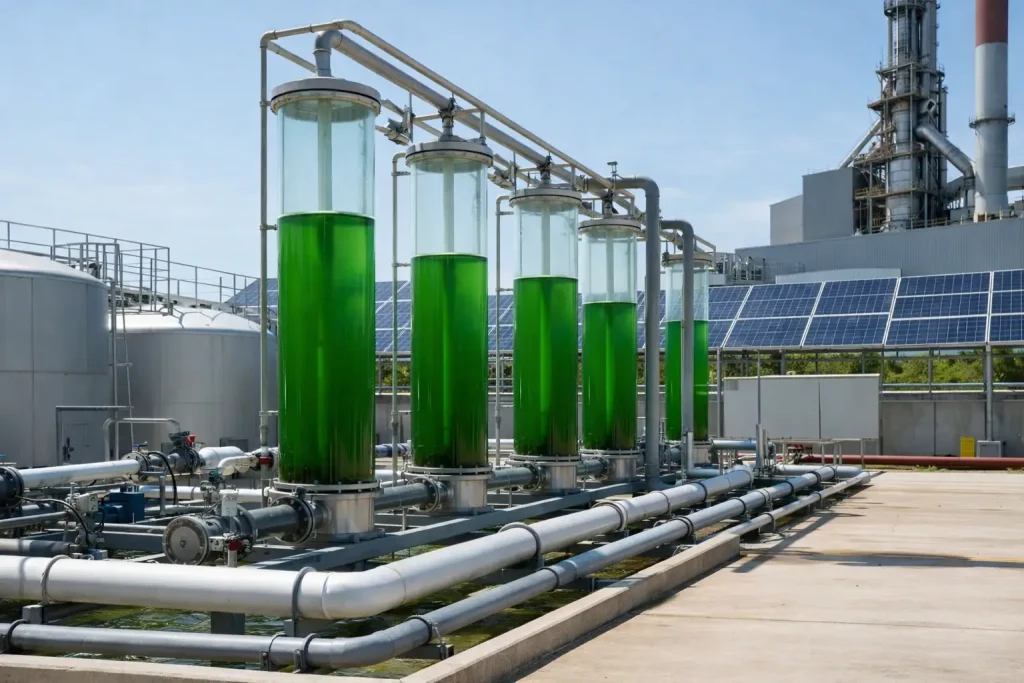
In a microalgae air purifier, algae are grown inside a controlled system called a photobioreactor. A photobioreactor provides the right conditions for algae growth, including light, nutrients, airflow, and circulation.
The system can be designed to interact with surrounding air. Carbon-rich air passes through or near the algae-based system, allowing microalgae to use CO₂ as part of their growth process. At the same time, the system supports oxygen generation and cleaner air circulation.
Modern photobioreactor technology can also include IoT sensors, smart dashboards, and real-time air quality monitoring. This makes the system more than a passive green installation. It becomes a smart clean air asset.
For a detailed understanding of this technology, Carbelim has also explained how algae bioreactors support biological air purification.
How Microalgae Help Capture Carbon and Improve Air Quality
Microalgae are highly effective because they grow quickly and use carbon dioxide during photosynthesis. This makes them useful for algae-based carbon capture and climate-focused clean air innovation.
A well-designed microalgae air purifier can support several environmental benefits.
First, it helps capture carbon dioxide. CO₂ is one of the major greenhouse gases linked to climate change. Microalgae use CO₂ for growth, making them a natural part of carbon capture technology.
Second, microalgae support oxygen generation. As they absorb CO₂, they release oxygen, helping create fresher and healthier surrounding air.
Third, algae-powered systems can support better air quality when combined with filtration, airflow design, and smart monitoring. This makes them suitable for public and private spaces where people spend long hours.
Fourth, these systems are compact. In Indian cities, space is limited. Microalgae systems can be designed as towers, panels, benches, dividers, facades, or indoor installations.
Fifth, algae-powered air purification can be integrated into public infrastructure. This includes roadsides, walkways, metro stations, campuses, airports, public parks, and smart city zones.
Finally, the impact can be measured. With air quality monitoring, dashboards, and sensor-based reporting, organizations can track environmental performance and show clear ESG and CSR sustainability outcomes.
This makes microalgae air purification a strong solution for India’s next generation of clean air infrastructure.
Applications in Indian Cities
Algae-powered air purification can be used across many urban environments. It is not limited to one industry or one building type. It can support public infrastructure, private campuses, transport hubs, commercial spaces, and industrial zones.
Roadsides
Roadsides are exposed to vehicle emissions, dust, and constant traffic movement. Algae-powered clean air systems can be installed along traffic corridors, road dividers, pedestrian walkways, and high-pollution zones.
Carbelim’s Biodivider Panels for sustainable road infrastructure show how algae-based systems can be integrated into urban road environments.
Airports
Airports are high-footfall public spaces with vehicle movement, passenger traffic, energy demand, and sustainability targets. Algae-based carbon capture systems can help airports demonstrate visible climate action and improve passenger-facing sustainability experiences.
For large public infrastructure, Carbelim has also discussed carbon capture for roadsides and airports as a future-ready urban solution.
Metro Stations
Metro stations and transit hubs experience high passenger density. Smart air purification systems with real-time air quality monitoring can support cleaner indoor and semi-outdoor environments.
IT Parks and Corporate Campuses
IT parks and corporate campuses can use algae-powered air purification as part of ESG solutions, employee wellbeing initiatives, and CSR sustainability programs.
Clean air infrastructure can be placed in entrances, indoor common areas, walkways, cafeterias, open campuses, and experience zones.
Schools and Universities
Educational institutions can benefit from cleaner air and sustainability awareness. Algae-based clean air systems can also help students understand climate-tech India, carbon capture, and nature-based air purification.
Hospitals
Hospitals require cleaner and healthier surroundings. Algae-powered systems can be used in selected public zones such as entrances, waiting areas, outdoor corridors, and green infrastructure spaces.
Shopping Malls
Shopping malls attract large public crowds. A visible microalgae air purifier can improve sustainability branding while supporting cleaner air circulation in selected spaces.
Industrial Zones
Industrial zones need stronger carbon capture technology and air quality monitoring. Algae-powered systems can support cleaner industrial campuses, environmental responsibility, and ESG reporting.
Carbelim’s Industrial CCUS solutions focus on microalgae-based carbon capture for hard-to-abate sectors and industrial emission sources.
Smart City Projects
Smart cities need smart air purification. Algae-powered systems can be integrated into public parks, bus shelters, road dividers, pedestrian zones, EV charging hubs, and climate-resilient urban infrastructure.
A citywide model such as the PureAir Network™ shows how microalgae photobioreactor panels can become part of urban clean air infrastructure.
Carbelim’s Role in Clean Air Innovation
Carbelim is an IIT Madras-incubated climate-tech innovator developing microalgae-powered photobioreactor technology for carbon capture, air purification, oxygen generation, and real-time air quality monitoring.
Carbelim’s solutions combine biology, engineering, and environmental data to create measurable clean air infrastructure for modern cities. The goal is to move beyond traditional air purification and build systems that actively support carbon capture, sustainability, and healthier public spaces.
Products such as AirForest™, PureAir Tower™, and algae-based clean air infrastructure are designed for high-impact locations including airports, campuses, metro stations, public spaces, roadsides, industries, and smart city projects.
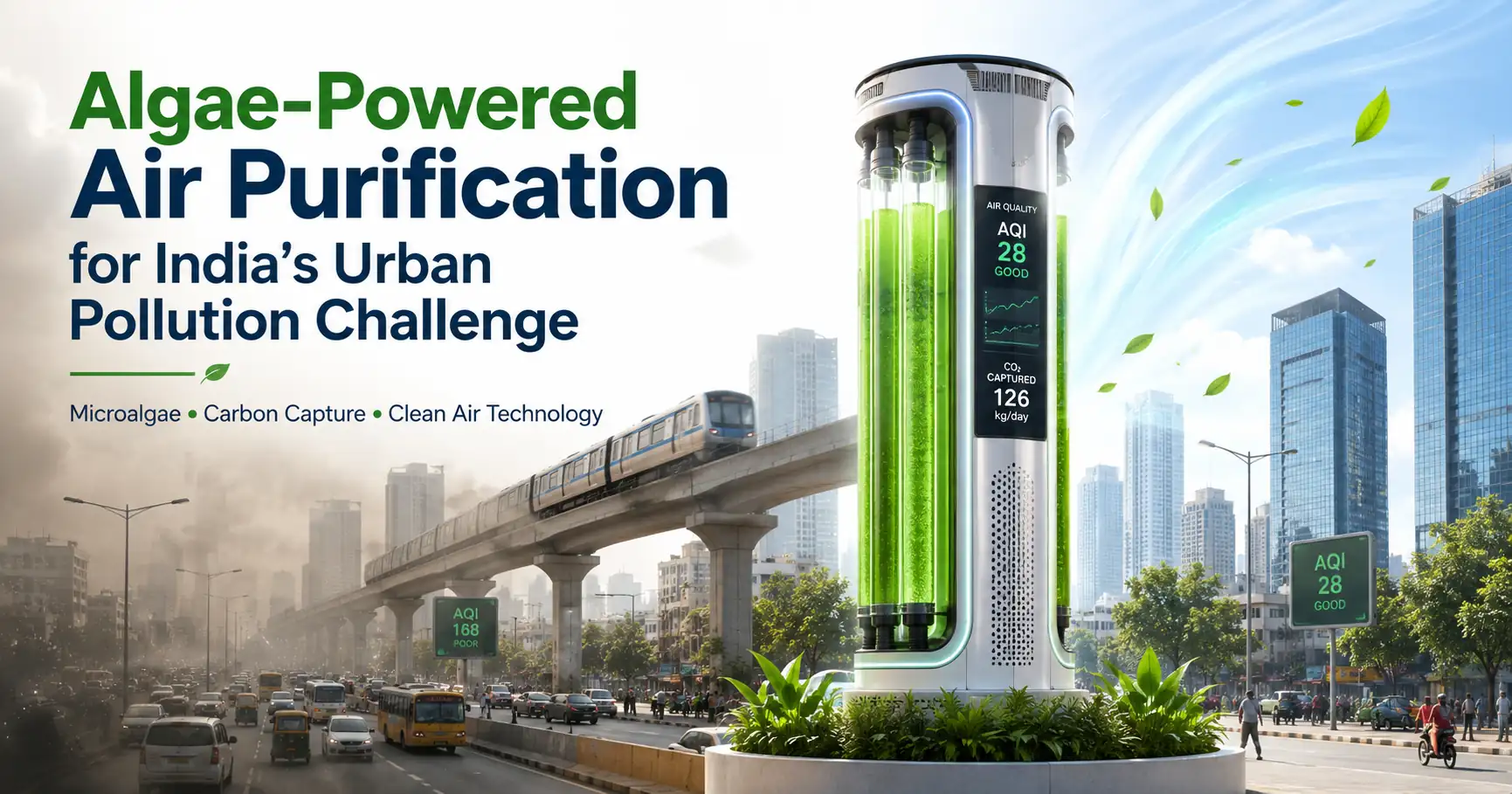
Carbelim’s PureAir Tower™ is designed as an outdoor biological air purification system for urban pollution hotspots, smart cities, and public infrastructure.
Carbelim’s work reflects a broader shift in climate-tech India: clean air solutions must be visible, measurable, scalable, and suitable for real-world deployment.
ESG, CSR, and Smart City Impact
Today, organizations are expected to show real environmental action. ESG and CSR are no longer only about reports. They must create visible and measurable outcomes.
Algae-powered air purification can help companies, governments, airports, universities, hospitals, industries, and public institutions demonstrate sustainability in a practical way.
For CSR teams, microalgae-based clean air systems can support community health, clean air awareness, climate education, and public environmental improvement.
For ESG teams, these systems provide a visible climate asset that can be connected with air quality monitoring, carbon capture reporting, oxygen generation data, and sustainability dashboards.
For smart city planners, algae-based carbon capture can support green infrastructure, clean air corridors, public parks, sustainable transport hubs, and climate-resilient city design.
For industries, algae-powered systems can support decarbonization goals, environmental monitoring, and responsible infrastructure development.
The key advantage is measurability. With smart sensors and dashboards, organizations can track air quality and communicate sustainability outcomes with greater transparency.
The Future of Urban Air Purification in India
The future of urban air purification in India will need more than conventional filters and isolated green spaces. Cities will need biological, data-driven, and infrastructure-integrated clean air systems.
Algae-powered air purification offers this future by connecting nature-based air purification with modern climate-tech engineering. It supports carbon capture, oxygen generation, smart air purification, and real-time air quality monitoring.
As India moves toward sustainable cities, net-zero goals, green buildings, smart mobility, and stronger ESG standards, clean air infrastructure will become an essential part of urban planning.
Airports, metro stations, IT parks, industrial corridors, campuses, roadsides, and public spaces will need solutions that are compact, scalable, and measurable.
Microalgae-powered systems do not replace trees, green spaces, or policy action. Instead, they add a new layer of clean air innovation that can work where traditional solutions may be limited.
For India’s growing urban pollution challenge, algae-based air purification is a practical bridge between nature, technology, and urban sustainability.
Benefits for Businesses, Institutions, and Public Spaces
Algae-powered air purification is not only useful for government-led projects. It also has strong value for private organizations and institutions that want to create healthier, greener, and more responsible spaces.
For businesses, it can support ESG goals, brand positioning, workplace wellness, and sustainability reporting. A visible clean air system in a corporate campus, IT park, or commercial building can show that the organization is taking real steps toward environmental responsibility.
For educational institutions, microalgae-based clean air technology can create both environmental and learning value. Schools, colleges, and universities can use these systems to improve campus sustainability while educating students about climate-tech India, carbon capture technology, photosynthesis, and nature-based innovation.
For hospitals and healthcare spaces, clean air infrastructure can support healthier surroundings and improve the overall environmental quality of public zones.
For malls, airports, and metro stations, algae-powered systems can improve visitor experience by combining sustainability, design, and environmental technology. These installations can become high-visibility clean air assets that communicate climate responsibility to thousands of people every day.
For industries, algae-based carbon capture can support sustainability initiatives in industrial campuses, manufacturing zones, and emission-sensitive environments. When connected with monitoring systems, it can help industries demonstrate progress toward cleaner operations and responsible growth.
This makes algae-powered air purification a flexible solution for both public and private sectors.
The Importance of Measurable Clean Air Infrastructure
One of the biggest challenges in sustainability is measurement. Many environmental initiatives are visible, but their actual impact can be difficult to track. For companies, governments, airports, industries, and institutions, this creates a need for solutions that provide both visibility and data.
Algae-powered air purification systems can support this requirement by combining biological carbon capture with air quality monitoring. Sensors can track important environmental parameters such as particulate matter, carbon dioxide, temperature, humidity, and other air quality indicators.
This data can help organizations understand local air quality conditions and evaluate the performance of clean air infrastructure. It also supports ESG reporting, CSR documentation, sustainability communication, and public awareness.
For example, a company installing a microalgae air purifier on its campus can use performance data to show commitment to employee wellbeing and climate action. An airport can use clean air installations to create a passenger-facing sustainability experience. A smart city authority can use algae-powered systems as part of public environmental monitoring and green infrastructure planning.
This shift from passive sustainability to measurable sustainability is important for India. Future cities will need climate solutions that are not only installed but also monitored, reported, and improved over time.
Carbelim’s PureAir Network™ represents this direction by connecting microalgae photobioreactor technology with smart urban clean air infrastructure.
Moving from Air Purification to Climate Infrastructure
The future of clean air technology is not only about removing pollutants from the air. It is about building climate infrastructure that supports cleaner cities, healthier communities, and long-term sustainability.
Traditional air purifiers are usually treated as devices. Algae-powered air purification systems can be treated as infrastructure. They can be placed in public spaces, connected with digital dashboards, integrated into architecture, and aligned with ESG and CSR goals.
This creates a new category of urban sustainability: living clean air infrastructure.
A microalgae air purifier is not just a machine. It is a biological system supported by engineering and data. It uses nature’s own process of photosynthesis while being designed for modern urban deployment.
This combination makes the technology powerful for India’s future. It brings together nature-based air purification, carbon capture technology, green infrastructure, and smart city planning into one integrated approach.
As Indian cities continue to expand, clean air solutions must also evolve. The next generation of urban air purification will need to be visible, measurable, scalable, and adaptable. Algae-powered air purification is well-positioned to support this transition.
By adopting microalgae-powered systems today, India can move closer to cleaner cities, stronger climate action, and more sustainable urban development.
Conclusion
Algae-powered air purification is not just an air-cleaning technology. It is a future-ready climate infrastructure solution for India’s clean air mission.
By using microalgae, photobioreactor technology, carbon capture systems, and real-time environmental monitoring, Indian cities can move toward cleaner, healthier, and more sustainable public environments.
For CSR heads, ESG teams, smart city planners, airports, industries, institutions, and government bodies, algae-powered clean air infrastructure offers a powerful way to combine sustainability with measurable impact.
India’s urban pollution challenge is growing. The need for clean air innovation is urgent. Algae-powered air purification can help build the next generation of sustainable cities where nature, technology, and climate action work together.
FAQ Section
1. What is algae-powered air purification?
Algae-powered air purification is a clean air technology that uses microalgae to absorb carbon dioxide, support oxygen generation, and improve air quality through controlled photobioreactor systems.
2. How does a microalgae air purifier work?
A microalgae air purifier works through photosynthesis. Microalgae absorb CO₂, use light and nutrients to grow, and release oxygen. The system can also include airflow design, sensors, and real-time air quality monitoring.
3. Why is algae-based carbon capture useful for Indian cities?
Algae-based carbon capture is useful because it can work in compact spaces, support measurable sustainability outcomes, and be integrated into roadsides, airports, campuses, metro stations, industrial zones, and smart city infrastructure.
4. Can algae-powered air purification support ESG and CSR goals?
Yes. Algae-powered systems can act as visible ESG and CSR sustainability assets. They support carbon capture, clean air innovation, air quality monitoring, and measurable environmental reporting.
5. Where can microalgae air purification systems be installed?
They can be installed at roadsides, airports, metro stations, IT parks, corporate campuses, schools, universities, hospitals, shopping malls, industrial zones, public parks, walkways, and smart city projects.