Carbon capture is becoming an increasingly important part of industrial decarbonization. But “carbon capture” is not a single technology. Chemical solvents, Direct Air Capture (DAC), mineralization and biological systems all remove or manage CO₂ in different ways.
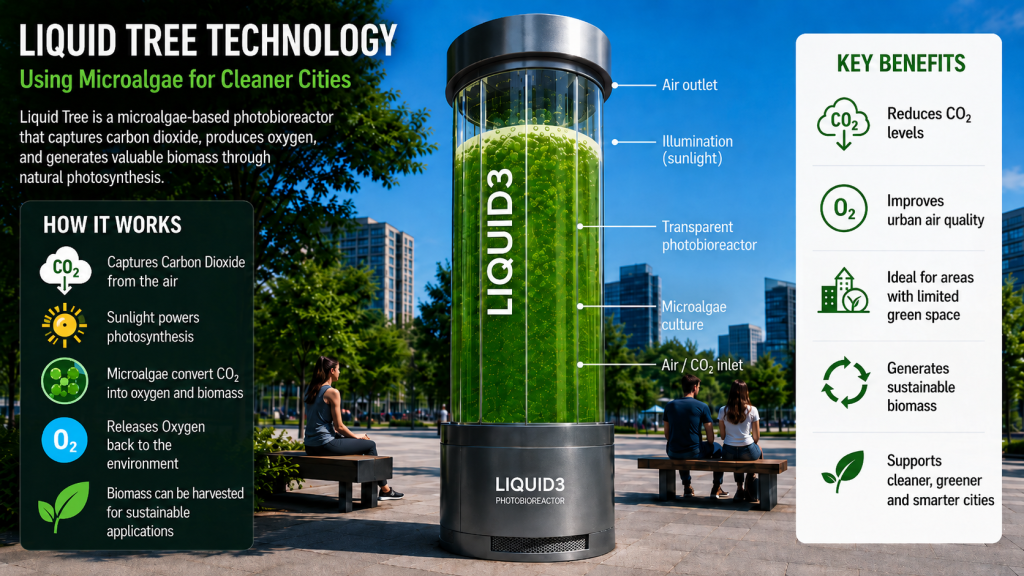
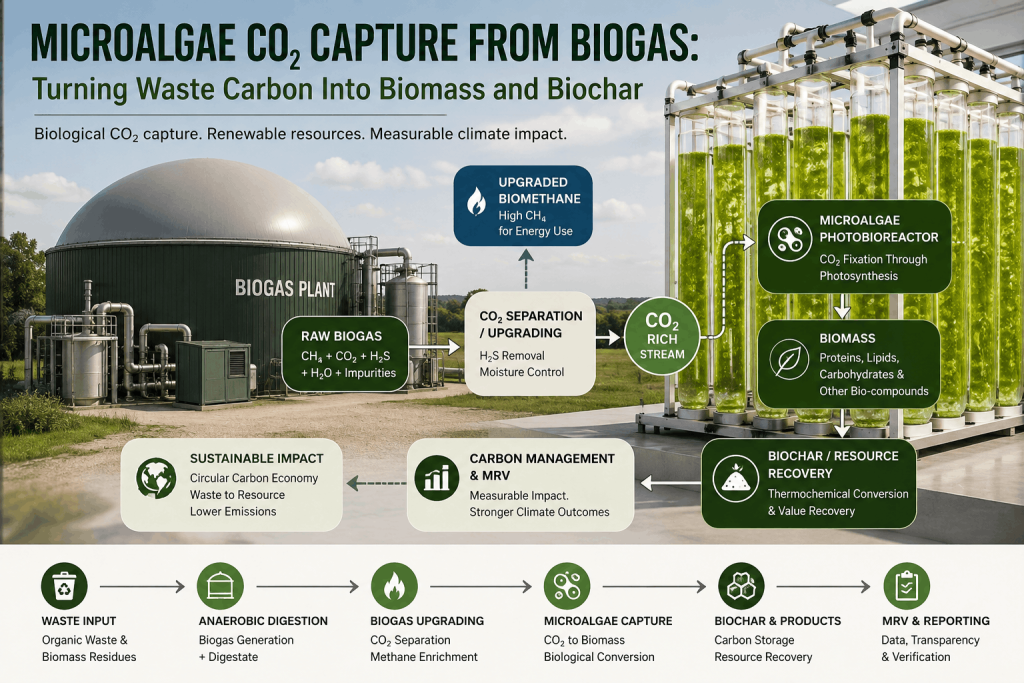
Microalgae carbon capture takes a distinctly biological route. Instead of only separating CO₂ into a concentrated gas stream, microalgae use carbon dioxide during photosynthesis and convert part of that carbon into new biomass. When this process is engineered inside a photobioreactor, it becomes a controllable carbon-conversion system rather than simply algae growing in water.
So, is microalgae carbon capture better than chemical CCS?
The short answer is: it depends on the CO₂ source, project scale, energy availability, available infrastructure and what happens to the carbon after capture.
For a large cement plant or refinery with a concentrated emission stream and access to CO₂ transport and geological storage, conventional chemical CCS may be the stronger option. For distributed applications where carbon conversion, biomass generation and modular deployment matter, microalgae carbon capture can offer a different set of advantages.
Understanding those differences is more useful than declaring one technology the universal winner.
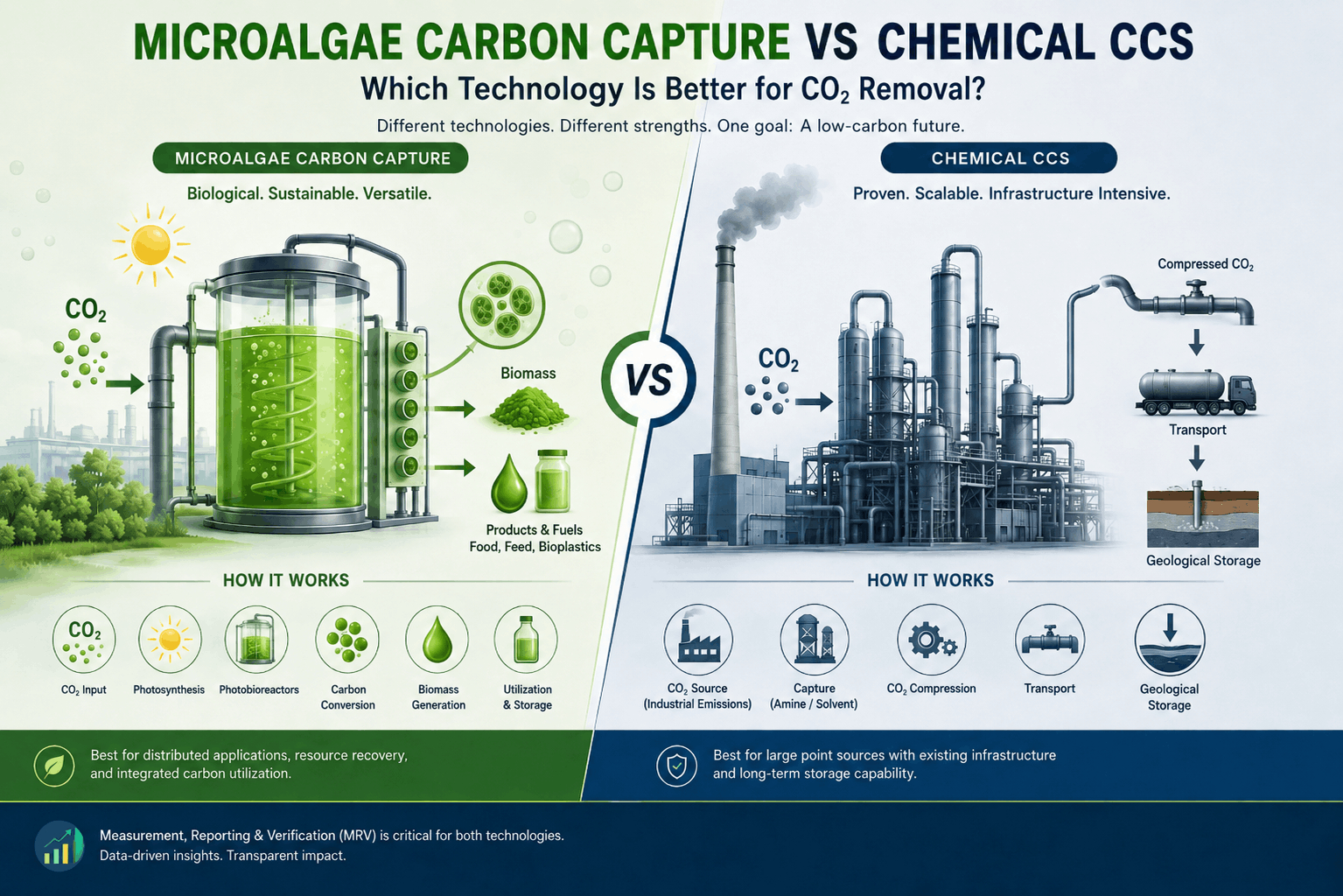
Table of Contents
First, What Do We Mean by Chemical CCS?
Carbon Capture and Storage (CCS) is commonly used to describe systems that capture CO₂ from industrial or power-generation sources, condition the gas and then transport it for long-term storage.
One of the best-known methods is amine-based absorption. Flue gas is brought into contact with a solvent that selectively binds CO₂. The CO₂-rich solvent is then heated in a regeneration unit, releasing a concentrated stream of carbon dioxide so the solvent can be reused.
This is an established engineering route for post-combustion capture and is particularly relevant to large point sources.
The captured CO₂ may then need to be dried, compressed, transported through pipelines, ships or other infrastructure, and injected into a suitable geological formation.
That is why chemical CCS is not simply “a filter on a smokestack.” It is a complete infrastructure chain.
The International Energy Agency’s CCUS overview identifies carbon capture, utilisation and storage as an important emissions-reduction technology for industrial and energy applications.
Where Chemical CCS Is Strongest
Chemical capture becomes attractive when the CO₂ stream is large, continuous and relatively concentrated.
Examples can include:
- Cement production
- Steel manufacturing
- Refineries
- Chemical industries
- Power generation
- Hydrogen production
- Other large industrial emission sources
For these facilities, the ability to process very large volumes of gas can outweigh the complexity of the system.
Geological storage also provides a route for keeping captured carbon isolated from the atmosphere for long periods when the storage site is properly selected, operated and monitored.
However, chemical CCS comes with an energy and infrastructure requirement.
Solvent regeneration needs heat. CO₂ compression consumes power. Transport and storage require additional equipment, permitting and suitable geological capacity.
This does not make chemical CCS ineffective.
It simply means the complete system has to be evaluated, not only the equipment responsible for separating CO₂.
What Is Microalgae Carbon Capture?
Microalgae carbon capture uses photosynthetic microorganisms to absorb carbon dioxide and convert it into biological material.
Microalgae require carbon, light, nutrients and suitable environmental conditions for growth. During photosynthesis, they use light energy to convert inorganic carbon into organic compounds that become part of the algal cells.
In an engineered system, this biological process can take place inside a photobioreactor, commonly known as a PBR.
A photobioreactor can control or monitor variables such as:
- Light exposure
- CO₂ delivery
- Gas-liquid contact
- Water circulation
- pH
- Temperature
- Nutrient availability
- Culture density
- Biomass growth
This makes microalgae carbon capture a combination of biology, reactor engineering and process control.
Pilot-scale research has demonstrated CO₂ bio-fixation using automated algal systems with controlled CO₂ dosing and real-time process feedback, showing how biological carbon capture can be engineered and monitored rather than treated as an uncontrolled natural process.
For a closer look at engineered systems, explore Carbelim’s Microalgae Photobioreactor Technology.
How Microalgae Carbon Capture Works
The basic pathway can be understood as:
CO₂ source → gas delivery → photobioreactor → photosynthesis → biomass growth → harvesting → utilization or storage
1. CO₂ Enters the System
Depending on the application, carbon dioxide may come from ambient air or a suitable industrial gas stream.
2. CO₂ Is Transferred Into the Culture
Gas-liquid mass transfer is important.
Simply bubbling more CO₂ through a reactor does not mean all of it will be biologically captured. Reactor geometry, bubble size, residence time, pH and gas-flow conditions influence how much carbon becomes available to the culture.
3. Photosynthesis Converts the Carbon
Microalgae use available carbon during photosynthesis.
As the cells multiply, carbon becomes incorporated into algal biomass.
This is the core mechanism behind microalgae carbon capture.
4. Biomass Is Harvested
Part of the growing biomass can be harvested while the remaining culture continues operating under controlled conditions.
5. The Carbon Enters a Downstream Pathway
The biomass must then be managed.
Depending on the project, it may be processed, utilized as a feedstock or directed towards another carbon-management pathway.
This last stage matters because microalgae carbon capture does not automatically equal permanent carbon removal.
Microalgae Carbon Capture vs Chemical CCS
The most important difference between the two approaches is what happens immediately after CO₂ is captured.
Chemical CCS primarily separates carbon dioxide from a gas stream and produces a concentrated CO₂ stream for transport, utilization or storage.
Microalgae carbon capture converts part of that CO₂ into biological material.
That creates two fundamentally different carbon-management pathways.
Chemical CCS is particularly strong when the priority is large-scale separation and geological storage.
Microalgae carbon capture becomes especially interesting when a project also values:
- Biological carbon conversion
- Biomass generation
- Modular deployment
- Distributed infrastructure
- Potential resource recovery
- Biological CCUS
- Integration with digital monitoring
Neither approach should automatically be presented as better in every application.
The application determines the technology.
Chemical CCS vs Microalgae Carbon Capture: Key Comparison
| Factor | Microalgae Carbon Capture | Chemical CCS |
|---|---|---|
| Capture mechanism | Photosynthetic biological conversion | Chemical or physical separation |
| Immediate carbon output | Carbon-containing biomass | Concentrated CO₂ stream |
| Main system | Photobioreactor | Absorber, solvent/sorbent and regeneration equipment |
| Typical deployment | Modular or distributed | Often centralized around large emission sources |
| Carbon utilization | Biomass creates downstream possibilities | Captured CO₂ may be stored or utilized |
| Permanent removal | Depends on final biomass pathway | Possible with appropriate geological storage |
| Biological management | Required | Not applicable |
| Gas/process monitoring | Required | Required |
| Biomass monitoring | Required | Not applicable |
| Infrastructure requirement | PBR, circulation, gas delivery, harvesting and controls | Capture plant, compression, transport and storage infrastructure |
The table makes one point clear:
Microalgae carbon capture is not simply a smaller version of chemical CCS.
It is a different approach to managing carbon.
What About Direct Air Capture?
Direct Air Capture removes CO₂ from ambient air rather than intercepting it at a concentrated industrial emission source.
The U.S. Department of Energy describes DAC as a carbon dioxide removal technology that extracts CO₂ directly from ambient air. The separated carbon can then be stored underground or converted into products.
The challenge is concentration.
Atmospheric CO₂ is far more dilute than the CO₂ found in many industrial gas streams.
Conventional DAC systems therefore commonly use engineered liquid solvents or solid sorbents to selectively capture carbon before releasing a concentrated CO₂ stream during regeneration.
Microalgae carbon capture approaches atmospheric carbon differently.
Microalgae do not first need to produce a purified CO₂ stream in order to photosynthesize. Instead, carbon moves through the gas-liquid environment and becomes biologically incorporated into biomass.
This creates possibilities for biological DAC in localized and distributed environments.
However, biological DAC and conventional industrial DAC should not be treated as identical technologies.
Conventional DAC generally aims to produce concentrated atmospheric CO₂ for storage or utilization.
Biological systems convert carbon into biomass.
Explore Carbelim’s Direct Air Capture platform to understand its approach to living-system-inspired DAC.
What About Carbon Mineralization?
Mineralization takes another route.
Instead of keeping carbon as compressed CO₂ or biological biomass, mineralization reacts CO₂ with suitable alkaline or mineral materials to form stable carbonate solids.
Its major attraction is durability.
Carbonates can provide a stable form of carbon storage when the chemistry and material pathway are suitable.
The challenge is that mineralization depends on:
- Suitable mineral or alkaline feedstocks
- Material availability
- Reaction conditions
- Processing requirements
- Transport and handling
- Project economics
Mineralization therefore solves a different part of the carbon problem.
It can complement chemical CCS, DAC and microalgae carbon capture rather than replacing all of them.
The Carbon Question Most Projects Miss
A carbon-capture system should not be judged only by how much CO₂ enters the equipment.
The more important question is:
Where did the carbon go after capture?
Consider the difference.
Pathway 1
Fossil CO₂ → capture → geological storage
The project can prevent that captured carbon from entering the atmosphere, subject to the full lifecycle and storage performance.
Pathway 2
Atmospheric CO₂ → DAC → durable storage
This can represent carbon dioxide removal when the complete process achieves net removal and sufficiently durable storage.
Pathway 3
CO₂ → microalgae → short-lived biomass
Carbon has been biologically captured, but it may return to the atmosphere if the biomass quickly decomposes or is combusted.
Pathway 4
CO₂ → microalgae → biomass → durable downstream pathway
The carbon can potentially remain outside the atmosphere for longer depending on the final pathway.
This is why microalgae carbon capture should not automatically be described as permanent carbon sequestration.
Carbon capture, carbon utilization and carbon removal are related concepts, but they are not interchangeable.
Biomass: An Advantage, but Also a Responsibility
One of the most interesting characteristics of microalgae carbon capture is that the process produces biomass.
This can create opportunities for carbon utilization.
Depending on the algae species, cultivation environment, contamination profile and downstream processing, algal biomass can potentially become a feedstock for materials or other bioproducts.
This approach is already becoming part of the competitive landscape.
Intrinsic Foundries, for example, positions industrial carbon as a feedstock and describes an algae-based process that converts it into biomass and product families including colour, protein and oils.
This represents a broader shift in biological CCUS.
The question is no longer simply:
Can algae absorb CO₂?
The commercial question is:
Can a company engineer a reliable, scalable and measurable carbon-conversion system around that biology?
For Carbelim, this is an important distinction.
The opportunity is not simply algae cultivation.
It is engineered microalgae carbon capture infrastructure.
Why Photobioreactor Engineering Matters
The biology cannot be separated from the engineering.
A highly productive algae strain will still underperform if the reactor provides poor gas transfer, inadequate circulation or insufficient light.
A serious microalgae carbon capture system therefore needs attention to:
- Reactor geometry
- Gas-contact efficiency
- Circulation
- Light distribution
- Culture stability
- pH
- Temperature
- Nutrient management
- Harvesting
- Maintenance
- Instrumentation
The system must also be designed around the actual carbon source.
Industrial gases may contain compounds or operate under conditions that are unsuitable for direct biological exposure.
Gas characterization, conditioning and appropriate biological selection may therefore be necessary depending on the application.
Carbelim’s Microalgae Photobioreactor Technology focuses on bringing the biological process into an engineered platform suitable for carbon-capture and environmental applications.
Where Microalgae Carbon Capture Makes the Most Sense
Microalgae carbon capture is unlikely to replace every large chemical CCS installation.
Its strongest opportunities are different.
It can be relevant when organizations want modular biological CCUS rather than a large centralized capture plant.
It can be considered for:
- Industrial campuses
- Selected manufacturing environments
- Commercial developments
- Research facilities
- Airports
- Public infrastructure
- Smart-city projects
- Distributed carbon-management installations
For suitable industrial applications, microalgae carbon capture can also operate as one part of a broader decarbonization strategy rather than attempting to replace every other carbon technology.
An organization may combine energy efficiency, renewable energy, electrification, conventional CCS, DAC, mineralization and biological CCUS depending on its emissions profile.
This portfolio approach is more realistic than assuming one carbon capture technology can solve every CO₂ problem.
For industrial applications, explore Carbelim’s Industrial CCUS Solutions.
Why Digital MRV Is Critical for Microalgae Carbon Capture
Microalgae carbon capture is a living process.
That means performance can change over time.
Light conditions vary.
Culture density changes.
Temperature and pH can change.
Gas-transfer efficiency can shift.
Pumps, sensors and other equipment may experience downtime.
A one-time theoretical calculation therefore cannot describe the complete performance of a biological carbon-capture project.
This is where Digital MRV becomes important.
MRV generally refers to Measurement or Monitoring, Reporting and Verification.
For microalgae carbon capture, useful monitoring parameters can include:
- CO₂ concentration
- Gas-flow conditions
- Photobioreactor working volume
- Optical density
- Biomass growth
- Harvest quantity
- pH
- Culture temperature
- System uptime
- Pump operation
- Power consumption
- Maintenance records
- Biomass destination
Digital MRV can help connect these measurements into a traceable operational record.
This matters because gross carbon capture and net climate benefit are not always the same.
Energy consumption, biomass processing, transport and the final destination of the carbon can influence the overall result.
Carbelim’s Digital MRV for Carbon Capture framework connects environmental monitoring, biological data, operational information and carbon reporting to create a stronger evidence trail for climate projects.
Reliable MRV therefore strengthens microalgae carbon capture by moving the conversation from theoretical capacity toward measurable operating performance.
Microalgae Carbon Capture and Industrial CCUS
Industrial decarbonization will probably not be solved by a single technology.
A large industrial site may have multiple carbon streams with different characteristics.
One stream may suit chemical absorption.
Another could be directed towards utilization.
Atmospheric carbon around the site may require another approach.
A suitable CO₂ stream may support biological conversion.
This creates a role for microalgae carbon capture inside a wider industrial CCUS strategy.
Rather than viewing biological and chemical capture as competitors in every project, industries can evaluate where each technology creates the strongest technical and economic fit.
For Carbelim, the system can be viewed as:
CO₂ source → gas conditioning and delivery → photobioreactor → biological fixation → biomass → monitoring → utilization or storage pathway
That is significantly different from simply installing an algae tank.
It requires biology, mechanical engineering, process controls and carbon accounting to work together.
Where Carbelim Fits in the Carbon-Capture Market
The carbon-capture sector now includes:
- Chemical solvent-based CCS providers
- Direct Air Capture companies
- Mineralization companies
- CO₂ utilization platforms
- Biochar and biomass carbon-removal developers
- Biological CCUS companies
- Microalgae technology developers
Carbelim’s opportunity is to operate where biological systems meet engineered carbon infrastructure.
Its approach connects microalgae carbon capture with photobioreactor design, industrial CCUS, environmental sensing and Digital MRV.
The goal is not to position algae as a universal replacement for chemical carbon capture.
A stronger position is to demonstrate where biology adds value that conventional capture does not naturally provide.
That includes:
Capture + biological conversion + biomass + monitoring + downstream carbon management.
This gives microalgae carbon capture a differentiated role in the broader carbon-capture category.
So, Which Technology Is Better for CO₂ Removal?
There is no universal winner.
Chemical CCS Is Stronger When:
A project has a very large and concentrated industrial CO₂ stream, centralized infrastructure and a technically suitable pathway for geological storage.
Direct Air Capture Is Stronger When:
The objective is specifically to remove CO₂ already present in the atmosphere and produce concentrated carbon for storage or utilization.
Mineralization Is Stronger When:
Suitable mineral resources and processing conditions allow carbon to be converted into stable solid forms.
Microalgae Carbon Capture Is Stronger When:
A project values biological carbon conversion, modular deployment, biomass generation, distributed installation and integration with resource-recovery pathways.
In some projects, microalgae carbon capture may be used alongside other carbon-management technologies rather than instead of them.
That is likely to be an increasingly important way of looking at industrial decarbonization.
The Future of Carbon Capture Is Not Chemical vs Biological
The future carbon-management market will be more complex than choosing between algae and amines.
Industries increasingly need to answer several questions:
- Where did the carbon originate?
- How was it captured?
- How much energy was consumed?
- What happened to the captured carbon?
- Was the carbon utilized or stored?
- How durable is that storage?
- How was the result measured?
- Can the data be independently reviewed?
These questions give microalgae carbon capture a clear place in the wider carbon-management landscape.
It does not need to replace chemical CCS to be valuable.
Instead, microalgae carbon capture can complement conventional technologies by introducing a biological pathway that converts CO₂ into biomass inside an engineered system.
For suitable applications, that combination of carbon capture, biological conversion and measurable operation can become a powerful CCUS platform.
The better question is therefore not:
“Which carbon capture technology is the best?”
It is:
“Which technology is best for this carbon stream, this site and the carbon outcome we want to achieve?”
That is the framework industries should use when evaluating the next generation of carbon capture technology.
Frequently Asked Questions
Is Microalgae Carbon Capture Better Than Chemical CCS?
Not in every application.
Chemical CCS can be better suited to very large, concentrated industrial CO₂ streams where transport and geological storage infrastructure are available.
Microalgae carbon capture can be attractive where biological conversion, biomass generation, modular deployment and distributed installation are important.
How Does Microalgae Carbon Capture Remove CO₂?
Microalgae use CO₂ during photosynthesis and incorporate carbon into new cellular biomass.
In engineered microalgae carbon capture applications, photobioreactors provide controlled conditions for gas transfer, light exposure, circulation and biological growth.
Can Microalgae Carbon Capture Use Industrial CO₂?
Potentially, yes.
Research has demonstrated microalgal CO₂ fixation with CO₂-enriched gas streams and pilot-scale engineered cultivation systems. Actual deployment depends on factors such as gas composition, contaminants, temperature, CO₂ concentration, algae strain and reactor design.
Does Algae Biomass Mean Permanent Carbon Removal?
No.
Biomass formation demonstrates biological fixation of carbon, but permanence depends on the downstream use or storage of that biomass.
A credible microalgae carbon capture project should therefore track what happens to harvested material.
What Is Biological CCUS?
Biological CCUS uses living systems to capture and potentially utilize carbon.
Microalgae carbon capture is one form of biological CCUS because photosynthesis converts CO₂ into biomass that can enter downstream utilization or storage pathways.
Why Is Digital MRV Important?
Digital MRV helps document what a carbon-capture system actually does.
For microalgae carbon capture, it can combine CO₂ measurements, biological data, energy consumption, system uptime, biomass production and carbon-fate records to support more transparent reporting.
Explore Carbelim Carbon Capture Solutions
Industrial CCUS Solutions
Explore Carbelim’s biological CCUS approach for industrial carbon management.
Microalgae Photobioreactor Technology
Learn how engineered photobioreactors support biological carbon capture and biomass production.
Direct Air Capture
Explore Carbelim’s living-system-inspired approach to Direct Air Capture.
Digital MRV for Carbon Capture
Learn how IoT monitoring, operational data and carbon accounting can support transparent carbon-capture reporting.