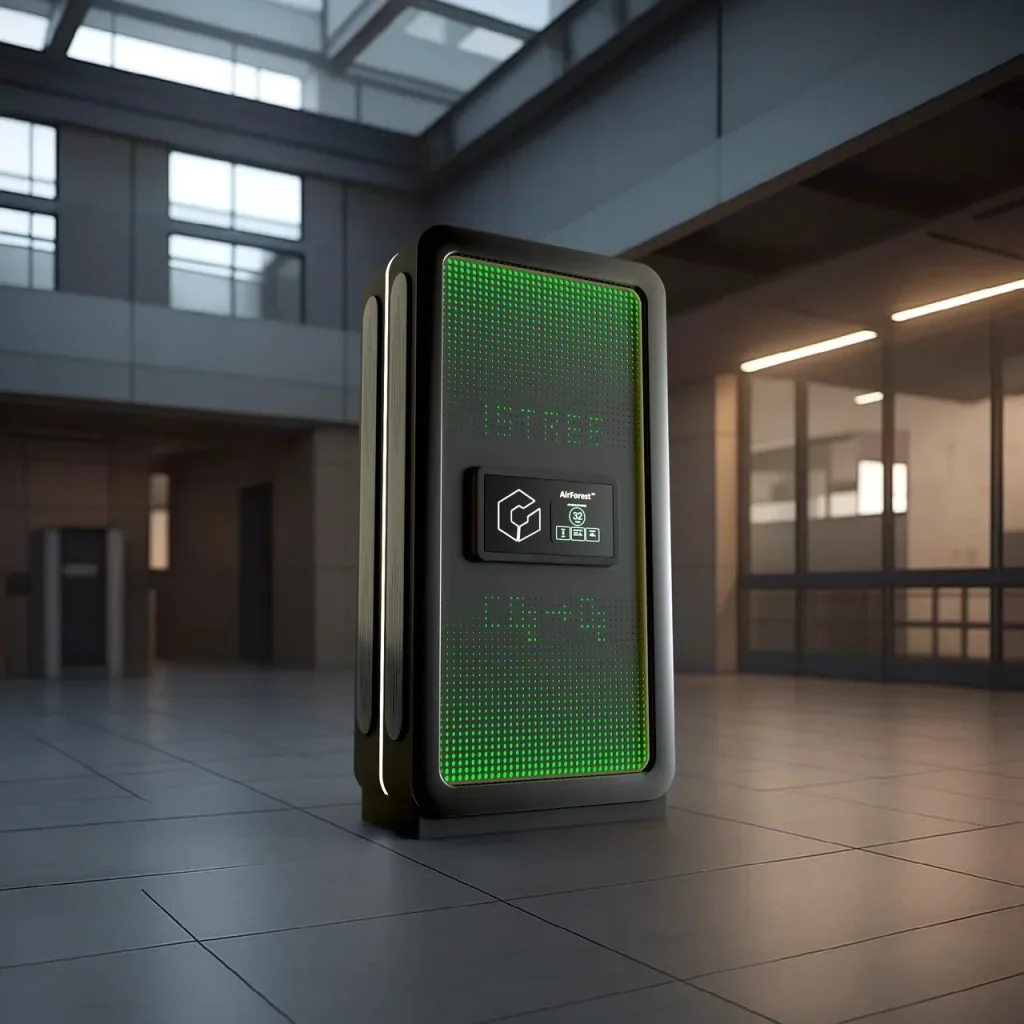
Microalgae direct air capture offers a biological way to approach one of carbon removal’s most difficult challenges: taking CO₂ back out of the atmosphere after it has already been emitted.
Most carbon-capture systems start with a concentrated source. A cement kiln, refinery or industrial process releases a stream containing CO₂, and capture equipment is placed close to that source.
Direct Air Capture, or DAC, is different.
The carbon has already entered the atmosphere. It has mixed with an enormous volume of air and is present only at a relatively low concentration.
That makes atmospheric CO₂ removal difficult.
Conventional DAC companies are tackling the problem with engineered sorbents, solvents, contactors, heat, vacuum and large air-handling systems. Microalgae direct air capture takes another route. It uses photosynthesis to move atmospheric carbon into living biomass.
The basic pathway is easy to understand:
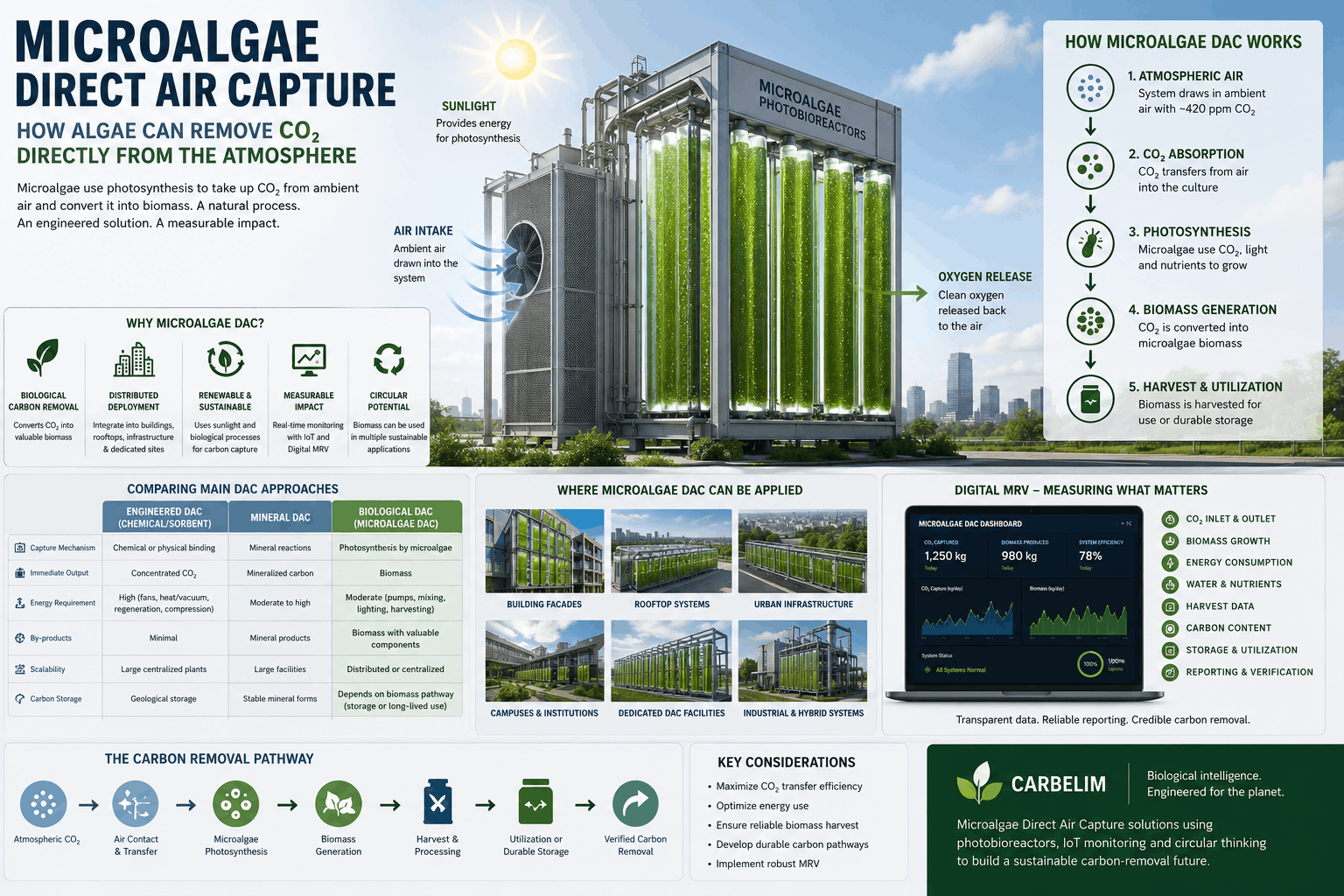
Atmospheric air → CO₂ transfer → microalgae → photosynthesis → biomass → carbon utilization or durable storage
The engineering behind that pathway is much more complicated.
A biological system has to move CO₂ efficiently from air into water, maintain a healthy culture, supply light and nutrients, harvest biomass, manage energy use and eventually prove what happened to the captured carbon.
That last step matters most.
Growing algae proves biological carbon fixation.
It does not automatically prove permanent carbon removal.
What Is Direct Air Capture?
Direct Air Capture refers to technologies that remove carbon dioxide directly from ambient air rather than capturing it from a concentrated industrial source.
The U.S. Department of Energy’s Direct Air Capture explainer describes DAC as a carbon dioxide removal approach that takes CO₂ from ambient air. The separated carbon can then be stored underground or converted into products.
This is an important distinction.
If a factory captures CO₂ before releasing it, the system is primarily preventing an emission.
If CO₂ is already in the atmosphere and a technology removes it again, the process can contribute to carbon dioxide removal, or CDR, provided the carbon is subsequently kept out of the atmosphere through an appropriate storage pathway.
That is the market microalgae direct air capture is beginning to enter.
Why Atmospheric CO₂ Is Hard to Capture
The challenge is concentration.
Ambient air contains far less CO₂ than most industrial exhaust streams.
A direct-air system therefore has to interact with a very large quantity of air to recover a relatively small quantity of carbon dioxide.
That affects almost everything.
More air may need to move through the system.
Contact between air and the capture medium becomes important.
Pressure drop matters.
Energy consumption matters.
And once the carbon is captured, the system still needs a plan for what happens next.
In a conventional DAC plant, that usually means producing a concentrated CO₂ stream.
In microalgae direct air capture, atmospheric carbon takes a different path.
It becomes biological material.
How Conventional Engineered DAC Works
Most engineered DAC systems use a material that has an affinity for carbon dioxide.
Depending on the technology, that material may be a solid sorbent, a liquid solvent or another specialised capture medium.
A simplified process looks like this:
Ambient air
↓
Air contactor
↓
CO₂ binds to capture material
↓
Capture material is regenerated
↓
Concentrated CO₂ is released
↓
Carbon utilization or durable storage
The ability to produce a concentrated CO₂ stream is one of the major advantages of engineered DAC.
Once separated, the carbon can be compressed and directed toward geological storage or another suitable pathway.
The trade-off is that the capture material needs to be regenerated, and the complete system needs energy for air movement, regeneration and downstream carbon handling.
This is where biological direct air capture begins to look very different.
What Is Microalgae Direct Air Capture?
Microalgae direct air capture uses photosynthetic microorganisms as the carbon-conversion mechanism.
Microalgae require inorganic carbon to grow.
If atmospheric CO₂ can be transferred efficiently into a microalgae culture, the organisms can use that carbon during photosynthesis.
Part of the carbon becomes incorporated into new cells.
So instead of immediately producing concentrated gaseous CO₂, the system produces carbon-containing biomass.
The pathway becomes:
Atmospheric CO₂ → microalgae → biomass
This distinction is central to understanding microalgae DAC.
Chemical DAC mainly separates atmospheric carbon.
Microalgae biologically convert it.
A Technical Note: Is Algae Really “DAC”?
There is an important terminology point.
In formal carbon-removal frameworks, conventional DAC usually refers to engineered systems that separate CO₂ directly from air.
The U.S. Department of Energy separately lists biomass carbon removal and storage as a CDR pathway involving plants and algae that take CO₂ from the atmosphere and then place that carbon into durable storage.
So microalgae direct air capture is useful as a descriptive term for engineered microalgae systems that directly process atmospheric CO₂, but the complete pathway may also sit within the broader category of biological or biomass carbon removal.
That distinction is worth making.
It prevents biological DAC from being presented as though it were identical to a conventional sorbent-based DAC plant.
It is not.
How Does Atmospheric CO₂ Reach the Microalgae?
This is one of the most important engineering questions.
Microalgae live in liquid.
Atmospheric CO₂ begins in air.
The carbon therefore needs to cross from the gas phase into the liquid phase before it becomes readily available to the culture.
This process is known as gas-liquid mass transfer.
A microalgae direct air capture system may improve that transfer using:
- Controlled airflow
- Fine bubbles
- Microbubble systems
- Increased gas-contact area
- Thin culture layers
- Efficient circulation
- Purpose-designed photobioreactors
- Controlled pH and carbonate chemistry
Simply leaving an algae tank exposed to air is not the same as engineering a high-performance atmospheric carbon-removal system.
The air-contact design matters.
Why Photobioreactor Design Matters
A photobioreactor, or PBR, creates a controlled environment for microalgae.
It allows engineers to manage variables that directly affect biological performance.
These can include:
- Light exposure
- Culture circulation
- CO₂ transfer
- Temperature
- pH
- Nutrients
- Culture density
- Biomass harvesting
- Sensors and automation
Photobioreactor engineering becomes especially important in microalgae direct air capture because atmospheric CO₂ is dilute.
The system cannot assume that a large carbon supply is already available.
It has to create effective contact between air and biology.
Carbelim’s Microalgae Photobioreactor Technology is built around modular PBR systems for carbon capture, air treatment and biomass cultivation.
Engineered DAC vs Microalgae Direct Air Capture
The two approaches are trying to deal with atmospheric carbon, but they do so differently.
| Area | Engineered DAC | Microalgae Direct Air Capture |
|---|---|---|
| Carbon source | Ambient air | Ambient air |
| Main mechanism | Chemical or physical separation | Photosynthesis |
| Capture medium | Sorbent, solvent or engineered material | Living microalgae |
| Immediate carbon output | Concentrated CO₂ | Biomass |
| Regeneration | Usually required | Biological growth and harvesting cycle |
| Main energy loads | Air movement, regeneration, vacuum, compression | Air transfer, circulation, pumps, lighting where required, harvesting |
| Carbon utilization | Separate downstream stage | Biomass generated during capture |
| Durable removal | Requires durable CO₂ storage | Requires durable biomass/carbon pathway |
| Biological management | No | Yes |
| MRV | Gas, energy and storage | Gas, biology, energy, biomass and carbon fate |
| Deployment | Dedicated DAC plants or modular collectors | PBRs, buildings, rooftops, infrastructure or dedicated facilities |
The table explains why microalgae direct air capture should not be sold simply as a greener copy of chemical DAC.
It is a different carbon-processing architecture.
Chemical DAC Has a Clear Storage Advantage
One strength of engineered DAC is what comes out of the system.
Concentrated CO₂ can be easier to connect to a geological storage pathway.
The chain can be relatively direct:
Atmospheric CO₂ → capture → concentrated CO₂ → compression → geological storage
That gives engineered DAC an important role in high-durability carbon removal.
With microalgae direct air capture, an extra biological stage appears:
Atmospheric CO₂ → microalgae → biomass → processing → utilization or storage
That creates more opportunities for carbon utilization.
But it also means the project needs to track what happens to the biomass.
Microalgae DAC Does Not Eliminate Energy Use
Photosynthesis uses light energy.
That does not mean an engineered algae system operates without electricity.
A microalgae direct air capture installation may require energy for:
- Air movement
- Pumps
- Culture circulation
- Aeration
- Sensors
- Automation
- Artificial lighting where required
- Biomass harvesting
- Dewatering
- Downstream processing
Systems designed around natural sunlight may reduce artificial-lighting requirements.
Closed PBRs can offer better control but may require more equipment.
So the correct comparison is not:
Chemical DAC uses energy while algae are free.
The useful question is:
How much atmospheric carbon remains removed after the complete lifecycle energy and resource requirements are considered?
What About Mineral DAC and Mineralization?
Mineralization is another important carbon-removal pathway, but it should be separated conceptually from DAC.
Direct Air Capture describes how CO₂ is taken from ambient air.
Mineralization describes a pathway in which carbon reacts with suitable minerals or alkaline materials and becomes stored in stable solid forms.
The two can work together.
For example:
Atmospheric air → engineered DAC → concentrated CO₂ → mineral storage
Enhanced mineralization can also operate as its own atmospheric carbon-removal pathway.
DOE currently identifies DAC with storage, biomass carbon removal and storage, and enhanced mineralization as separate CDR categories.
So the carbon-removal market is already broader than one DAC technology.
Why Biomass Makes Microalgae DAC Different
Biomass is both the opportunity and the challenge.
With microalgae direct air capture, the carbon captured from air becomes part of a biological material.
Microalgal biomass can contain:
- Proteins
- Lipids
- Carbohydrates
- Pigments
- Other biological compounds
That creates possible utilization pathways.
In some applications, the biomass could potentially become a feedstock rather than simply a waste stream.
This makes algae DAC interesting from a circular-carbon perspective.
But there is one crucial rule:
Carbon utilization is not automatically carbon removal.
Captured Carbon Can Return to the Atmosphere
Imagine that atmospheric CO₂ enters an algae culture.
The algae grow.
The biomass is harvested.
Then the biomass is converted into a short-lived product that decomposes quickly.
The carbon was captured.
It was utilized.
But much of it may eventually return to the atmosphere.
Now imagine the same carbon entering an appropriately durable storage pathway.
The climate outcome changes.
This is why permanence matters so much in microalgae direct air capture.
Biological fixation is the beginning of the carbon story.
It is not necessarily the end.
What Would Durable Biological Carbon Removal Require?
A serious biological CDR system has to follow the carbon after harvesting.
Depending on project design and applicable methodologies, possible pathways may involve:
- Long-lived materials
- Biochar production
- Other durable carbon products
- Geological storage of processed carbon
- Validated long-duration storage pathways
Different pathways have different levels of durability.
They also have different energy, cost and MRV requirements.
A strong microalgae direct air capture project therefore needs to define its carbon destination before making permanent-removal claims.
Land Use: Algae Still Need Physical Infrastructure
Microalgae are often discussed as an efficient biological production platform.
But no carbon-removal technology exists without physical requirements.
Open biological systems can require significant land area.
Closed PBRs can use vertical space and existing surfaces more effectively, but they involve more equipment.
This gives microalgae direct air capture at least two possible scaling models.
Large-Area Biological DAC
Raceways or dedicated cultivation facilities can use available land and natural sunlight.
Distributed Biological DAC
Photobioreactors can be integrated into:
- Building façades
- Rooftops
- Public infrastructure
- Commercial campuses
- Urban installations
- Industrial sites
The second model is particularly relevant to Carbelim.
Buildings Could Become Part of a Distributed DAC Network
One interesting feature of microalgae direct air capture is that the system does not necessarily need to look like a conventional carbon-removal plant.
A PBR can potentially become part of infrastructure that already exists.
A building has a façade.
A campus has rooftops.
A city has road infrastructure.
A commercial site has unused vertical surfaces.
This creates the possibility of distributing biological carbon capture instead of concentrating all capacity in one location.
Carbelim currently describes its Direct Air Capture platform as a biologically inspired approach using living systems such as microalgae for localized and distributed CO₂ reduction.
For microalgae direct air capture, this distributed model can become a genuine point of differentiation.
Atmospheric CO₂ and Flue Gas Are Not the Same Feedstock
This distinction is important.
A microalgae system connected to industrial flue gas may receive a relatively concentrated CO₂ supply.
A DAC system does not.
It works with ambient air.
That means a reactor developed for industrial CO₂ should not automatically be assumed to deliver the same performance in direct-air operation.
Microalgae direct air capture may require greater attention to:
- Air throughput
- Gas-liquid transfer
- Reactor contact area
- Culture depth
- pH
- Carbon-concentrating biological mechanisms
- Energy used to move air
The microalgae may be similar.
The carbon-delivery problem is completely different.
Biological DAC Can Scale Through More Than One Product Format
Conventional DAC companies often scale through repeated industrial modules.
Build one capture unit.
Standardize it.
Repeat it.
Biological systems can also be modular, but the modules can take different physical forms.
A microalgae direct air capture module might be:
- A flat façade PBR
- A cylindrical reactor
- A rooftop system
- A panel array
- A standalone outdoor system
- A larger dedicated biological facility
That physical flexibility creates interesting deployment options.
But scalability still needs to be proven through performance.
Building 1,000 reactors only makes sense if operators can predict how those reactors will perform.
Monitoring Becomes More Important When the Capture System Is Alive
An engineered DAC machine needs instrumentation.
A biological DAC system needs instrumentation plus biological monitoring.
Useful information can include:
Air Data
- Ambient CO₂
- Inlet CO₂
- Outlet CO₂
- Airflow
- Temperature
- Humidity
Biological Data
- pH
- Culture temperature
- Optical density
- Biomass concentration
- Growth rate
Operational Data
- Pump status
- Air-transfer system status
- Lighting
- Runtime
- Downtime
- Energy consumption
Carbon Data
- Biomass harvested
- Carbon content
- Downstream processing
- Final carbon pathway
Reliable monitoring is therefore fundamental to microalgae direct air capture.
Why Digital MRV Matters
MRV stands for Measurement, Reporting and Verification.
In carbon removal, it is much more than a dashboard.
It establishes the evidence behind the environmental claim.
A credible microalgae direct air capture project should be able to answer:
How much atmospheric air interacted with the system?
How much CO₂ entered the culture?
How much carbon became biomass?
How much energy did the system consume?
How much biomass was harvested?
How much carbon was lost during processing?
Where did the remaining carbon go?
How durable is the final storage?
That is the evidence chain required to move from theoretical biological uptake toward measurable carbon removal.
Digital MRV Can Be a Strength of Biological DAC
Microalgae systems naturally change over time.
The culture grows.
pH shifts.
Temperature changes.
Biomass concentration changes.
Equipment operates for measurable periods.
This produces data.
A connected microalgae direct air capture platform can potentially create a traceable chain:
Atmospheric CO₂
↓
Reactor operating data
↓
Biological growth
↓
Biomass harvest
↓
Carbon content
↓
Utilization or storage
↓
Carbon report
This is significantly more useful than simply publishing the theoretical annual carbon-capture capacity of a reactor.
Carbelim’s Custom Photobioreactor Platform includes configurable sensing and reactor engineering for different cultivation and carbon-management applications.
Engineered DAC and Biological DAC Can Coexist
The carbon-removal market does not need one winner.
Engineered DAC has clear strengths.
It can produce concentrated CO₂.
It can connect directly to geological storage.
It can be designed as standardized industrial infrastructure.
Microalgae direct air capture offers another set of possibilities.
It can create biomass.
It can potentially use distributed infrastructure.
It can become part of buildings and urban spaces.
It can connect carbon capture with biological production.
These are different use cases.
They can coexist.
When Engineered DAC May Be the Better Option
A conventional DAC system may be more appropriate where a project prioritizes:
- Large dedicated carbon-removal facilities
- Concentrated CO₂ production
- Geological storage
- Highly standardized capture modules
- Direct integration with CO₂ transport infrastructure
That is an important part of the carbon-removal market.
Microalgae do not need to replace it.
When Microalgae Direct Air Capture Becomes Interesting
Microalgae direct air capture becomes more interesting where a project values several functions at the same time.
For example:
- Biological carbon conversion
- Biomass production
- Distributed deployment
- Building integration
- Urban applications
- Visible climate infrastructure
- Environmental monitoring
- Potential carbon utilization
This makes biological DAC particularly relevant to places where conventional large DAC facilities may not fit physically or commercially.
Where Carbelim Fits in the DAC Market
Carbelim’s strongest opportunity is not to copy an existing chemical DAC company.
Its differentiation is biological.
The technology can be understood as:
Atmospheric air
↓
Engineered air contact
↓
Microalgae photobioreactor
↓
Photosynthesis
↓
Biomass
↓
Carbon utilization or durable pathway
↓
Digital MRV
That is a complete microalgae direct air capture architecture.
The microalgae provide the biological conversion.
The photobioreactor provides the controlled environment.
The downstream pathway determines the carbon outcome.
The monitoring layer establishes evidence.
Carbelim’s current DAC page explicitly positions its work around biologically inspired and microalgae-based pathways rather than conventional point-source carbon capture.
What Should a Microalgae DAC Project Measure?
A serious project should not rely only on reactor volume.
Several measurements matter.
Air Contact
How much ambient air actually interacts with the system?
Carbon Transfer
How much CO₂ moves from air into the liquid culture?
Biological Fixation
How much carbon becomes biomass?
Biomass Productivity
How much new biological material is produced over time?
Energy Consumption
How much electricity is used by pumps, airflow, lighting and controls?
Resource Consumption
How much water and nutrient input is required?
Harvesting
How much biomass is physically removed?
Carbon Fate
What happens to the carbon after harvest?
Net Removal
After lifecycle emissions are considered, how much atmospheric carbon remains removed?
These measurements are central to credible microalgae direct air capture.
Can Microalgae DAC Produce Carbon Credits?
Potentially, but biological growth by itself is not enough.
A high-integrity carbon-removal project needs an applicable methodology and clear rules covering areas such as:
- Baseline
- Additionality
- Lifecycle emissions
- Measurement
- Leakage
- Permanence
- Carbon ownership
- Verification
An algae culture growing inside a PBR does not automatically create a carbon credit.
A monitoring dashboard does not automatically create one either.
The project needs to demonstrate a complete and accepted carbon-removal pathway.
That is another reason Digital MRV matters.
Microalgae Direct Air Capture Still Has Engineering Challenges
The technology is promising, but several questions need serious work.
Can air-to-water CO₂ transfer become efficient enough?
Can pumps and air handling remain energy efficient?
How much water is needed?
Can the culture remain stable throughout the year?
How much land or façade area is required?
How expensive is harvesting?
Can the carbon be stored durably?
Can the project achieve credible net-negative lifecycle performance?
Can MRV meet the requirements of future carbon markets?
These challenges should not be hidden.
They define the engineering roadmap for microalgae direct air capture.
Carbon Removal Will Need More Than One Technology
There is no reason to expect one carbon-removal technology to dominate every environment.
Different regions have different resources.
Some have geological storage.
Some have cheap renewable electricity.
Some have abundant land.
Some have suitable minerals.
Cities have enormous quantities of building and infrastructure surface.
DOE’s current carbon-removal framework itself includes multiple pathways, including DAC with storage, biomass carbon removal and storage, enhanced mineralization and other approaches.
Microalgae direct air capture can become one complementary technology within that larger portfolio.
Frequently Asked Questions
What Is Microalgae Direct Air Capture?
Microalgae direct air capture is an engineered biological approach in which microalgae use CO₂ taken directly from ambient air during photosynthesis and convert part of that carbon into biomass.
How Is Microalgae DAC Different From Chemical DAC?
Chemical DAC typically uses sorbents or solvents to separate atmospheric CO₂ and produce a concentrated carbon stream.
Microalgae direct air capture converts atmospheric carbon biologically into biomass.
Can Microalgae Capture CO₂ Directly From the Atmosphere?
Yes. Microalgae naturally use inorganic carbon during photosynthesis.
In an engineered system, the main challenge is transferring enough dilute atmospheric CO₂ from air into the culture efficiently.
Does Microalgae Direct Air Capture Require Energy?
Yes.
Energy can be required for air movement, pumps, circulation, sensors, controls, harvesting and artificial lighting where used.
Is Biological Direct Air Capture Better Than Engineered DAC?
Not universally.
Engineered DAC can be particularly suitable when concentrated CO₂ and geological storage are the main objectives.
Biological DAC can offer different advantages around biomass generation, distributed deployment and infrastructure integration.
Does Microalgae Direct Air Capture Permanently Remove CO₂?
Not automatically.
Photosynthesis transfers atmospheric carbon into biomass.
Durable removal depends on what happens to that carbon afterward.
What Is the Difference Between DAC and Mineralization?
DAC removes CO₂ from ambient air.
Mineralization stores carbon by converting it into stable mineral forms.
The technologies can operate separately or be combined.
What Is Biological Carbon Removal?
Biological carbon removal uses living organisms to take CO₂ from the atmosphere and combines that capture with an appropriate durable storage pathway.
DOE includes biomass carbon removal and storage, involving plants and algae, within its broader CDR portfolio.
Why Is MRV Important for Microalgae DAC?
MRV is needed to establish how much atmospheric carbon entered the system, how much was biologically fixed, what energy was consumed, what biomass was generated and where the carbon ultimately went.
Where Can Microalgae DAC Be Used?
Potential applications include:
- Building façades
- Rooftops
- Corporate campuses
- Urban infrastructure
- Institutional sites
- Dedicated biological DAC facilities
- Other environments where photobioreactors can operate effectively
A Different Route to Atmospheric Carbon Removal
Atmospheric carbon is difficult to recover precisely because it is everywhere.
Conventional Direct Air Capture tackles the problem through chemistry, advanced materials and process engineering.
Microalgae direct air capture approaches it through biology.
Air reaches the system.
CO₂ moves into the culture.
Microalgae use the carbon during photosynthesis.
Biomass grows.
The biomass is harvested.
The carbon enters a utilization or storage pathway.
And MRV determines whether the result can genuinely be described as durable carbon removal.
That full chain is what matters.
The value of microalgae direct air capture is not simply that algae naturally consume CO₂.
The opportunity lies in engineering that biology into a measurable system that can operate in places where conventional carbon-removal infrastructure may not naturally fit.
For Carbelim, this creates a clear role in the wider Direct Air Capture market: developing microalgae-based DAC through photobioreactor engineering, distributed deployment, biological carbon conversion and Digital MRV.
Not a replacement for every engineered DAC technology.
A different route to the same atmospheric carbon problem.