Microalgae carbon capture buildings introduce a different way of thinking about sustainable architecture. Instead of asking only how a building can consume less energy or use lower-carbon materials, they raise another question: can part of the building itself actively participate in carbon management?
The façade is a logical place to start.
Every large commercial building already has hundreds or thousands of square metres of external surface. Most of that area is designed to keep out rain, manage heat, control daylight and give the building its architectural identity.
What if some of that surface could also support a biological process?
That is the idea behind the algae façade.
Microalgae can be grown inside transparent photobioreactor panels integrated with the building envelope. Light reaches the culture, CO₂ becomes available to the organisms, and photosynthesis converts part of that carbon into new biomass.
It looks green, but calling it a “green wall” does not really describe what is happening.
A better description is building-integrated biological carbon capture.
The façade is no longer only decoration or cladding. It becomes functional environmental infrastructure.
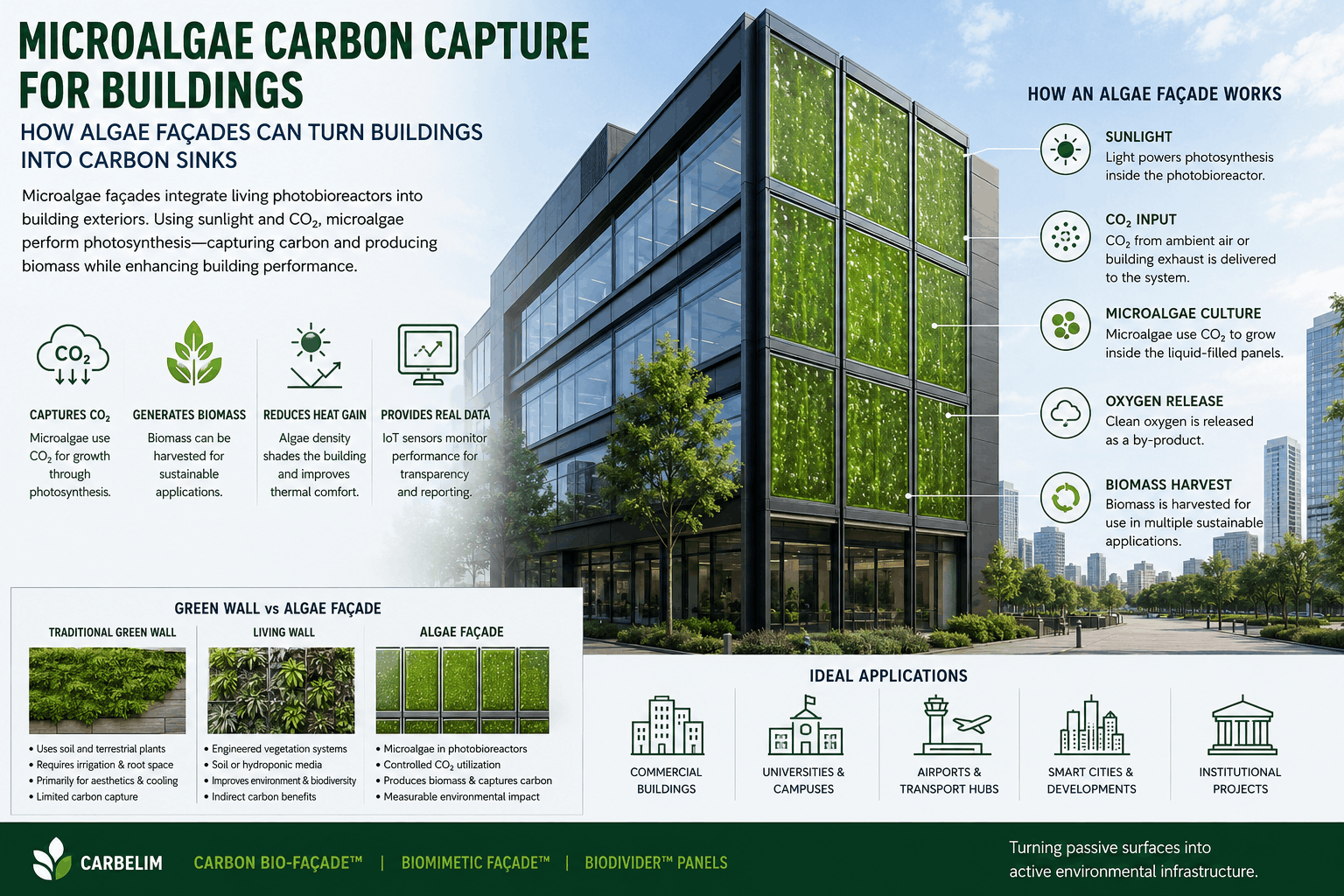
Table of Contents
A Green Wall and an Algae Façade Are Not the Same Thing
Green walls are already familiar in modern architecture.
Hotels use them in lobbies. Offices install them on exterior walls. Shopping centres and airports use vertical planting to soften large built surfaces.
They can be beautiful, and they can provide useful benefits.
Plants can offer shading, contribute to local cooling, improve visual comfort and support biodiversity. In dense cities, vertical greenery also allows vegetation to be introduced where there may be very little ground available for landscaping.
But a conventional green wall is primarily a horticultural system.
It normally depends on:
- Terrestrial plants
- Roots
- Soil or another growing medium
- Irrigation
- Drainage
- Plant maintenance
Carbon dioxide is naturally used as the plants grow, but the system is not usually designed as a controlled carbon-processing reactor.
An algae façade begins from a different engineering logic.
What Changes When We Use Microalgae?
Microalgae do not need soil.
They do not need root systems or large planting pockets.
They grow suspended in liquid.
That simple biological difference changes the entire architecture of the system.
Instead of filling a wall with soil and plants, designers can work with transparent or translucent chambers containing microalgae culture.
Those chambers become photobioreactors.
Within them, it becomes possible to control much more than simply watering a plant.
Operators can potentially manage:
- Culture circulation
- Light exposure
- CO₂ supply
- Nutrients
- pH
- Temperature
- Biomass concentration
- Harvesting
- Sensors and controls
That makes an algae wall closer to a piece of environmental process equipment than conventional landscaping.
It just happens to be part of the architecture.
The Photobioreactor Is What Makes the Façade Functional
The microalgae perform the biology.
The photobioreactor makes that biology useful in a building.
A well-designed façade reactor has to provide enough light for photosynthesis while keeping the culture mixed and stable. It also needs a way to deliver carbon dioxide, circulate liquid and remove biomass as the culture grows.
This is where the technology becomes much more serious than a green-coloured architectural feature.
The panel has to work as both:
part of the building
and
part of a biological process
Those two requirements do not always naturally agree.
A façade engineer thinks about wind, water, structural loads, thermal movement, UV exposure and maintenance.
A microalgae engineer thinks about gas transfer, light distribution, pH, nutrients, circulation and biological productivity.
A successful building carbon capture façade has to satisfy both.
How Does an Algae Façade Capture Carbon?
At the centre of the system is photosynthesis.
Microalgae need carbon to build new cellular material. When CO₂ becomes available inside the reactor, the organisms can use that inorganic carbon as they grow.
The process can be understood simply:
CO₂ enters the system
↓
Carbon becomes available in the culture
↓
Light supports photosynthesis
↓
Microalgae grow
↓
Carbon becomes part of biomass
That is biological carbon fixation.
For a building, the important part is that the process happens on a surface that would otherwise have been largely passive.
A façade panel can therefore become an active carbon-processing surface.
Where Would the CO₂ Come From?
This is one of the first questions any real project needs to answer.
There is no single carbon source that suits every algae façade.
Ambient Air
The façade can interact with outdoor air.
This sounds simple, but atmospheric CO₂ is relatively dilute, so efficient gas-liquid transfer becomes important.
The system must actually bring enough air into meaningful contact with the culture.
Building Exhaust Air
Occupied buildings continuously generate CO₂ because people exhale it.
Depending on the building-services strategy, certain exhaust streams could potentially become an input to a biological system.
This would require proper engineering and integration with HVAC infrastructure.
Controlled CO₂ Supply
A project may also use a more concentrated CO₂ supply where cultivation performance or another process objective requires it.
The important point is that the source should be designed deliberately.
An algae façade does not capture a meaningful quantity of carbon simply because green liquid is present behind glass.
We Have Already Seen a Full-Scale Precedent
Arup's SolarLeaf project demonstrated how microalgae photobioreactors can be integrated into a real building façade as an active biological system.
The idea of putting algae reactors on buildings is not new.
One of the best-known examples is the BIQ House in Hamburg, where the SolarLeaf project integrated microalgae bioreactors into the building’s exterior.
The project became important because it demonstrated something that had previously looked highly experimental: a building could operate with a living photobioreactor skin.
The façade was not added only for appearance.
The algae were cultivated within controlled panels, biomass could be harvested, and the system also interacted with the building’s solar and thermal performance.
The BIQ project did not prove that every office tower should immediately receive an algae façade.
What it proved was more fundamental:
a photobioreactor can become part of real architecture.
That opened the door to a much larger field of building-integrated biological technology.
Why Building Façades Are Interesting for Microalgae
Cities have a shortage of land.
They do not have a shortage of walls.
This is what makes façade integration so attractive.
A high-rise or large commercial complex may offer enormous vertical surface area without requiring additional land.
That surface can potentially support modules such as:
- Transparent algae panels
- Double-skin façade reactors
- Architectural screens
- Shading elements
- Atrium installations
- Retrofit PBR modules
- Feature walls
For microalgae carbon capture buildings, this is a major advantage.
The biological system can occupy an architectural surface that is already part of the project.
It Can Also Change How the Building Handles Sunlight
Microalgae cultures do not remain visually constant.
As biomass increases, the culture becomes denser.
That changes how much light passes through the panel.
This creates an interesting architectural possibility.
Instead of being only a carbon-capture surface, an algae façade can potentially contribute to solar control.
A denser culture can reduce the amount of light passing through the biological layer. Depending on design and orientation, that could become part of a shading strategy.
This is one of the reasons photobioreactor façades are so interesting.
One system can potentially perform several functions:
Biological carbon capture
Biomass production
Solar control
Architectural shading
Environmental monitoring
The value of the façade then comes from combining functions rather than doing only one thing.
But an Algae Façade Is More Complicated Than a Green Wall
There is an obvious trade-off.
The more a façade is expected to do, the more carefully it has to be engineered.
An algae panel contains liquid.
That adds weight.
The system needs pipework.
Pumps need power.
Sensors need calibration.
The culture needs to remain healthy.
The panels have to stay clean enough for light to enter.
Maintenance teams need access.
Leakage has to be prevented.
The building also has to operate safely across years of heat, rain, wind and seasonal change.
A practical design may therefore need to consider:
- Structural loading
- Panel sealing
- Drainage
- Water quality
- Circulation
- Biofouling
- Cleaning
- Temperature control
- Pump reliability
- Nutrient management
- Biomass harvesting
- Maintenance access
- Sensor performance
These challenges should not be hidden.
They are exactly why the technology belongs in the field of engineering rather than decorative landscaping.
From Algae Façade to Carbon Bio-Façade™
This distinction is central to Carbelim’s positioning.
A conventional green wall is normally sold as greenery.
A Carbon Bio-Façade™ should be understood through its function.
It is designed as a biological building surface that can participate in carbon management.
That changes the conversation with architects and developers.
Instead of asking:
“Where can we add some greenery?”
the discussion becomes:
“Which part of this building envelope can perform an environmental function?”
That is a much larger opportunity.
The façade can become a platform where architecture, biotechnology and carbon management meet.
The Biomimetic Façade™ Takes the Idea Further
Nature rarely builds surfaces that perform only one job.
Leaves manage light, gas exchange, water and temperature at the same time.
That multifunctionality is part of the thinking behind a Biomimetic Façade™.
The objective is not to copy the appearance of a leaf.
It is to borrow the idea that a surface can actively interact with its environment.
A microalgae façade can therefore be designed to do more than separate indoor space from the outdoors.
It can host biological activity.
It can respond to light.
It can generate measurable environmental data.
And it can become part of a building’s carbon strategy.
This is why Carbelim should position the technology as biological building infrastructure, not as another type of vertical garden.
What Does Building-Integrated CCUS Actually Mean?
The term CCUS is usually associated with industries such as cement, steel and power generation.
There, the carbon problem is concentrated and large.
Buildings are different.
A commercial property does not normally have a stack emitting CO₂ at the scale of a cement kiln.
But buildings have something industries often do not:
huge amounts of usable surface area spread throughout cities.
Building-integrated CCUS therefore needs a different model.
Instead of one massive capture system, a property could use smaller biological systems integrated into:
- Façades
- Atriums
- Screens
- Architectural partitions
- External shading
- Selected exhaust-air pathways
This creates a distributed form of carbon management.
For developers, the attraction is not simply the amount of carbon captured.
It is that the technology can become part of the building itself.
Does That Turn the Building Into a Carbon Sink?
Potentially, the façade can contribute to that direction.
But the phrase carbon sink needs to be used carefully.
If microalgae take up CO₂ and convert carbon into biomass, carbon fixation has taken place.
That does not automatically mean the entire building is carbon negative.
A building has many other carbon sources.
Concrete has embodied carbon.
Steel has embodied carbon.
Glass has embodied carbon.
Pumps consume electricity.
Façade components have to be manufactured.
Maintenance requires resources.
Biomass has to be processed.
And captured biological carbon may eventually return to the atmosphere.
So the stronger claim is not:
“Install algae and the building becomes carbon negative.”
It is:
“Integrating microalgae can turn part of the building envelope into an active biological carbon-capture surface.”
Whether the entire development becomes carbon neutral or carbon negative has to be established through full lifecycle accounting.
The Biomass Is Part of the Carbon Story
A biological façade does not make carbon disappear.
It moves carbon.
CO₂ enters the biological process and part of that carbon becomes biomass.
As the algae grow, biomass eventually has to be removed.
This is where the project’s carbon strategy continues.
What happens to the harvested material?
Is it processed?
Is it used as a feedstock?
Does it enter a short-lived application?
Can it be directed towards a more durable carbon pathway?
These questions matter because biomass formation alone does not guarantee permanent carbon removal.
For serious building-integrated carbon capture, the carbon should be followed beyond the reactor.
This Is Why Monitoring Matters
A green façade can be evaluated visually.
Are the plants healthy?
Is irrigation working?
Does the wall look good?
A biological carbon façade needs another layer of evidence.
If a developer says the façade is capturing carbon, there should be data behind the claim.
A monitored system could potentially track:
- CO₂
- Reactor temperature
- pH
- Culture density
- Biomass growth
- Harvest quantity
- Pump operation
- System uptime
- Energy consumption
- Maintenance events
This begins to turn the façade into measurable climate infrastructure.
For an architect, the system may be a design element.
For a facility manager, it becomes equipment.
For an ESG team, it becomes a source of environmental data.
All three perspectives have to work together.
Digital MRV Can Make the Façade More Valuable
One of the most interesting opportunities is not visible from the street.
It is the data layer.
A large building could potentially have a dashboard showing how its biological façade is performing over time.
That might include:
Current reactor conditions
Biomass growth trends
System uptime
Carbon-related measurements
Maintenance status
Historical performance
For corporate developments and high-visibility sustainability projects, this can be valuable.
The façade stops being a sustainability symbol.
It becomes something that can actually report.
This is where Digital MRV can differentiate engineered microalgae systems from conventional decorative green walls.
A Green-Wall Company and a Biological Façade Company Are Solving Different Problems
Traditional living-wall providers typically focus on:
- Plants
- Irrigation
- Growing media
- Landscape design
- Horticultural maintenance
- Visual greening
That is a specialised field in its own right.
A microalgae façade requires a different mix of capabilities.
It can involve:
- Biotechnology
- Photobioreactor engineering
- Gas-liquid transfer
- Pumps and circulation
- Sensors
- Automation
- Carbon measurement
- Building integration
That places Carbelim in a different competitive category.
The objective is not to out-compete landscape companies at vertical gardening.
It is to establish a new category around building-integrated microalgae carbon capture.
Living Walls Still Have an Important Role
None of this means algae façades should replace planted walls.
They provide different benefits.
A living wall can offer:
- Biodiversity
- Habitat
- Visual comfort
- Evaporative cooling
- Urban greening
A microalgae façade can provide:
- Controlled biological carbon conversion
- Biomass generation
- Process monitoring
- Architectural integration
- Carbon-performance data
A high-performance project could use both.
There is no reason a building must choose between natural vegetation and engineered biology.
The two systems solve different environmental problems.
Why Architects May Like Working With Algae
There is another reason algae façades are interesting.
They make environmental technology visible.
Most building systems are hidden.
Air-conditioning equipment sits above ceilings.
Pumps are in plant rooms.
Sensors are concealed.
Carbon accounting exists in spreadsheets.
An algae façade can make an environmental process part of the architecture itself.
The liquid moves.
Bubbles travel through the reactor.
The culture changes colour and density.
Light behaves differently through the panels throughout the day.
That movement gives the building a living quality that ordinary cladding cannot reproduce.
For:
- Corporate headquarters
- Innovation centres
- Airports
- Universities
- Research campuses
- Premium commercial developments
that visibility can become part of the project’s identity.
Where Microalgae Carbon Capture Buildings Make the Most Sense
Not every building needs an algae façade.
The technology makes more sense where there is a clear reason for adding a biological layer.
Corporate Campuses
Companies with visible sustainability goals may use the façade as both functional infrastructure and an engagement asset.
Commercial Developments
Large façades provide opportunities for modular installation without consuming more ground space.
Airports
Large public buildings offer extensive envelope area and high visibility for environmental technology.
Universities
Campuses can combine real-world operation with research, education and demonstration.
Institutional Projects
Government and public buildings can use the technology as part of measurable sustainability programmes.
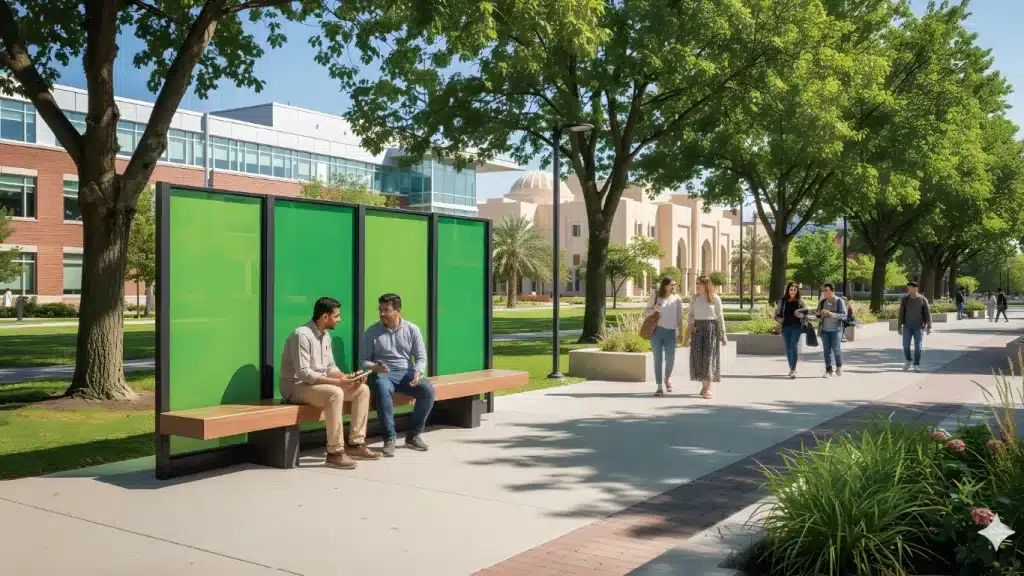
Smart-City Developments
Connected façade systems could potentially form part of wider environmental-monitoring networks.
Premium Green Buildings
Developers seeking differentiated sustainability features may find biological façades particularly attractive.
In every case, the design should respond to orientation, local climate, maintenance capacity and the actual carbon objective.
New Building or Retrofit?
Both are possible, but they are not equally simple.
New Construction
Integrating the system from the start gives the project team more control.
Architects, façade engineers and MEP consultants can coordinate:
- Structural support
- Pipe routes
- Electrical systems
- Drainage
- Maintenance access
- Sensor networks
- Control systems
This usually creates the cleanest installation.
Retrofit
Existing buildings can potentially receive PBR modules as:
- A secondary skin
- Architectural screens
- Shading elements
- Feature façade zones
Retrofitting can be attractive because it allows existing buildings to gain new environmental functions.
But structural capacity, services and waterproofing need to be checked carefully.
Start Small, Then Scale
A developer does not need to cover an entire tower in algae on day one.
A more practical approach is modular.
Start with one section.
Monitor it.
Understand the biology.
Measure energy consumption.
Evaluate maintenance.
Review the biomass pathway.
Then decide whether expansion makes sense.
A possible sequence is:
Pilot façade
↓
Monitor
↓
Validate performance
↓
Optimize
↓
Expand
This is especially valuable for emerging biological building technologies.
A project can build confidence using real operating data instead of relying entirely on theoretical design calculations.
BioDivider™ Shows That the Same Logic Can Extend Beyond the Building
The idea of converting passive surfaces into biological infrastructure is not limited to façades.
Road medians are another example.
Traditionally, a road divider performs a simple physical function.
It separates traffic.
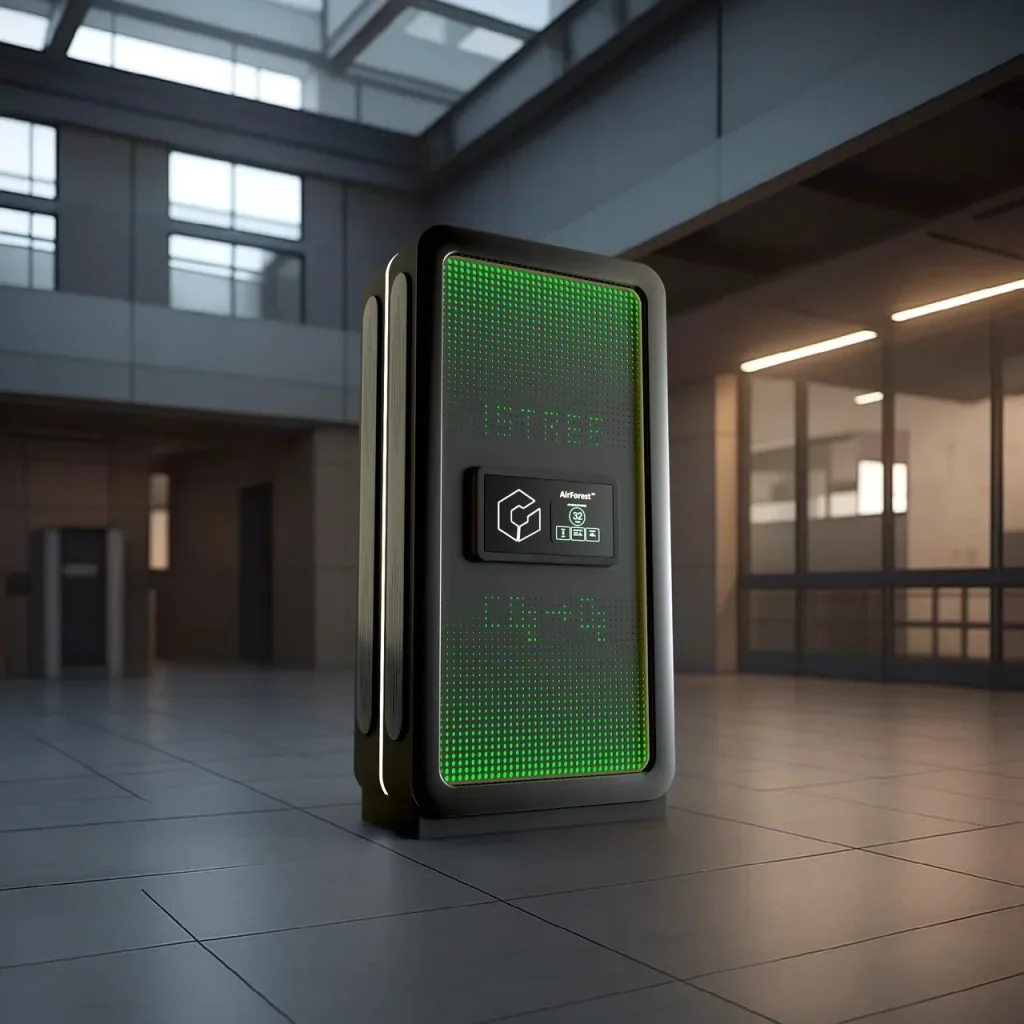
A BioDivider™ Panel can apply the same photobioreactor principle to urban infrastructure.
That means the larger idea is not really about walls.
It is about surfaces.
A façade can become active.
A divider can become active.
An architectural screen can become active.
Urban infrastructure can begin to participate in environmental management instead of remaining purely passive.
What Could the Future Building Envelope Look Like?
The most interesting future façades may not rely on one solution.
A high-performance envelope could combine several environmental technologies.
For example:
High-performance glazing
to manage heat and daylight.
Photovoltaics
to generate electricity.
External shading
to reduce solar heat gain.
Natural planting
to support biodiversity.
Microalgae photobioreactors
to provide biological carbon conversion.
Sensors
to measure performance.
This is probably more realistic than expecting microalgae to replace conventional façade systems.
The strongest building is usually not the one with a single sustainability technology.
It is the one where different technologies are carefully integrated around a common performance goal.
The Technology Still Has Challenges to Solve
Building-integrated microalgae systems are promising, but they are not simple.
Cost remains important.
Maintenance remains important.
Reliability remains important.
Climate conditions can vary dramatically between buildings.
Some of the practical challenges include:
- Capital cost
- Pumping energy
- Seasonal sunlight variation
- Temperature control
- Panel cleaning
- Biofouling
- Structural loading
- Water management
- Nutrient supply
- Culture stability
- Harvesting
- Biomass utilization
- Long-term maintenance
These are not reasons to dismiss the technology.
They are the areas that need to be solved if biological façades are going to move from demonstration projects into mainstream buildings.
Where Carbelim Fits
Carbelim should not position Carbon Bio-Façade™ as another decorative green wall.
The opportunity is larger than that.
The company sits at the intersection of:
Microalgae
Photobioreactors
Building integration
Carbon capture
Environmental monitoring
This allows Carbelim to position Carbon Bio-Façade™ and Biomimetic Façade™ as functional biological building systems.
The central idea is simple:
turn a passive building surface into an active environmental surface.
That is a much clearer category than “green wall.”
What a Real Carbon Bio-Façade Project Could Look Like
A practical project might begin with an architectural and technical assessment.
Step 1: Identify the Façade Area
Look at orientation, sunlight, structure and available surface.
Step 2: Define the Carbon Objective
Determine whether the system will interact with ambient air, a building exhaust stream or another suitable source.
Step 3: Design the Photobioreactor
Choose the module geometry, culture volume and circulation strategy.
Step 4: Integrate With the Building
Coordinate power, pipework, drainage, structure and maintenance access.
Step 5: Commission the Biology
Establish the culture and operating conditions.
Step 6: Monitor Performance
Track the physical and biological system.
Step 7: Harvest Biomass
Manage growth rather than allowing biomass to accumulate indefinitely.
Step 8: Track the Carbon
Document what happens to the harvested material.
Step 9: Expand if It Works
Add modules based on measured performance.
This is how microalgae carbon capture buildings can move from an architectural concept into real climate infrastructure.
Can This Help Create Carbon-Negative Buildings?
It can contribute.
That distinction matters.
A carbon-negative building needs to consider much more than one façade system.
Its overall performance depends on:
- Embodied carbon
- Operational energy
- Renewable energy
- Building materials
- Refrigerants
- Maintenance
- Replacement cycles
- Carbon captured
- Carbon storage duration
Microalgae façades can add biological carbon capture to that equation.
They can help make the building more active.
But they should not be used as a shortcut for claiming the whole building is automatically carbon negative.
Serious developers and sustainability teams will appreciate that distinction.
From Green Buildings to Buildings That Perform Environmental Work
The first generation of green buildings focused heavily on using less.
Less energy.
Less water.
Less cooling.
Less waste.
Less carbon-intensive material.
Those goals remain essential.
But the next generation of sustainable building technology can also ask what the building can actively do.
A roof can generate electricity.
A rainwater system can collect water.
A shaded façade can reduce cooling demand.
A living wall can support vegetation.
And a microalgae façade can participate in biological carbon conversion.
That is a different ambition.
The building stops being only something whose environmental impact needs to be reduced.
Part of it begins performing environmental work.
Frequently Asked Questions
What Are Microalgae Carbon Capture Buildings?
Microalgae carbon capture buildings integrate microalgae photobioreactors into architectural surfaces so that part of the building can participate in biological CO₂ conversion.
What Is an Algae Façade?
An algae façade is a building surface that incorporates controlled microalgae photobioreactors. Depending on the system, it can include CO₂ delivery, circulation, monitoring and biomass harvesting.
Is an Algae Façade the Same as a Green Wall?
No.
A conventional green wall uses terrestrial plants growing in soil, substrate or another root-supporting system.
An algae façade uses microorganisms suspended in liquid inside an engineered reactor.
What Is a Carbon Bio-Façade?
A Carbon Bio-Façade is a building-integrated biological system designed to make façade surfaces part of a carbon-management process.
Can an Algae Wall Capture CO₂?
Yes. Microalgae use inorganic carbon during photosynthesis. Actual performance depends on the photobioreactor, gas transfer, light, culture condition and operating environment.
Does an Algae Façade Produce Oxygen?
Microalgae release oxygen during photosynthesis. Actual output varies with biological productivity and system conditions.
Does an Algae Façade Need Maintenance?
Yes.
Pumps, sensors, liquid systems and the biological culture all require appropriate operation and maintenance.
Can It Replace a Conventional Building Façade?
It is more realistic to integrate the technology as selected façade modules or as a secondary building skin rather than assume it can replace every conventional envelope component.
Can an Algae Façade Make a Building Carbon Negative?
It can contribute to a carbon-negative strategy, but the complete building lifecycle has to be evaluated before making that claim.
What Is Building-Integrated CCUS?
Building-integrated CCUS brings carbon capture and utilization functions into the building itself. Microalgae façades offer one biological approach to doing this.
A Building Wall Does Not Have to Stay Passive
For most of architectural history, the façade has separated the inside from the outside.
It keeps rain out.
It manages heat.
It controls sunlight.
It gives the building an identity.
Microalgae introduce the possibility that the same surface can do something else.
It can host a biological process.
CO₂ can enter.
Light can support photosynthesis.
Microalgae can grow.
Biomass can be harvested.
Sensors can record what is happening.
That is the opportunity behind microalgae carbon capture buildings.
It is not simply another green wall.
And it should not be sold as a shortcut to a carbon-negative building.
It is a new form of building-integrated environmental technology.
For Carbelim, Carbon Bio-Façade™, Biomimetic Façade™ and BioDivider™ Panels can help define that category by bringing microalgae, photobioreactor engineering and environmental monitoring into surfaces that have traditionally done very little carbon-management work.
The future building envelope may still protect the building from its environment.
But it may also begin working for the environment.