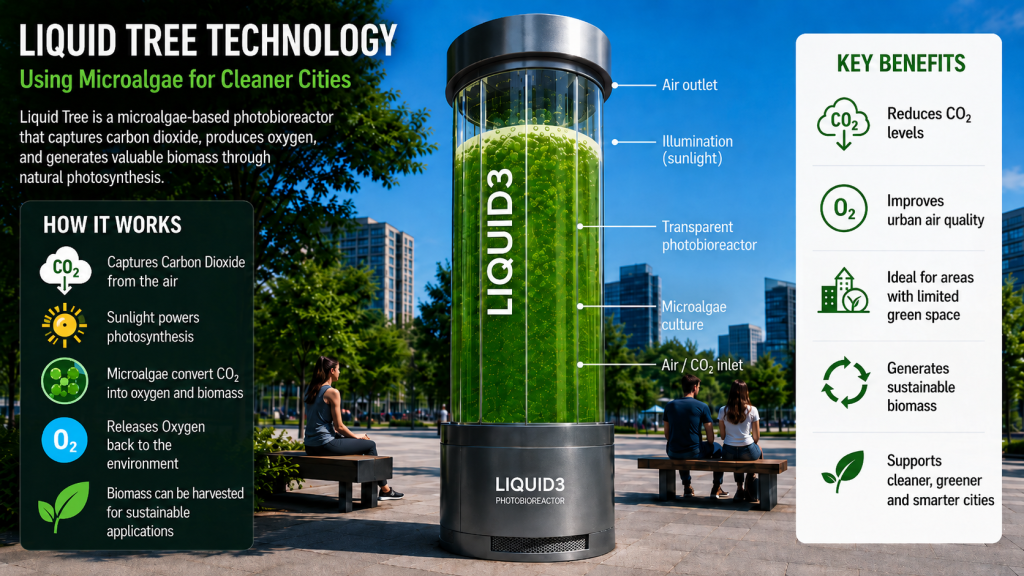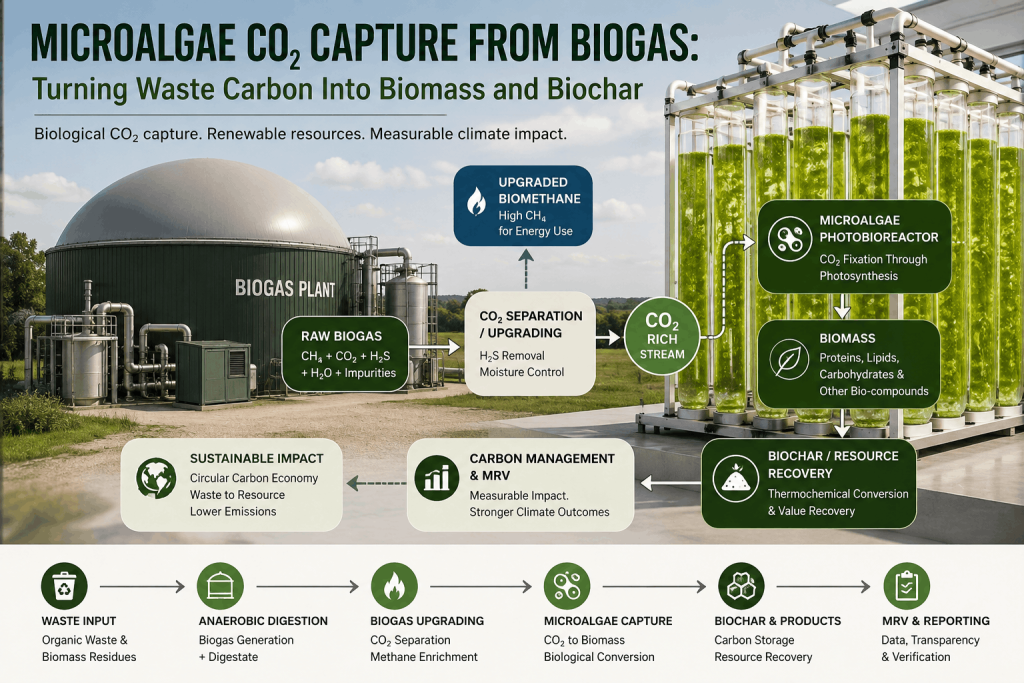
For most industrial facilities, carbon dioxide is not an abstract climate problem. It leaves the site every day through process vents, boilers, furnaces, and exhaust stacks.
The usual carbon-capture conversation begins with chemical separation: capture the CO₂, concentrate it, compress it and decide whether it should be transported, stored or used elsewhere.
Microalgae CCUS approaches the same carbon stream differently.
Instead of treating CO₂ only as a waste gas that needs to be separated, microalgae can use carbon dioxide as an input for photosynthesis. Inside an engineered photobioreactor, part of the carbon entering the culture can be converted into new biological material.
The pathway is straightforward to understand:
Industrial emission → flue gas → CO₂ delivery → microalgae photobioreactor → biomass → carbon utilization → MRV
But building a reliable industrial system around that pathway is not straightforward.
Real flue gas can be hot. Its CO₂ concentration changes from one process to another. It may contain particulates, nitrogen oxides, sulfur compounds or other components that affect biological growth. Gas-liquid transfer has to be engineered correctly. The culture must remain healthy. Biomass must be harvested. And if a company wants to make a carbon claim, the fate of that biomass must also be understood.
That is why microalgae CCUS should be viewed as an industrial biotechnology platform rather than simply algae cultivation beside a factory.
Research has already demonstrated the core principle. Pilot-scale studies have cultivated microalgae using actual industrial flue gas, while more recent work has examined direct use of combustion flue gas in photobioreactors and the engineering and lifecycle implications of doing so.
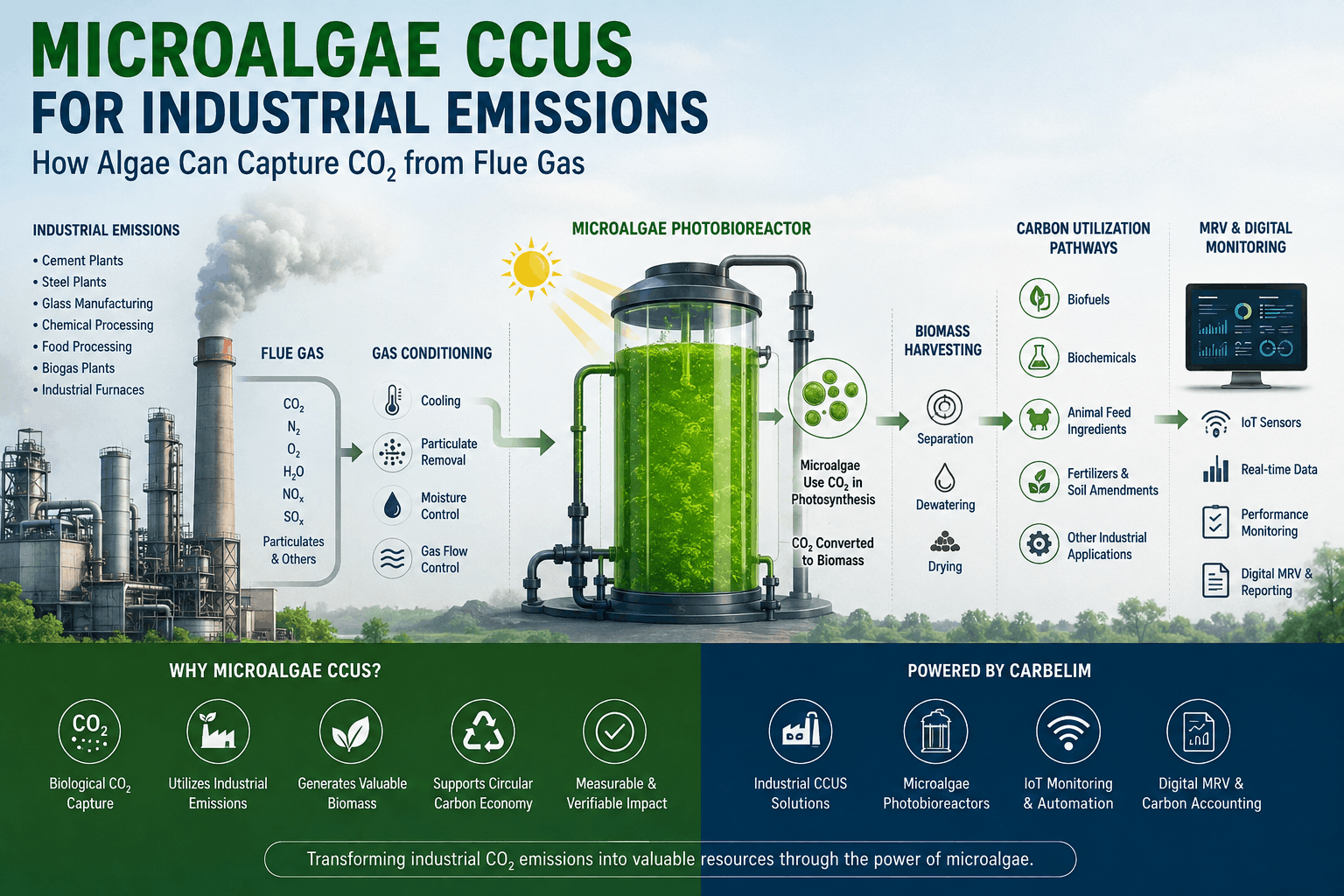
Table of Contents
What Is Microalgae CCUS?
CCUS stands for Carbon Capture, Utilisation and Storage.
In conventional industrial systems, capture often means separating CO₂ from a gas mixture to create a more concentrated carbon stream.
With microalgae CCUS, the utilization step begins inside the biological reactor itself.
Microalgae are photosynthetic microorganisms. When light, water, nutrients and suitable environmental conditions are available, they use inorganic carbon during growth.
In simplified form:
CO₂ + light + water + nutrients → microalgal biomass
The carbon that originally existed as CO₂ becomes incorporated into cellular material.
This makes microalgae carbon capture different from a system that only separates and compresses carbon dioxide.
A photobioreactor is not simply holding captured CO₂.
It is providing an engineered environment in which biological carbon conversion can occur.
That distinction is important because it changes what an industrial facility has to manage after capture.
Instead of only asking, “Where will we send the concentrated CO₂?”, a biological CCUS project also asks:
How much biomass did we produce, and what happens to the carbon contained within it?
Why Industrial Flue Gas Is Interesting for Microalgae
Microalgae need a source of inorganic carbon to grow.
In ordinary cultivation, that carbon may come from ambient air or an added CO₂ supply.
An industrial exhaust stream can provide a more concentrated carbon source.
The International Energy Agency identifies CCUS as an important emissions-reduction technology for industrial and energy applications.
That makes microalgae flue gas integration attractive in principle: a gas that would otherwise release CO₂ to the atmosphere can potentially become an input to biological production.
This concept is not purely theoretical.
A pilot-scale study using Scenedesmus obliquus operated a 100-litre airlift photobioreactor with actual coke-oven flue gas and demonstrated biological CO₂ capture under optimized conditions.
A separate long-duration project investigated microalgae cultivation using cement flue gas outdoors over multiple years, showing that biological systems can be operated against a real industrial carbon source rather than only bottled laboratory CO₂.
More recently, a 2025 pilot-scale study evaluated direct flue-gas capture for algae cultivation using combustion gases containing roughly 3–5% CO₂, together with techno-economic and lifecycle analysis.
The evidence supports an important conclusion:
Microalgae can use CO₂ from industrial flue gas, but performance is highly dependent on the actual gas stream and the way the biological system is engineered.
Flue Gas Is More Than CO₂
A common mistake is to describe flue gas as though it were simply concentrated carbon dioxide.
It is not.
The exact composition depends on the fuel, industrial process, combustion conditions and existing pollution-control equipment.
A flue-gas stream may contain:
- CO₂
- Nitrogen
- Oxygen
- Water vapour
- Particulate matter
- Nitrogen oxides
- Sulfur compounds
- Carbon monoxide
- Trace contaminants
Temperature can also be much higher than a microalgae culture can tolerate.
That means an industrial microalgae CCUS project cannot begin by connecting an arbitrary stack directly to a photobioreactor.
It begins with the gas.
What is the CO₂ concentration?
How much gas is produced every hour?
Does the flow change with production?
What is its temperature?
What contaminants are present?
What pollution-control equipment is already installed?
Can the selected microalgal strain tolerate the conditioned gas?
Those answers determine whether biological integration is technically sensible.
How Microalgae CCUS Works with Industrial Flue Gas
A practical microalgae CCUS project can be understood as a sequence of engineering stages rather than a single capture device.
1. Industrial Emissions Are Characterized
The first stage is measurement.
Before a photobioreactor is sized, the facility needs to understand the carbon stream available to it.
Useful information can include:
- CO₂ concentration
- Gas-flow rate
- Gas temperature
- Moisture
- Operating hours
- Production cycles
- Particulate loading
- NOx and SOx concentrations
- Other process-specific contaminants
This creates the design basis for the biological system.
A furnace operating continuously cannot automatically be treated the same way as a batch chemical process or a fermentation facility.
Microalgae CCUS begins with the real emission profile of the site.
2. The Gas Is Conditioned Where Required
The next question is whether the gas can safely enter a biological reactor.
Flue gas may need to be cooled before it contacts the culture.
Particulates may need to be removed.
Some applications may require dilution or additional conditioning.
In other cases, an industrial site may already have upstream pollution-control equipment that makes a downstream carbon stream more suitable for biological use.
There is therefore no universal flue-gas conditioning train for algae.
The required design depends on the source.
This is also why biological CCUS should generally be seen as complementary to conventional pollution-control infrastructure, not as a replacement for every scrubber, particulate-control system or NOx-control technology at a plant.
3. CO₂ Is Delivered into the Photobioreactor
Once a suitable gas stream reaches the biological system, the next challenge is transferring carbon dioxide from gas into liquid.
This sounds simple but is one of the core engineering problems in industrial algae carbon capture.
If gas bubbles move through the reactor too quickly, a large portion of the CO₂ can leave before it becomes available to the culture.
If gas transfer changes pH too rapidly, biological performance can also be affected.
The reactor therefore has to balance gas flow, bubble behaviour, mixing and culture chemistry.
Modern research on controlled photobioreactor operation continues to show that variables such as flue-gas flow and inlet CO₂ concentration materially influence microalgal productivity and CO₂ capture performance.
The implication is important:
The amount of CO₂ supplied to a reactor is not the same as the amount of CO₂ biologically fixed.
4. Microalgae Convert Carbon Through Photosynthesis
Once inorganic carbon becomes available in the culture, microalgae use it during photosynthetic growth.
Light provides energy.
Nutrients support cellular development.
Carbon becomes incorporated into new algal cells.
The result is biomass.
This conversion is the biological core of microalgae CCUS.
Unlike a conventional absorber that ultimately releases concentrated CO₂ from a solvent, a photobioreactor produces a carbon-containing biological output.
That is why algae-based capture sits naturally within the broader concept of carbon capture and utilization.
5. Biomass Is Harvested
A continuously growing culture cannot simply accumulate biomass forever.
Material must be removed.
Depending on system design, part of the culture can be harvested while the remaining organisms continue to grow.
Harvesting creates several practical questions:
How much biomass is produced?
What is its moisture content?
What contaminants may be present?
How will it be separated from water?
What processing will follow?
Where will it go?
These are not secondary questions.
They determine both the economics and the carbon outcome of the project.
6. Captured Carbon Enters a Utilization Pathway
One of the most attractive features of microalgae CCUS is that the output can potentially become a feedstock rather than simply a waste material.
Depending on the organism, gas source, cultivation conditions and downstream processing, microalgal biomass can contain useful fractions such as lipids, proteins, carbohydrates or pigments.
But not every industrially grown biomass stream will be suitable for every end use.
A culture exposed to industrial flue gas, for example, must be evaluated according to its actual composition and contamination risk before selecting a product pathway.
This is where the broader concept of algae carbon utilization becomes important.
The commercial objective is not simply:
capture CO₂ → grow algae
It is:
capture CO₂ → generate controlled biomass → create an appropriate carbon or material pathway
Biomass Does Not Automatically Mean Permanent Carbon Removal
This distinction is critical.
Suppose an industrial photobioreactor captures carbon into microalgal biomass.
That demonstrates biological carbon fixation.
But if the biomass is rapidly decomposed or converted into a short-lived product, much of that carbon may eventually return to the atmosphere.
So:
CO₂ fixation is not automatically permanent CO₂ removal.
A credible carbon project should distinguish between:
- Carbon captured
- Carbon utilized
- Emissions avoided
- Carbon durably stored
- Net carbon removed
The downstream pathway determines which claim is appropriate.
This is why MRV becomes important later in the system.
The photobioreactor tells us where carbon entered the biological process.
Carbon accounting needs to tell us where it ultimately went.
The Photobioreactor Is the Core of Microalgae CCUS
The organism performs the photosynthesis.
The reactor determines whether that biology can become an industrial process.
An effective photobioreactor has to manage several competing requirements.
Light
Microalgae need sufficient light for photosynthesis.
But as a culture becomes denser, cells begin shading one another.
Reactor geometry therefore influences how effectively the culture receives light.
Mixing
Cells, nutrients and gases need to move through the system.
Mixing also helps expose organisms to changing light conditions rather than leaving some cells permanently in dark zones.
CO₂ Transfer
Gas has to remain in contact with the culture long enough for useful transfer.
pH
Dissolved CO₂ changes culture chemistry.
Poorly controlled carbon delivery can move pH outside the desired operating range.
Temperature
Every strain has an operating window.
Industrial gas may therefore require cooling before biological contact.
Nutrients
CO₂ alone does not produce biomass.
Nitrogen, phosphorus and micronutrients still have to be available.
Harvesting
The reactor system needs a practical method for removing biomass.
Monitoring
Operators need to know whether the culture is healthy and whether the reactor is operating as intended.
These factors explain why microalgae CCUS is as much a reactor-engineering problem as a biological one.
Carbelim’s Microalgae Photobioreactor and Custom PBR Design Platform are positioned around engineered microalgae cultivation, including monitoring and industrial applications.
Microalgae CCUS vs Conventional Industrial Carbon Capture
These technologies should not be treated as direct replacements for one another in every project.
A conventional capture system may be appropriate when an industrial facility has an enormous continuous CO₂ stream and the goal is to separate that carbon for transport or geological storage.
Microalgae CCUS becomes interesting where biological utilization itself creates value.
A simplified comparison is:
| Factor | Microalgae CCUS | Conventional Chemical Capture |
|---|---|---|
| Main mechanism | Photosynthetic biological fixation | Chemical/physical CO₂ separation |
| Immediate output | Microalgal biomass | Concentrated CO₂ |
| Core equipment | Photobioreactor | Absorption/separation system |
| Biological control | Essential | Not required |
| Biomass production | Yes | No |
| Carbon utilization | Built into biological conversion | Requires separate utilization pathway |
| Large point-source scale | Site dependent | Often better suited |
| Modular deployment | Possible | Depends on process |
| MRV requirement | Gas + biology + biomass + operations | Gas + process + transport/storage |
| Permanence | Depends on biomass pathway | Depends on utilization/storage pathway |
The point is not that microalgae CCUS is better than chemical capture.
The point is that it does something different.
Can Microalgae Use Real Flue Gas?
Yes, and this has been demonstrated in multiple real-world research settings.
A pilot-scale study using actual coke-oven flue gas demonstrated cultivation in a 100-litre airlift photobioreactor.
Research involving a commercial cement environment screened locally derived microalgal strains for their ability to utilize cement-kiln CO₂ and produce biomass.
Another project reported multi-year outdoor cultivation using cement flue gas, showing that algae production could be maintained across changing seasons and operating conditions.
Recent work has also evaluated direct use of natural-gas and biogas combustion flue gas in pilot-scale algae cultivation, reinforcing the idea that industrial carbon can potentially be supplied directly to biological production under appropriate conditions.
These studies demonstrate feasibility.
They do not mean that every flue gas can be connected directly to every algae strain.
That distinction matters.
Why Site-Specific Testing Matters
Microalgae behave differently across strains.
Industrial exhaust behaves differently across plants.
Photobioreactors behave differently across designs.
A result from one pilot cannot simply be copied into another facility’s carbon model.
A robust microalgae CCUS programme should therefore be based on site-specific information.
That usually means evaluating:
- The actual gas stream
- Candidate microalgal strains
- Reactor configuration
- Carbon-transfer performance
- Biomass productivity
- Resource consumption
- Biomass quality
- Downstream carbon pathway
- Monitoring requirements
- Scale-up economics
A pilot can then provide operating data before larger deployment.
That is more credible than beginning with a large theoretical annual CO₂ number and designing the project around the claim.
Cement as an Application for Microalgae CCUS
Cement is one of the industries most frequently discussed in connection with carbon capture.
Microalgae research has specifically examined cement-flue-gas utilization, including strain screening and long-duration outdoor cultivation.
But this does not mean Carbelim should position itself as a conventional cement-CCS company.
Cement plants have major process emissions and large carbon flows. Large-scale chemical capture, process optimization, alternative materials and other decarbonization technologies may all form part of the industry’s pathway.
The role of microalgae CCUS is narrower and more precise:
to evaluate whether selected, appropriately conditioned CO₂ streams can support biological carbon conversion in engineered photobioreactors.
That positioning is both more technically credible and more differentiated.
Steel as an Application
Steelmaking can generate several different gas streams depending on the production route and equipment used.
There is no single “steel flue gas” specification.
A biological project therefore has to identify a suitable source rather than treating the entire plant as one emission stream.
For Carbelim, steel should be described as an application environment for microalgae CCUS assessment, not as a claim that an algae reactor can replace the industry’s primary decarbonization technologies.
The relevant question is:
Does the site have a technically compatible CO₂ stream that can be conditioned and supplied to a biological system?
Glass Manufacturing
Glass manufacturing relies on high-temperature furnace processes.
Combustion gases can contain CO₂, but the exhaust temperature itself makes direct biological contact impractical without appropriate conditioning.
That creates a potential application pathway:
Furnace exhaust → gas conditioning → controlled CO₂ delivery → microalgae photobioreactor
Again, feasibility depends on the actual site.
Chemical Processing
Chemical facilities can contain multiple process vents and combustion sources.
Some streams may be relatively concentrated in CO₂.
Others may contain components unsuitable for biological cultivation.
This makes chemical manufacturing a good example of why industrial CO₂ capture cannot be designed around the industry name alone.
The individual carbon stream has to be assessed.
Food Processing and Fermentation
Food and beverage facilities can present a different opportunity.
Alongside boiler or furnace emissions, some processes — particularly fermentation — can generate comparatively concentrated CO₂ streams.
Where gas quality is appropriate, these streams may offer an interesting source for microalgae CCUS because less conditioning may be required than with a complex combustion exhaust.
The same logic applies:
Use the right carbon source for the right biological system.
Biogas
Biogas is generally a mixture containing methane and a significant fraction of CO₂.
During upgrading, CO₂-rich gas streams can become available.
That creates a potentially useful integration point for microalgae cultivation.
Recent pilot research has specifically examined algae production using flue gas from natural-gas and biogas combustion.
A biological system could therefore be evaluated as part of a broader carbon-utilization strategy around biogas infrastructure.
Industrial Furnaces
Industrial furnaces exist across metal processing, ceramics, manufacturing and other sectors.
Their exhaust streams vary widely.
Where a suitable CO₂-containing stream can be cooled and conditioned, microalgae CCUS may be assessed downstream.
This should always be presented as a site-specific application rather than a universal furnace-treatment claim.
Industrial Applications Are Opportunities, Not One-Size-Fits-All Products
This distinction is important for Carbelim’s positioning.
The company does not need to claim:
“We solve cement emissions.”
or:
“We solve steel emissions.”
A stronger positioning is:
Carbelim develops microalgae CCUS technology that can be engineered around suitable industrial CO₂ streams.
Cement, steel, glass, chemicals, food processing, biogas and furnaces then become application categories.
The technology remains the product.
The industry remains the deployment environment.
That protects the brand from competing directly with conventional mega-scale CCS companies where the technologies are solving fundamentally different problems.
From Flue Gas to Carbon Utilization
Capture is only the beginning of the biological pathway.
A better way to understand microalgae CCUS is to follow the carbon:
Industrial CO₂
↓
Gas conditioning
↓
Photobioreactor
↓
Photosynthesis
↓
Microalgal biomass
↓
Downstream utilization or durable carbon pathway
This is where algae can create something conventional capture does not inherently produce: biological feedstock.
The commercial opportunity then depends on the quality and destination of that biomass.
What Intrinsic Foundries Tells Us About the Market
Intrinsic Foundries is useful to study because it demonstrates how the biological carbon market is evolving.
The company currently describes itself as a carbon-to-value biomanufacturing platform and positions industrial carbon as an input for producing higher-value biochemicals.
That is an important market signal.
The biological CCUS industry is moving beyond the simple statement:
“Algae absorb CO₂.”
That fact alone is not enough to build an industrial company.
The competitive questions are becoming:
- How is CO₂ delivered?
- How reliable is the biology?
- How productive is the reactor?
- What happens to the biomass?
- Can the system scale?
- Can it integrate with a real facility?
- Can performance be monitored?
- Can the carbon pathway be documented?
- Is there a commercially useful output?
Intrinsic Foundries emphasizes carbon-to-products.
Carbelim has an opportunity to own a somewhat different part of the category:
engineered microalgae carbon-capture infrastructure + photobioreactors + industrial integration + IoT monitoring + Digital MRV.
Where Carbelim Fits
Carbelim’s current Industrial CCUS platform is explicitly positioned around biological carbon capture, industrial integration, site assessment and photobioreactor system design rather than conventional amine-based stack capture.
That creates a clear technology stack.
Industrial CCUS
The project begins with the industrial CO₂ source and feasibility assessment.
Explore Carbelim Industrial CCUS
Microalgae Photobioreactors
The PBR becomes the controlled environment where biological carbon conversion occurs.
Explore Microalgae Photobioreactor Technology
Custom Reactor Engineering
Different gas streams, sites and cultivation objectives may require different reactor, aeration, sensing and automation configurations.
Explore the Custom PBR Design Platform
IoT Monitoring
Sensors allow biological and operational parameters to be tracked continuously rather than relying entirely on occasional manual observations.
Digital MRV
Monitoring data can then feed into a more structured carbon-performance record.
This is where Carbelim can differentiate.
The algae are the biological engine.
The surrounding system turns them into infrastructure.
Why IoT Monitoring Matters
A living reactor changes every day.
The culture does not behave exactly the same way at 9 a.m. and 4 p.m.
Industrial production also changes.
Gas flow may rise or fall.
Temperature can vary.
The culture can become denser.
pH changes.
Pumps can fail.
Gas-transfer equipment can lose efficiency.
A microalgae CCUS system therefore needs more than a yearly theoretical sequestration number.
Useful monitoring can include:
Gas-Side Data
- Inlet CO₂
- Outlet CO₂
- Gas flow
- Gas temperature
Biological Data
- pH
- Culture temperature
- Optical density
- Biomass concentration
- Growth trends
System Data
- Pump status
- Aeration status
- Operating hours
- Downtime
- Maintenance
Carbon-Pathway Data
- Biomass harvested
- Biomass quantity
- Processing route
- Final destination
Carbelim currently integrates sensor and monitoring capabilities into its biological and custom PBR platforms.
Digital MRV: Turning Capture into Evidence
MRV stands for Monitoring, Reporting and Verification.
For an industrial biological project, its purpose is not simply to create a nice dashboard.
It should help answer practical questions.
How much CO₂ was available?
How long did the system actually operate?
What were the biological conditions?
How much biomass was generated?
How much energy was used?
Was the system offline at any point?
Where did the harvested carbon go?
These are the questions that turn microalgae CCUS from a sustainability claim into an auditable operating process.
Carbelim’s own MRV positioning emphasizes continuous environmental and operational data rather than relying entirely on assumed climate impact.
For companies working on ESG reporting, carbon accounting or future carbon-credit methodologies, this data layer can become a significant part of project value.
Explore Carbelim’s Digital MRV approach
Gross CO₂ Capture Is Not the Same as Net Climate Benefit
This point should be built into every serious microalgae CCUS project.
A reactor can biologically fix carbon.
But the system also consumes resources.
Pumps use electricity.
Gas has to be moved.
Biomass has to be harvested.
Water and nutrients may be required.
Processing requires energy.
Transportation may create emissions.
And the captured carbon may eventually return to the atmosphere depending on biomass use.
That means a credible project should distinguish between:
Gross biological CO₂ fixation
and
Net lifecycle climate benefit
This is not a weakness of microalgae technology.
The same lifecycle logic applies to serious carbon-management technologies generally.
Being transparent about it makes the technology more credible.
A Practical Industrial Microalgae CCUS Deployment Strategy
A sensible project does not have to begin by trying to process an entire plant’s emissions.
A staged approach can be more useful.
Stage 1: CO₂ Stream Assessment
Measure actual gas composition, flow, temperature and operating profile.
Stage 2: Biological Compatibility
Evaluate microalgal strains and their operating requirements.
Stage 3: Gas Conditioning Design
Determine whether cooling, particulate control, dilution or other treatment is needed.
Stage 4: Pilot Photobioreactor
Operate against a representative industrial stream.
Stage 5: Digital Monitoring
Collect gas, culture and equipment data.
Stage 6: Biomass Assessment
Measure productivity and determine suitable downstream pathways.
Stage 7: Carbon Accounting
Calculate gross capture, resource inputs and biomass carbon fate.
Stage 8: Scale-Up
Increase capacity based on demonstrated operating results.
This approach treats microalgae CCUS as industrial biotechnology rather than a decorative environmental installation.
What Makes a Strong Microalgae CCUS Project?
A good project is not necessarily the one with the largest reactor.
It is the one where the entire carbon pathway makes sense.
A suitable CO₂ source.
A compatible culture.
Good gas transfer.
Stable biological conditions.
An engineered photobioreactor.
A realistic biomass pathway.
Reliable sensors.
Measured performance.
Transparent carbon accounting.
Put together, the formula looks like this:
Industrial CO₂ + engineered PBR + stable biology + useful biomass pathway + Digital MRV
That is the system.
Not the algae alone.
The Role of Microalgae CCUS in Industrial Decarbonization
Industrial decarbonization will not be solved by one technology.
A factory may reduce energy use.
Electrify some processes.
Change fuels.
Improve efficiency.
Use renewable power.
Deploy chemical carbon capture.
Use mineralization.
Adopt biological carbon utilization.
Different carbon streams may require different approaches.
Microalgae CCUS does not need to replace all of these technologies to become valuable.
Its role is to provide an additional biological pathway where converting CO₂ into biomass makes technical and commercial sense.
This is especially relevant when a project values:
- Modular deployment
- Biological conversion
- Biomass production
- Resource recovery
- Site-level visibility
- IoT monitoring
- Measurable operating data
- Carbon utilization
That is a much more credible market position than presenting algae as the universal answer to industrial emissions.
Why Microalgae CCUS Is Moving Beyond the Laboratory
The scientific question — whether microalgae can use industrial CO₂ — already has considerable experimental evidence behind it.
The harder questions are now engineering and economics.
Can a reactor operate reliably outside a laboratory?
Can the culture tolerate a real gas stream?
Can gas be transferred efficiently?
Can contamination be controlled?
Can the biomass be harvested economically?
Is there a worthwhile downstream application?
Can the carbon outcome be measured?
Can the system be replicated across sites?
Those are the questions that will determine whether microalgae CCUS becomes a significant industrial technology category.
Recent pilot-scale work using direct combustion flue gas shows that the field is increasingly being evaluated not only for biological performance but also for lifecycle and techno-economic feasibility.
Carbelim’s Opportunity in Industrial Microalgae CCUS
Carbelim does not need to become a conventional cement-plant or steel-plant CCS contractor.
Its opportunity is more focused.
Build the biological carbon-management layer that can be integrated with suitable industrial emissions.
The complete pathway is:
Industrial emission
↓
Flue-gas characterization
↓
Gas conditioning
↓
CO₂ delivery
↓
Microalgae photobioreactor
↓
Photosynthetic carbon fixation
↓
Biomass generation
↓
Carbon utilization or downstream management
↓
IoT monitoring
↓
Digital MRV
Carbelim already positions its Industrial CCUS offering around site-specific assessment, photobioreactor design and integration with existing industrial infrastructure, while its custom PBR platform adds configurable sensors and automation.
That creates a clear category:
Microalgae CCUS infrastructure for industrial carbon conversion.
Frequently Asked Questions
What Is Microalgae CCUS?
Microalgae CCUS is a biological carbon-capture and utilization approach in which microalgae use CO₂ during photosynthesis and convert part of that carbon into biomass. Engineered photobioreactors provide controlled conditions for the process.
Can Microalgae Capture CO₂ from Industrial Flue Gas?
Yes. Pilot-scale research has demonstrated microalgal CO₂ fixation using actual industrial flue gas and other real combustion-derived streams. Suitability depends on gas composition, temperature, contaminants, strain selection and reactor conditions.
Does Flue Gas Need to Be Treated Before It Reaches the Algae?
Sometimes.
Hot gas, particulates or unsuitable contaminants may require cooling or conditioning before biological contact. The required treatment depends on the actual industrial stream.
What Is the Role of a Photobioreactor?
A photobioreactor provides a controlled environment for microalgae growth. It manages factors such as CO₂ delivery, gas transfer, light exposure, circulation, pH, temperature and biomass harvesting.
Can Microalgae CCUS Be Used in Cement Plants?
Cement flue gas has been used in microalgal research and long-duration cultivation studies.
However, microalgae CCUS should be evaluated as one possible biological carbon-utilization pathway within a broader cement decarbonization strategy, not as an automatic replacement for conventional large-scale CCS.
Can It Be Used in Steel Plants?
Potentially, for selected compatible CO₂ streams.
Steel facilities contain different gas sources and operating conditions, so feasibility should be assessed at the specific stream level.
Can Microalgae CCUS Work with Biogas?
Biogas-related systems can generate CO₂-rich streams, and pilot research has evaluated algae cultivation using flue gas produced from biogas combustion.
Does Microalgae Biomass Permanently Store Carbon?
Not automatically.
The biomass contains biologically fixed carbon, but permanence depends on what happens to that biomass afterward.
Why Is IoT Monitoring Important?
Biological systems are dynamic. Sensors can help track gas conditions, pH, temperature, culture performance, equipment uptime and other parameters that influence actual capture performance.
What Is Digital MRV?
Digital MRV uses monitoring and operational data to create a traceable record of project performance. In a microalgae CCUS system, this can connect CO₂ measurements, biological conditions, biomass output and system operation.
Is Microalgae CCUS Better Than Conventional CCS?
They serve different purposes.
Conventional CCS can be better suited to very large concentrated industrial CO₂ streams intended for transport and geological storage.
Microalgae CCUS is particularly interesting when a project wants biological conversion, biomass generation, modular deployment and carbon utilization.
From Industrial Emissions to Biological Carbon Management
The most useful way to think about microalgae CCUS is not as an algae tank attached to a factory.
It is an engineered carbon pathway.
The gas has to be understood.
The biology has to be matched to it.
The photobioreactor has to transfer carbon effectively.
The culture has to remain productive.
The biomass has to be harvested.
The carbon needs a destination.
And the process has to be measured.
When those elements work together, industrial CO₂ stops being only an emission to manage.
It becomes a potential input to biological production.
That is the opportunity behind microalgae CCUS — and the space Carbelim can build around: combining industrial carbon streams with engineered photobioreactors, IoT monitoring and Digital MRV to create measurable biological carbon-management infrastructure.