Microalgae biogas CO₂ capture offers a different way to think about one of the largest carbon side streams in renewable-gas production.
A biogas plant does not produce methane alone.
Raw biogas normally contains methane together with a significant proportion of carbon dioxide, along with varying levels of water vapour, hydrogen sulphide and other impurities.
When biogas is upgraded into higher-quality biomethane, much of that CO₂ has to be separated.
Conventional upgrading technologies already know how to perform that separation.
The more interesting question is:
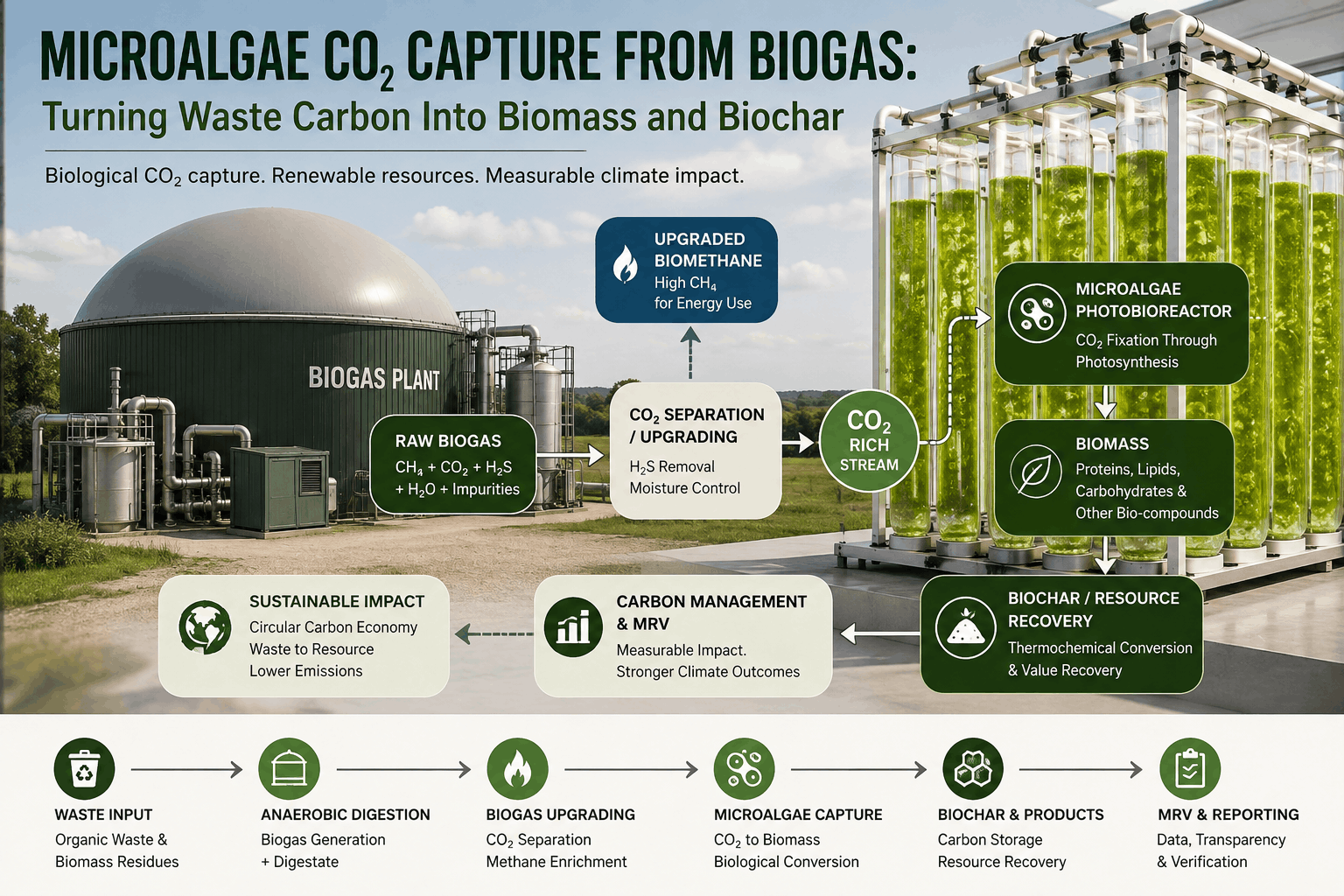
Table of Contents
What happens to the separated carbon afterward?
It can remain an off-gas.
It can be purified for another industrial use.
Or it can become a feedstock for biology.
This is where microalgae biogas CO₂ capture creates a different pathway.
Instead of treating separated biogas CO₂ only as an unwanted gas, the carbon can be supplied to microalgae growing inside an engineered photobioreactor. The organisms use CO₂ during photosynthesis and convert part of that carbon into new biological material.
That biomass can then enter resource-recovery, material-utilization or longer-duration carbon-management pathways such as appropriately engineered biochar.
The basic pathway looks like this:
Biogas
↓
CO₂ separation / upgrading
↓
Microalgae photobioreactor
↓
Biological CO₂ fixation
↓
Biomass
↓
Biochar or resource recovery
↓
Carbon management + MRV
The important point is that this is not simply another way to purify methane.
It is a way to ask whether the carbon removed during biogas upgrading can become a useful biological feedstock rather than ending the process as a waste stream.
Why Biogas Needs Upgrading
Biogas is produced when microorganisms break down organic material under anaerobic conditions.
Common feedstocks include:
- Food waste
- Agricultural residues
- Animal manure
- Sewage sludge
- Industrial organic waste
- Other biodegradable materials
The process produces a methane-rich gas together with digestate.
Raw biogas is not automatically equivalent to pipeline-quality natural gas.
Carbon dioxide reduces the methane concentration and energy density of the gas.
Other components can create additional problems.
Hydrogen sulphide can be corrosive.
Water vapour can create condensation and equipment issues.
Siloxanes and other contaminants may also be present depending on the feedstock.
Biogas upgrading therefore aims to improve methane quality by removing CO₂ and unwanted impurities.
This creates two important streams:
Methane becomes the energy product.
CO₂ becomes a carbon stream that needs a destination.
That second stream is where microalgae become interesting.
How Conventional Biogas Upgrading Removes CO₂
IEA Bioenergy notes that biogas upgrading removes CO₂ and other impurities to increase methane concentration and produce biomethane.
There is no single biogas-upgrading technology.
Commercial plants use different systems depending on plant capacity, gas quality, energy costs, methane-recovery targets and final biomethane specifications.
Common approaches include:
- Water scrubbing
- Pressure Swing Adsorption
- Chemical absorption
- Physical scrubbing
- Membrane separation
- Cryogenic separation
Water Scrubbing
CO₂ is more soluble in water than methane.
The gas is brought into contact with water so more CO₂ transfers into the liquid phase while methane remains concentrated in the gas stream.
Pressure Swing Adsorption
Special adsorbent materials preferentially retain gases such as CO₂ under pressure.
The operating pressure is then changed to regenerate the material.
Chemical Absorption
A solvent chemically binds CO₂.
The solvent must later be regenerated so it can be reused.
Membrane Separation
Membranes exploit differences in gas permeability to separate CO₂ from methane.
These technologies are designed around an important goal:
maximize methane quality and recovery.
But once the CO₂ has been separated, another opportunity appears.
The carbon can potentially be biologically utilized.
What Is Microalgae Biogas CO₂ Capture?
Microalgae biogas CO₂ capture uses carbon dioxide associated with biogas production or upgrading as a carbon source for photosynthetic microorganisms.
Microalgae require inorganic carbon to grow.
Inside an engineered photobioreactor, CO₂ can be introduced into the culture where it becomes available for biological growth.
Part of the carbon is then incorporated into new biomass.
The pathway becomes:
CO₂ → photosynthesis → microalgal biomass
This produces a different outcome from simply venting the separated carbon dioxide.
The CO₂ becomes an input.
The photobioreactor becomes a biological conversion platform.
Biomass becomes a new carbon-containing output.
That is the core idea behind microalgae biogas CO₂ capture.
Two Ways Microalgae Can Be Integrated With Biogas
There are two main ways microalgae can be connected to a biogas process.
They should not be confused.
Route 1: Direct Biological Biogas Upgrading
In this configuration, raw or partially treated biogas is brought into contact with a biological absorption system associated with microalgae.
CO₂ transfers from the gas into the liquid.
The microalgae then use part of that inorganic carbon during photosynthesis.
Depending on the microbial community and reactor design, biological systems can also interact with compounds such as hydrogen sulphide.
The objective is to increase methane concentration while biologically processing part of the carbon.
This is biological biogas upgrading in the direct sense.
Route 2: Use the CO₂ After Conventional Upgrading
This configuration is different.
The plant keeps its existing:
- Membrane system
- PSA unit
- Water scrubber
- Chemical scrubber
- Other upgrading technology
The upgrading system produces biomethane.
The separated CO₂ stream is then routed to a dedicated microalgae photobioreactor.
The pathway becomes:
Raw biogas
↓
Existing upgrading system
↓
Biomethane + separated CO₂
↓
CO₂ to microalgae
↓
Biomass
For Carbelim, this is a particularly strong positioning.
The technology does not need to replace the equipment already responsible for methane purification.
Instead, it becomes a biological carbon-utilization layer downstream of upgrading.
Why This Distinction Matters
It would be easy to describe microalgae as a complete replacement for conventional biogas upgrading.
That would be too broad.
Biomethane plants have strict gas-quality requirements.
An upgrading system may need to control:
- Methane concentration
- CO₂
- Hydrogen sulphide
- Moisture
- Oxygen
- Nitrogen
- Siloxanes
- Pressure
- Methane losses
Microalgae systems have different strengths.
Their key value is biological carbon conversion.
A stronger technology position is therefore:
Conventional upgrading produces the methane product.
Microalgae convert the separated CO₂ into biomass.
The technologies can complement each other rather than compete for exactly the same function.
Why Biogas CO₂ Is an Interesting Feedstock for Microalgae
Atmospheric CO₂ is highly dilute.
Biogas CO₂ is not.
A separated biogas stream can provide microalgae with a much richer carbon source than ordinary outdoor air.
That changes the engineering challenge.
A Direct Air Capture system may have to move enormous quantities of ambient air to obtain a relatively small amount of carbon.
A microalgae biogas CO₂ capture system can receive carbon from a process where CO₂ has already been concentrated or separated.
That can make biogas particularly interesting for biological CCUS.
But more CO₂ is not automatically better.
The gas-delivery rate still has to match:
- Photobioreactor size
- Culture volume
- Biomass concentration
- Light availability
- Biological growth rate
- pH
- Gas-liquid transfer
If CO₂ is supplied faster than the culture can use it, biological performance can suffer.
The objective is therefore not simply:
add as much CO₂ as possible.
The objective is:
deliver carbon at a rate the biological system can actually process.
Gas-Liquid Transfer Is Critical
There is a basic physical challenge.
The CO₂ begins as a gas.
The microalgae live in liquid.
Before the organisms can use the carbon effectively, CO₂ has to move from the gas phase into the liquid phase.
This is known as gas-liquid mass transfer.
Several factors influence it:
- Bubble size
- Gas flow
- Contact time
- Reactor geometry
- Mixing
- pH
- Alkalinity
- Temperature
- Culture density
If a large CO₂ bubble enters the reactor and escapes almost immediately, only limited transfer may occur.
Smaller bubbles and improved gas residence time can increase contact between the carbon and the culture.
This is one reason microalgae biogas CO₂ capture is as much an engineering problem as a biological one.
Why the Photobioreactor Matters
The microalgae perform the photosynthesis.
The photobioreactor creates the conditions that allow the biology to function reliably.
A commercial system has to manage several things simultaneously.
CO₂ Delivery
Carbon has to reach the culture efficiently.
Light
Photosynthesis requires appropriate illumination.
Mixing
The culture needs circulation so cells, gases and nutrients are distributed.
pH
CO₂ changes carbonate chemistry and can affect culture pH.
Temperature
The microalgae need to remain within a suitable operating range.
Nutrients
Carbon alone cannot support continuous growth.
Harvesting
Biomass eventually needs to be removed.
Monitoring
Operators need visibility into both biological and mechanical performance.
Carbelim’s Microalgae Photobioreactor Technology provides the engineering platform for controlled biological CO₂ capture and biomass cultivation.
For microalgae biogas CO₂ capture, the PBR is the core carbon-conversion equipment.
What About Hydrogen Sulphide?
Raw biogas can contain hydrogen sulphide, or H₂S.
This requires attention.
H₂S is corrosive and can become harmful to biological systems at unsuitable concentrations.
A biogas plant may therefore remove most of the H₂S before the CO₂ stream reaches the photobioreactor.
In some direct biological-upgrading configurations, however, microalgal-bacterial systems can participate in sulphide conversion.
That creates a potentially interesting biological pathway.
But it should not be assumed that any algae culture can safely handle any H₂S concentration.
The correct approach is:
characterize the gas first.
Then decide:
- Whether pretreatment is necessary
- Which microalgae are appropriate
- What reactor conditions are required
- Whether H₂S treatment should remain separate
A biological system should be designed around the actual gas stream rather than a generic biogas composition.
Oxygen Also Matters
Microalgae release oxygen during photosynthesis.
For many environmental applications, that can be useful.
For biomethane production, oxygen has to be controlled.
If too much oxygen enters the methane product stream, the resulting gas may not satisfy applicable biomethane or grid-quality requirements.
This creates an additional challenge for direct photosynthetic upgrading.
The reactor has to remove CO₂ while avoiding unacceptable oxygen contamination of the methane stream.
That does not make biological upgrading impossible.
It means the system needs careful design.
For the alternative configuration — where conventional upgrading happens first and the separated CO₂ goes to a dedicated PBR — the problem becomes easier to isolate.
The biomethane product has already been separated from the biological stage.
This is another reason the two-stage architecture can be attractive.
Methane Loss Cannot Be Ignored
Methane is the valuable energy component of biogas.
An upgrading system is not performing well if too much methane leaves with the reject stream.
Methane losses affect:
- Plant economics
- Product yield
- Greenhouse-gas performance
This is especially important because methane is a potent greenhouse gas.
For microalgae biogas CO₂ capture, the cleanest strategy is therefore:
recover as much methane as practical in the fuel stream.
Then:
route the separated CO₂ into biological utilization.
The microalgae system should strengthen the carbon-management pathway without creating unnecessary methane losses.
Conventional Biogas Upgrading vs Microalgae Carbon Utilization
| Area | Conventional Biogas Upgrading | Microalgae Carbon Utilization |
|---|---|---|
| Main objective | Increase methane purity | Convert separated CO₂ into biomass |
| Carbon action | Separate CO₂ | Biologically fix CO₂ |
| Main output | Biomethane | Microalgal biomass |
| Core equipment | Membranes, PSA, scrubbers, absorption systems | Photobioreactor |
| Light required | No | Yes |
| Biological management | No | Yes |
| Biomass produced | No | Yes |
| CO₂ utilization | Requires another pathway | Integrated into biological growth |
| Key risks | Methane loss, energy demand, gas quality | Culture stability, gas transfer, light, harvesting |
| Carbon permanence | Depends on CO₂ destination | Depends on biomass destination |
| Monitoring | Gas quality and recovery | Gas + biology + biomass + carbon fate |
The two technologies do not necessarily need to compete.
They can form two stages of one carbon-management system.
Why Biomass Changes the Carbon Story
A separated CO₂ stream is still a gas.
Microalgae turn part of that carbon into a physical biological material.
As the culture grows, biomass accumulates.
Depending on the microalgae strain and cultivation conditions, biomass may contain:
- Proteins
- Lipids
- Carbohydrates
- Pigments
- Mineral components
- Other cellular compounds
This creates opportunities for algae carbon utilization.
The captured carbon may potentially become a feedstock for another process.
But not every algae biomass stream should automatically be used in food, feed or high-value biological applications.
The origin of the gas matters.
Contamination matters.
Biomass composition matters.
Product standards matter.
For industrial biological CCUS projects, one alternative downstream pathway is particularly interesting:
biochar.
From Microalgae Biomass to Biochar
Fresh microalgae biomass contains captured biological carbon.
But untreated biomass is not necessarily durable carbon storage.
Microorganisms can decompose it.
The carbon may eventually return to the atmosphere.
Biochar provides another route.
Biochar is generally produced by heating biomass under limited-oxygen conditions.
The conversion changes the physical and chemical structure of the material and can create a more carbon-rich product that is more resistant to rapid decomposition than untreated biomass.
For a microalgae biogas CO₂ capture system, the conceptual chain becomes:
Biogas CO₂
↓
Microalgae
↓
Biomass
↓
Thermochemical conversion
↓
Algal biochar
↓
Carbon utilization or storage
This begins to connect biological carbon capture with a potentially more durable downstream pathway.
Biochar Is Not Automatically Permanent
The word biochar should not be treated as proof of permanent storage.
Its carbon stability depends on several factors.
These can include:
- Biomass feedstock
- Processing temperature
- Residence time
- Conversion technology
- Biochar chemistry
- Final use
- Storage conditions
Different biochars can behave differently.
Therefore, the correct statement is not:
“Convert algae into biochar and the carbon is permanently removed.”
A more credible statement is:
“Biochar can potentially increase the durability of carbon captured in microalgal biomass, subject to appropriate production, characterization, application and MRV.”
This distinction is important for high-integrity carbon-management projects.
The Wet Biomass Problem
There is another practical challenge.
Microalgae grow in water.
Traditional pyrolysis usually works better with relatively dry biomass.
That means algal biomass may first require:
- Harvesting
- Thickening
- Dewatering
- Drying
Those processes use energy.
If the project ignores that energy consumption, the net carbon result can be overstated.
This is why lifecycle thinking is important.
A microalgae biogas CO₂ capture project should not report only the gross amount of CO₂ biologically fixed.
It should also account for the resources required to process the biomass.
Alternative conversion technologies that can handle wetter feedstocks may also be evaluated depending on the project.
The right route depends on:
- Biomass moisture
- Plant scale
- Energy availability
- Final product
- Economics
- Carbon objectives
The Bigger Opportunity Is a Circular Biogas System
Biogas already begins with a circular-economy concept.
Waste becomes an energy resource.
Microalgae can extend that circular pathway.
Consider the full chain:
Organic waste
↓
Anaerobic digestion
↓
Biogas
↓
Biogas upgrading
↓
Biomethane + CO₂
↓
CO₂ to microalgae
↓
Biomass
↓
Resource recovery / biochar
↓
Carbon management
Instead of allowing carbon to leave one system as an unwanted side stream, it becomes an input to another process.
This is more than carbon capture.
It is carbon routing.
That makes microalgae biogas CO₂ capture especially interesting for circular bioeconomy projects.
Where Microalgae Biogas CO₂ Capture Can Be Applied
Several types of facilities could evaluate this pathway.
Anaerobic Digestion Plants
These already generate continuous biogas streams.
Biomethane Facilities
Existing upgrading equipment creates a defined separated CO₂ stream.
Wastewater Treatment Plants
Many wastewater facilities combine anaerobic digestion with biological nutrient streams and existing process infrastructure.
Food-Waste Facilities
Organic residues can be digested and the resulting carbon stream can potentially support biological utilization.
Agricultural Biogas Plants
Manure and agricultural residues can produce biogas while the separated CO₂ becomes another biological feedstock.
Industrial Organic-Waste Facilities
Facilities processing biodegradable industrial wastes may also produce CO₂ streams suitable for evaluation.
The industry type alone does not determine feasibility.
The actual gas stream matters.
What Makes a Good CO₂ Stream for Microalgae?
Before designing the PBR, the carbon source has to be understood.
Important questions include:
- What is the CO₂ concentration?
- What is the gas flow?
- Is the flow continuous?
- How much methane remains?
- How much H₂S is present?
- What is the gas temperature?
- Is the stream wet?
- Are there other contaminants?
- At what pressure is it available?
- Does production change throughout the day?
These answers determine whether the stream can be sent directly to the biological stage or whether conditioning is required.
This is why microalgae biogas CO₂ capture begins with process characterization.
Not with reactor size.
Does Microalgae Technology Need to Replace the Existing Biogas Upgrader?
No.
In many cases, keeping the existing upgrader may be the stronger engineering choice.
A membrane, PSA or scrubber has already been designed to produce biomethane.
The microalgae system can address the carbon stream after separation.
The architecture becomes:
Biogas
↓
Existing upgrading technology
↓
Biomethane
Separated CO₂
↓
Microalgae PBR
↓
Biomass
↓
Biochar / utilization
This allows both systems to do what they are best designed to do.
That is a strong role for Carbelim.
Where Direct Biological Upgrading Could Still Make Sense
Direct algae-based biogas upgrading remains an interesting technology area.
In the right conditions, biological systems may help:
- Remove CO₂
- Increase methane concentration
- Interact with sulphur compounds
- Produce biomass
Such systems may become relevant when:
- The plant scale is suitable
- Light is available
- Nutrient streams can be integrated
- Gas composition is compatible
- Oxygen is carefully controlled
- Methane loss remains low
- Biological operation can remain stable
It should be viewed as one process option rather than a universal replacement for every existing upgrading technology.
Biological Biogas Upgrading Is About More Than Methane Purity
Traditional upgrading asks:
How do we remove CO₂ so the methane becomes more valuable?
A biological carbon-management system adds another question:
What do we do with that CO₂ once we remove it?
This changes the role of the carbon stream.
It is no longer only a contaminant.
It becomes a feedstock.
That is the larger opportunity behind microalgae biogas CO₂ capture.
Why Monitoring Matters
A biogas plant changes continuously.
Gas composition varies.
Digester loading changes.
Microalgae cultures change.
Light conditions change.
pH changes.
Biomass increases.
Equipment can experience downtime.
This means both sides of the system need monitoring.
Gas-Side Monitoring
Useful parameters can include:
- CO₂ concentration
- Gas flow
- Methane concentration
- Temperature
- Pressure
- H₂S
Biological Monitoring
Useful parameters can include:
- pH
- Culture temperature
- Optical density
- Biomass concentration
- Growth trend
Operational Monitoring
Useful data can include:
- Pump status
- Aeration
- Lighting
- Runtime
- Downtime
- Energy consumption
Carbon Monitoring
Useful records can include:
- CO₂ delivered to the PBR
- Biomass harvested
- Biomass carbon content
- Biochar production
- Biochar carbon content
- Final carbon destination
This is how microalgae biogas CO₂ capture becomes measurable rather than theoretical.
Why Digital MRV Matters
MRV stands for Measurement, Reporting and Verification.
For this type of carbon-management project, MRV has to follow the carbon through the complete chain.
A useful system should answer questions such as:
How much CO₂ entered the photobioreactor?
How much was biologically fixed?
How much biomass was produced?
How much biomass was harvested?
How much energy was consumed?
How much carbon remained after biomass processing?
How much biochar was produced?
Where was the final carbon-containing material used or stored?
This is far more useful than simply publishing a theoretical annual CO₂ capture number.
Carbelim’s Industrial CCUS approach can connect biological capture, biomass utilization and carbon-performance monitoring within one industrial carbon-management framework.
Carbon Credits Should Come After Carbon Accounting
It can be tempting to move directly from:
CO₂ capture → carbon credits
A serious carbon-removal project requires more evidence.
Depending on the applicable methodology, the project may need to account for:
- Baseline
- Additionality
- Energy consumption
- Methane leakage
- Biomass harvesting
- Biomass processing
- Transport
- Biochar production
- Carbon stability
- Final storage
- Monitoring
- Verification
The entire lifecycle matters.
This is especially important around biogas because methane leakage can significantly affect climate performance.
A credible microalgae biogas CO₂ capture project should therefore evaluate the complete system rather than reporting only gross biological carbon uptake.
Gross CO₂ Capture and Net Carbon Removal Are Different
Suppose the algae biologically fix 100 units of carbon.
That does not automatically mean 100 units have been permanently removed.
Some carbon may be lost through:
- Biomass respiration
- Processing
- Drying
- Transport
- Thermochemical conversion
- Product use
- Decomposition
Energy used by the system may also create emissions.
A stronger carbon analysis asks:
How much atmospheric or biogenic carbon remains stored after all project emissions and losses are considered?
That distinction should remain central to any project involving algae biochar or biological carbon removal.
Where Carbelim Fits
Carbelim does not need to become another membrane manufacturer or chemical-scrubbing company.
Its opportunity begins around the carbon stream those technologies create.
The pathway can be:
Biogas production
↓
Biogas upgrading
↓
Separated CO₂
↓
Carbelim microalgae photobioreactor
↓
Photosynthetic CO₂ fixation
↓
Biomass
↓
Resource recovery / biochar
↓
Digital MRV
This gives Carbelim a clear role.
The company provides the biological carbon-utilization layer, not necessarily the complete conventional methane-purification system.
Carbelim’s Industrial CCUS and Microalgae Photobioreactor Technology can form the core of this approach.
A Practical Deployment Model
A microalgae biogas CO₂ capture project does not need to begin at full plant scale.
A staged approach can provide better information.
Step 1: Characterize the Biogas Plant
Measure:
- Gas production
- Methane concentration
- CO₂ concentration
- H₂S
- Operating schedule
- Existing upgrading system
Step 2: Identify the CO₂ Stream
Determine where usable carbon becomes available.
Possible sources include:
- Membrane reject gas
- Scrubber off-gas
- PSA off-gas
- Digester gas
- Another separated carbon stream
Step 3: Determine Gas Conditioning Requirements
Check whether the stream needs:
- H₂S reduction
- Cooling
- Moisture management
- Pressure control
- Dilution
- Other treatment
Step 4: Pilot the Photobioreactor
Use a representative CO₂ stream with a controlled microalgae system.
Step 5: Measure Biological Performance
Track:
- pH
- Growth
- CO₂ transfer
- Biomass production
- Energy use
Step 6: Validate Biomass Processing
Determine whether the biomass is best suited to:
- Resource recovery
- Biochar
- Another appropriate pathway
Step 7: Build MRV
Create a traceable record from CO₂ input to final carbon destination.
Step 8: Scale Based on Data
Increase capacity after real operating performance is demonstrated.
This approach treats microalgae biogas CO₂ capture as process engineering rather than a sustainability add-on.
What Makes a Strong Microalgae-Biogas Project?
A strong project is not defined by the largest photobioreactor.
It is defined by whether the complete carbon pathway makes sense.
The plant needs:
A predictable biogas stream.
Strong methane recovery.
A usable CO₂ source.
Efficient gas transfer.
Stable microalgae.
Consistent biomass harvesting.
A realistic downstream pathway.
Measured energy consumption.
Characterized biochar where applicable.
Reliable MRV.
The complete model can be summarized as:
Reliable biogas upgrading + usable CO₂ + engineered PBR + biomass pathway + carbon management + MRV
Every part matters.
Why Existing Biogas Plants Are Interesting for Biological CCUS
A biogas facility already has something that many carbon-capture projects spend significant effort trying to obtain:
a recurring carbon-rich gas stream.
Many sites also already operate:
- Pumps
- Tanks
- Biological processes
- Gas handling
- Control systems
- Maintenance programmes
- Process monitoring
This creates a natural environment for biological carbon utilization.
The carbon does not have to be captured from dilute atmospheric air.
It already exists within the industrial process.
That can make microalgae biogas CO₂ capture a particularly logical application of microalgae CCUS.
From Renewable Gas Production to Carbon Management
Biogas is traditionally seen as an energy technology.
Organic waste is converted into methane.
That remains an important function.
But a more advanced plant can also think about the carbon side stream.
The facility could generate:
Renewable methane
and
Biologically converted carbon
The methane continues into the energy system.
The CO₂ enters the microalgae system.
Biomass is generated.
Part of that biomass may enter resource-recovery pathways.
Part may potentially be converted to biochar.
And Digital MRV records how the carbon moves through the process.
This starts to change the identity of the plant.
It is no longer only producing renewable gas.
It is also managing carbon.
Frequently Asked Questions
What Is Microalgae Biogas CO₂ Capture?
Microalgae biogas CO₂ capture uses microalgae to biologically convert CO₂ associated with biogas production or upgrading into biomass through photosynthesis.
Why Is CO₂ Removed From Biogas?
CO₂ lowers the methane concentration and energy value of raw biogas. Upgrading removes CO₂ and other unwanted components to produce higher-quality biomethane.
Can Microalgae Upgrade Biogas Directly?
Potentially, yes.
Photosynthetic biological systems can remove CO₂ from biogas under suitable operating conditions.
However, gas composition, oxygen, H₂S, methane recovery, light and reactor design all need to be controlled.
Does Carbelim Need to Replace an Existing Biogas Upgrading System?
No.
A practical project can keep the existing membrane, PSA, scrubber or other upgrading equipment and route the separated CO₂ into a Carbelim microalgae photobioreactor.
What Happens to CO₂ Inside the Photobioreactor?
The microalgae use inorganic carbon during photosynthesis.
Part of that carbon becomes incorporated into new biomass.
Can Microalgae Biomass Become Biochar?
Yes, microalgae biomass can potentially be converted into biochar using suitable thermochemical processes.
The actual product properties depend on the feedstock and processing conditions.
Does Algae Biochar Permanently Store All the Captured Carbon?
No.
Biochar can provide a more durable carbon pathway than untreated biomass, but permanence depends on material properties, production conditions and final use or storage.
What Is Biological Biogas Upgrading?
Biological biogas upgrading uses biological processes to remove or convert components such as CO₂ from biogas.
Microalgal and microalgal-bacterial systems are examples of technologies being investigated for this purpose.
Why Is MRV Important?
MRV helps track the carbon from the biogas stream through the microalgae reactor, biomass harvesting, processing, biochar production and final carbon destination.
Where Can Microalgae Biogas CO₂ Capture Be Used?
Potential applications include:
- Anaerobic digestion plants
- Biomethane facilities
- Wastewater treatment plants
- Agricultural biogas facilities
- Food-waste digesters
- Industrial organic-waste facilities
Each project requires site-specific evaluation.
Turning a Carbon Side Stream Into a Managed Resource
Biogas upgrading is usually judged by what happens to methane.
That is understandable.
Methane is the energy product.
But every upgrading plant creates another question:
What happens to the CO₂?
Traditionally, that carbon has mainly been treated as something that needs to be separated.
Microalgae create another possibility.
The CO₂ becomes a biological feedstock.
The photobioreactor provides the controlled environment.
The microalgae convert carbon into biomass.
The biomass enters another process.
Biochar can potentially create a more durable carbon pathway.
And Digital MRV follows the carbon from one stage to the next.
That is the opportunity behind microalgae biogas CO₂ capture.
It does not require Carbelim to replace every conventional biogas-upgrading technology.
It does not mean every tonne of algae automatically becomes permanent carbon removal.
Instead, it creates another layer in the process:
Biogas → biomethane + CO₂ → microalgae → biomass → biochar / resource recovery → measurable carbon management.