Algae air purifier technology offers a biological approach to indoor air treatment by using microalgae to capture and convert CO₂ through photosynthesis. Unlike conventional HEPA filtration, which primarily targets airborne particles, microalgae introduce an additional biological pathway for indoor CO₂ management.
Most indoor air purifiers follow a familiar model: pull room air into the unit, pass it through one or more filters, trap pollutants and send treated air back into the space.
That approach works well for many contaminants, especially particles.
But carbon dioxide is different.
CO₂ is a gas, not a particle. A conventional HEPA filter is designed to capture airborne particles, so it does not function as a carbon-dioxide removal technology.
This is where an algae air purifier becomes interesting.
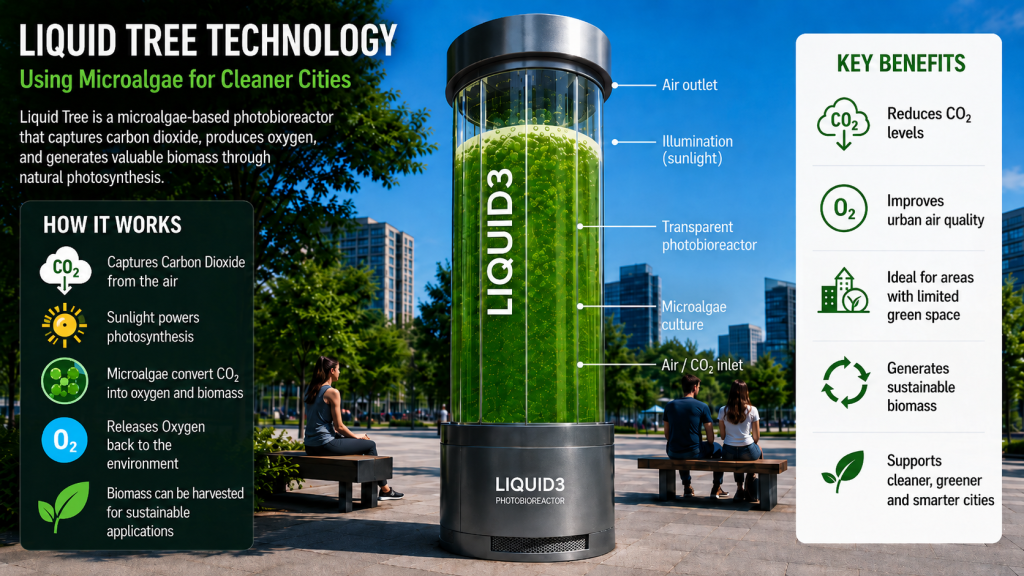
Microalgae use carbon dioxide during photosynthesis. Inside an engineered photobioreactor, CO₂ can be transferred from air into the culture and used as a carbon source for biological growth.
That does not mean microalgae should replace HEPA filters.
The better approach is to understand what each technology is actually designed to do.
HEPA → particulate matter
Activated carbon → selected gases, VOCs and odours
Ventilation → fresh-air exchange and indoor CO₂ management
Microalgae → biological CO₂ capture and conversion
Instead of asking which technology should replace the others, the more useful question is how they can work together.
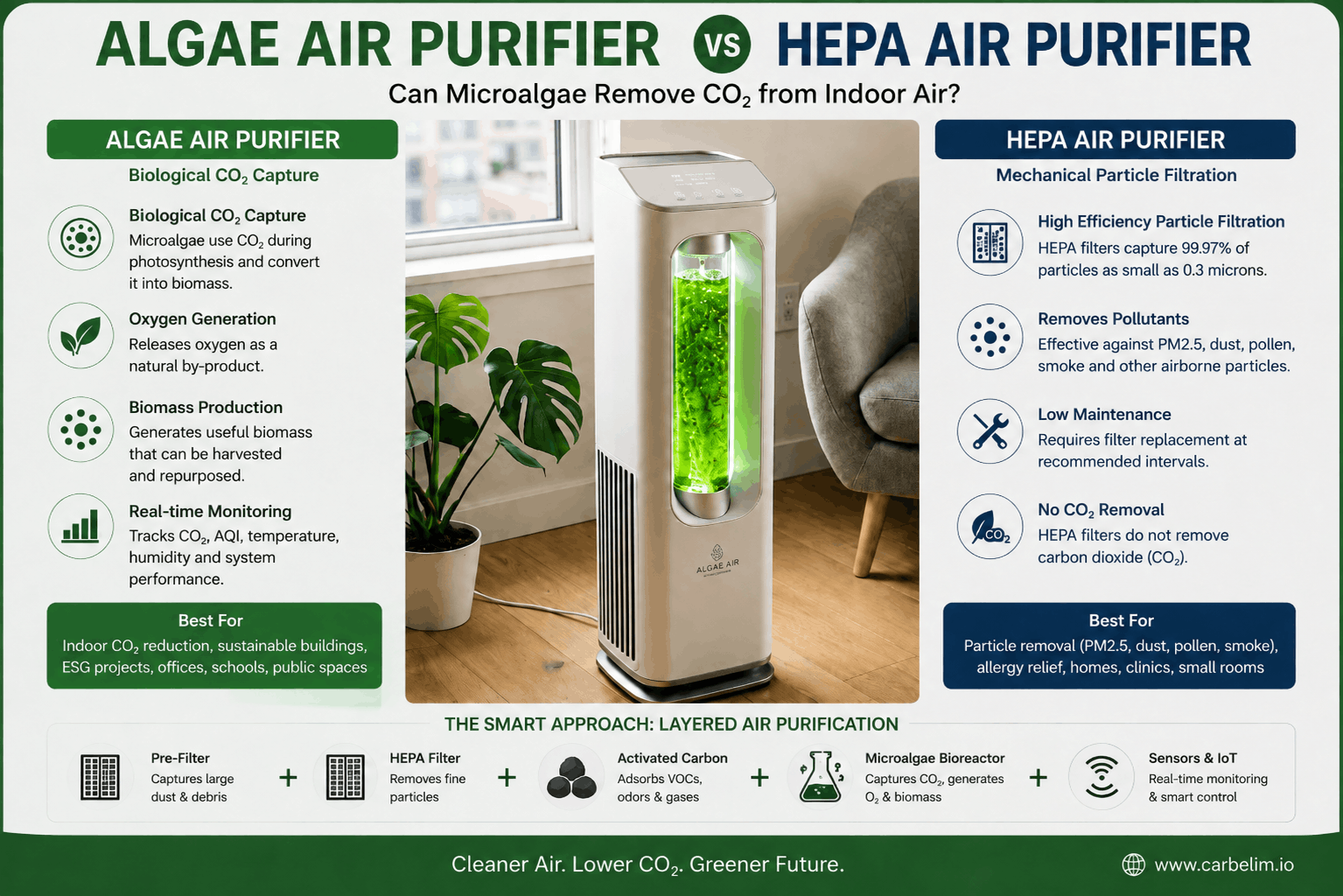
Table of Contes
Why Indoor Air Needs More Than One Treatment Technology
Indoor air is rarely affected by only one pollutant.
An office may contain fine particulate matter from outdoors, VOCs from furniture, carbon dioxide from occupants and humidity generated by people and building activities.
A classroom may have excellent particle filtration but still experience rising CO₂ when many students occupy the room.
A meeting room may have a high-quality purifier running continuously, yet the room can still feel uncomfortable if ventilation is poor.
This happens because different pollutants require different treatment mechanisms.
Particles can be filtered.
Certain gaseous contaminants can be adsorbed.
Indoor CO₂ can be diluted through ventilation or addressed using a dedicated carbon-management process.
This is the foundation of the algae air purifier vs HEPA comparison.
What Does a HEPA Filter Actually Remove?
According to the U.S. Environmental Protection Agency, HEPA filters are designed for high-efficiency particle removal, while gas-phase pollutants require different air-cleaning technologies.
HEPA stands for High Efficiency Particulate Air.
It is a mechanical filtration technology designed to remove airborne particles as air passes through a dense fibrous filter medium.
HEPA filtration is useful for contaminants such as:
- PM2.5
- PM10
- Dust
- Pollen
- Smoke particles
- Mold spores
- Many airborne biological particles
This is why HEPA filters are widely used in homes, offices, healthcare facilities, laboratories and commercial buildings.
For particle removal, HEPA remains an extremely important technology.
But CO₂ behaves differently.
A carbon-dioxide molecule is much smaller than the particles HEPA filters are designed to capture and moves through the filter along with the surrounding air.
So if an indoor space has elevated CO₂ levels, increasing HEPA filtration alone does not directly solve that problem.
The issue is not that HEPA is ineffective.
It is simply being asked to treat the wrong pollutant.
Why HEPA Still Matters in an Algae Air Purifier System
Microalgae should not be presented as a replacement for HEPA filtration.
If an indoor system needs to remove PM2.5, dust, smoke, pollen or other suspended particles, a suitable physical filtration stage is still important.
A well-designed algae air purifier can therefore operate as part of a hybrid system rather than as a standalone replacement for every air-cleaning technology.
A practical treatment train might include:
Pre-filter → HEPA → activated carbon → microalgae photobioreactor → sensors and controls
Each stage performs a different job.
This is more technically credible than claiming that one technology can solve every indoor pollutant.
What Does Activated Carbon Do?
Activated carbon is commonly used alongside HEPA filters in commercial and residential air purifiers.
It works differently from particle filtration.
Activated carbon contains a large internal surface area that can adsorb certain gaseous compounds.
Depending on the media and system design, it can help with:
- Selected VOCs
- Odours
- Certain gaseous pollutants
- Chemical vapours
But activated carbon is not a universal gas-removal technology.
Its performance depends on:
- The target pollutant
- Carbon type
- Quantity of media
- Airflow
- Humidity
- Contact time
- Filter age
Standard consumer activated-carbon filters should therefore not automatically be treated as dedicated room-scale CO₂ removal systems.
This gives each technology a clearer role:
HEPA → particles
Activated carbon → selected VOCs and gases
Microalgae → biological CO₂ conversion
Why Indoor CO₂ Is a Different Problem
Humans continuously produce carbon dioxide through respiration.
In a well-ventilated space with relatively low occupancy, indoor CO₂ may remain close to outdoor levels.
In a crowded office, classroom or conference room, however, CO₂ can accumulate when people generate it faster than the building removes it.
This is why ventilation plays such an important role in indoor-air management.
Fresh outdoor air is introduced while indoor air is exhausted or diluted.
An algae air purifier should not be marketed as a reason to ignore required building ventilation.
Ventilation also helps manage pollutants that a biological CO₂ system may not address.
The stronger positioning is:
microalgae can provide an additional biological CO₂-management layer within a properly engineered indoor-air strategy.
What Is an Algae Air Purifier?
An algae air purifier uses living microalgae inside a controlled photobioreactor.
A photobioreactor provides the conditions the organisms need to remain productive.
These can include:
- Light
- Water
- Nutrients
- CO₂
- Circulation
- Suitable temperature
- Suitable pH
Indoor air can be directed into or brought into contact with the biological system.
Carbon dioxide moves from the air into the liquid culture, where it becomes available to the microalgae.
The organisms then use part of that carbon during photosynthesis.
The basic pathway is:
Indoor air → CO₂ transfer → microalgae → photosynthesis → biomass
This is what separates an algae air purifier from an ordinary filtration-only device.
A conventional filter captures pollutants.
Microalgae biologically transform carbon into living material.
Can Microalgae Really Remove CO₂ from Indoor Air?
Microalgae naturally use inorganic carbon for growth.
So at the biological level, yes — microalgae can use CO₂.
But the more important commercial question is not whether algae consume carbon dioxide.
The real question is:
How much CO₂ can a complete system remove from a real occupied space?
That depends on several factors.
Reactor Size
A small photobioreactor cannot automatically be expected to manage the same CO₂ load as a larger system.
Microalgae Culture
Different strains can perform differently under the same conditions.
Light
Photosynthesis requires adequate illumination.
Airflow
Room air has to reach the biological stage.
Gas-Liquid Transfer
CO₂ has to move efficiently from the air into the liquid culture.
Occupancy
More people generate more indoor CO₂.
Room Volume
A meeting room and an airport terminal are completely different environments.
Ventilation
Existing fresh-air exchange strongly affects room CO₂.
Culture Health
Biological performance changes when pH, temperature, nutrients or culture density move outside the desired range.
This is why a commercial CO₂ air purifier should be evaluated using actual operating data rather than relying only on the fact that algae perform photosynthesis.
Algae Air Purifier vs HEPA: Key Differences
| Area | HEPA Air Purifier | Algae Air Purifier |
|---|---|---|
| Main mechanism | Mechanical filtration | Biological photosynthesis |
| Main target | Airborne particles | CO₂ biological conversion |
| PM2.5 | Strong particle-removal application | Requires a separate particle-removal stage |
| Dust | Yes | Not primarily a biological function |
| Pollen | Yes | Not primarily a biological function |
| CO₂ | Not removed by conventional HEPA | Microalgae can use CO₂ |
| Biomass production | No | Yes |
| Photosynthetic oxygen production | No | Yes |
| Light required | No | Yes |
| Biological management | No | Yes |
| Filter replacement | Required periodically | Depends on hybrid system configuration |
| Culture management | No | Required |
| Smart monitoring | Possible | Air + biological monitoring possible |
| Best role | Particle filtration | Biological CO₂ treatment |
The important conclusion is simple.
Algae air purifier and HEPA technologies should not be treated as direct substitutes.
They address different pollutant categories.
Why Microalgae Should Not Be Used as a HEPA Replacement Claim
For a biological air-treatment company, this distinction is important.
Microalgae photosynthesis is primarily a carbon-conversion process.
It should not automatically be credited with removing every indoor pollutant.
If a system claims to remove PM2.5, dust or pollen, it should contain an appropriate mechanism for doing so.
That might be:
- A pre-filter
- Fine filtration
- HEPA filtration
- Wet separation
- Another validated particle-control technology
The biological stage should then be evaluated for what it actually contributes.
That makes the product story more credible.
Instead of:
“Algae replace HEPA.”
the stronger statement is:
“HEPA filtration and microalgae can address different parts of the indoor-air problem.”
A Smarter Layered Air-Purification System
A modern indoor treatment system does not need one technology to do everything.
Different stages can be combined.
Stage 1: Pre-Filtration
Large dust and debris can be removed before air reaches finer treatment stages.
Stage 2: HEPA Filtration
Fine airborne particles such as PM2.5, pollen and smoke can be captured.
Stage 3: Activated Carbon
Selected VOCs, gases and odours can be addressed using an appropriate adsorbent.
Stage 4: Microalgae Photobioreactor
CO₂ can enter a biological conversion process.
Stage 5: Sensors and Controls
Indoor air and biological performance can be monitored continuously.
This layered design gives the algae air purifier a much clearer role.
It does not compete with filtration for the same job.
It adds another treatment mechanism.
Why Light Is Important for Microalgae Air Purification
Microalgae require light for photosynthesis.
That creates an engineering requirement that HEPA and activated carbon systems do not have.
Indoor photobioreactors may use:
- Natural daylight
- Artificial lighting
- A combination of both
But simply increasing light intensity does not always improve biological performance.
Dense cultures can shade themselves.
Cells near the light source may receive strong illumination, while cells deeper in the reactor may receive much less.
This means reactor geometry matters.
A commercial algae air purifier has to balance:
- Light availability
- Culture depth
- Reactor surface area
- Biomass concentration
- Energy consumption
- Heat generation
- Product appearance
This is where photobioreactor engineering becomes critical.
CO₂ Must Reach the Microalgae
Another important factor is gas-liquid mass transfer.
The CO₂ begins in air.
The algae live in liquid.
The gas therefore has to cross into the culture before the organisms can use it efficiently.
This transfer is influenced by:
- Airflow
- Bubble size
- Contact time
- Reactor geometry
- Mixing
- pH
- Culture density
If air passes through the system too quickly, some CO₂ may leave the reactor before meaningful transfer occurs.
This is why microalgae air purification performance cannot be judged only by the amount of green liquid visible inside a device.
The way air and culture interact is equally important.
What Happens to the Captured Carbon?
When microalgae use carbon dioxide, part of that carbon becomes incorporated into biomass.
This is biological carbon fixation.
But biomass is not the end of the story.
Eventually, biomass may need to be harvested.
Its final destination affects the carbon outcome.
If the biomass rapidly decomposes, part of the carbon can return to the atmosphere.
If it enters a useful or longer-lived pathway, the result may be different.
A credible biological system should therefore distinguish between:
- CO₂ biologically captured
- Biomass produced
- Carbon utilized
- Carbon stored
- Net carbon removed
An algae air purifier should not treat these terms as interchangeable.
This becomes especially important when systems are linked to ESG or climate-impact reporting.
Why Monitoring Matters in Biological Air Purification
A HEPA filter is primarily a physical component.
A microalgae culture is alive.
That means its operating condition changes.
pH may change.
Temperature can change.
Culture density increases.
Nutrients are consumed.
Light conditions vary.
Pumps or circulation equipment can experience downtime.
This makes monitoring especially important.
Useful parameters may include:
- Indoor CO₂
- PM2.5
- PM10
- Temperature
- Relative humidity
- pH
- Culture temperature
- Optical density
- Reactor uptime
- Airflow
- Filter status
- Biomass growth
An intelligent algae air purifier can therefore become more than an air-treatment device.
It can also become an indoor environmental-monitoring platform.
Where AirForest™ Fits
Carbelim’s AirForest™ is designed around indoor microalgae-based air treatment.
The strongest product positioning is not:
“AirForest replaces every conventional air purifier.”
Its more useful role is to add biological carbon treatment to the wider indoor-air system.
Depending on system configuration, AirForest™ can combine:
- Conventional air treatment
- Microalgae photobioreactors
- Biological CO₂ conversion
- Photosynthetic oxygen generation
- Environmental sensing
- IoT monitoring
- Biological system data
This places AirForest™ in a different category from a standard HEPA-only purifier.
AirForest Pro15 for Larger Indoor Environments
Commercial buildings have different requirements from small residential rooms.
A corporate office, institution, airport or public indoor environment may need:
- Higher treatment capacity
- Longer operating hours
- Remote monitoring
- Environmental data
- Maintenance tracking
- Integration with facility operations
This is where AirForest Pro15 can be positioned within Carbelim’s indoor portfolio.
Instead of focusing only on whether the fan is running, facility teams can potentially monitor broader parameters such as:
- CO₂
- PM2.5
- Temperature
- Humidity
- System status
- Biological condition
- Runtime
This creates a more data-driven approach to indoor environmental management.
AirForest Wallmount: Using Indoor Space Differently
Commercial floor space is valuable.
An air-treatment unit that occupies significant floor area may not suit every interior.
Wall-mounted systems provide another option.
AirForest Wallmount can position biological air treatment as part of the architecture rather than simply another appliance placed in a room.
Potential environments include:
- Offices
- Airports
- Educational institutions
- Hospitality spaces
- Corporate campuses
- Premium commercial interiors
This is one advantage of photobioreactor technology.
The biological system can be adapted into different physical formats.
CleanAir HUB™: Making Clean-Air Technology Part of the Space
Indoor environmental technology does not always need to sit in a corner.
CleanAir HUB™ represents a different approach by integrating clean-air functions into shared-space infrastructure.
This can be useful in:
- Airport terminals
- Metro stations
- Corporate lobbies
- Educational campuses
- Shopping centres
- Public waiting areas
The broader design idea is important.
Furniture, walls and shared spaces can potentially become active environmental infrastructure rather than remaining passive objects.
Microalgae systems make this type of integration possible in ways that conventional purifier form factors may not.
Where AlgaeTree Fits in the Market
AlgaeTree is another company helping bring attention to microalgae-based environmental technology.
The presence of multiple companies in this space is useful because it demonstrates that biological air treatment is developing into a larger technology category.
For Carbelim, the objective should not simply be:
“We also use microalgae.”
A stronger differentiation can be built around:
- Photobioreactor engineering
- Multiple indoor product formats
- Commercial deployment
- Indoor CO₂ management
- IoT sensors
- Biological monitoring
- Carbon-performance data
The algae are only one part of the platform.
The engineering around them determines whether the system can operate reliably indoors.
How Does an Algae Air Purifier Work with HVAC?
Commercial HVAC systems remain fundamental to indoor environmental management.
They typically provide combinations of:
- Fresh-air ventilation
- Cooling
- Heating
- Air circulation
- Filtration
- Humidity management
An algae air purifier should therefore complement existing building infrastructure.
Possible deployment formats can include:
- Standalone indoor units
- Wall-mounted systems
- Shared common-area installations
- Hybrid HEPA + microalgae systems
- Environmental monitoring
- Building-management-system connectivity
This makes the biological system another layer within indoor environmental engineering rather than an attempt to replace the complete HVAC system.
Where Can Algae Air Purifiers Be Used?
Commercial algae air purifier technology can be relevant in environments such as:
- Corporate offices
- Schools
- Universities
- Meeting rooms
- Airports
- Hotels
- Commercial lobbies
- Shared workspaces
- Institutional buildings
- Public waiting areas
But every application should be evaluated according to actual conditions.
A meeting room with eight occupants is different from a large airport lounge.
A classroom behaves differently from a commercial lobby.
This is why one generic indoor CO₂-removal number should not automatically be applied across every site.
Algae Air Purifier vs HEPA: Which One Is Better?
There is no universal winner.
It depends on what the project is trying to remove.
If the Main Problem Is PM2.5, Dust or Pollen
HEPA filtration should remain a core technology.
If the Problem Is Selected VOCs or Odours
Activated carbon or another suitable gas-phase treatment system may be appropriate.
If Indoor CO₂ Is Increasing
Ventilation, occupancy and fresh-air exchange should be evaluated first.
If the Project Also Wants Biological CO₂ Conversion
A microalgae photobioreactor can add an additional treatment pathway.
This is where the algae air purifier becomes valuable.
The Better Question Is: What Is in the Air?
Indoor-air technology is often marketed as a competition.
HEPA vs ionizer.
Activated carbon vs another filter.
Ventilation vs air purifier.
Algae vs HEPA.
But indoor-air engineering works better when the pollutant is identified first.
If the problem is particulate matter, use particle filtration.
If the problem is a VOC, use a suitable gas-treatment process.
If occupancy is driving CO₂ upward, investigate ventilation.
If a building also wants biological carbon conversion and measurable environmental technology, microalgae become relevant.
The system should be designed around the pollutant.
Not the other way around.
Frequently Asked Questions
What Is an Algae Air Purifier?
An algae air purifier uses living microalgae inside a photobioreactor as part of an indoor air-treatment system. The microalgae use CO₂ during photosynthesis and convert carbon into biomass.
Can an Algae Air Purifier Remove CO₂?
Microalgae can biologically use carbon dioxide. Actual indoor CO₂ reduction depends on reactor design, airflow, light, culture health, room size, occupancy and existing ventilation.
Does HEPA Remove CO₂?
No. Conventional HEPA filters are designed to capture airborne particles. Carbon dioxide is a gas and is not removed through ordinary HEPA filtration.
Is an Algae Air Purifier Better Than HEPA?
Not in every application.
HEPA is highly effective for particulate matter. Microalgae provide a biological pathway for CO₂ conversion.
The technologies can be used together.
Does Activated Carbon Remove CO₂?
Typical activated-carbon filters are primarily used for selected VOCs, gases and odours. Standard air-purifier carbon filters should not automatically be considered dedicated room-scale CO₂-removal systems.
Can Microalgae Replace Building Ventilation?
No. Building ventilation performs a much wider indoor-air-quality function.
Microalgae can potentially provide a complementary biological carbon-management layer.
Does an Algae Air Purifier Produce Oxygen?
Microalgae release oxygen during photosynthesis. The actual quantity depends on biological productivity and operating conditions.
What Is Biological Air Purification?
Biological air purification uses living or biologically active systems as part of pollutant treatment. In microalgae systems, photosynthesis provides a pathway for converting CO₂ into biomass.
Where Can Commercial Algae Air Purifiers Be Used?
Potential applications include offices, educational institutions, airports, commercial buildings, hospitality spaces, corporate campuses and other occupied indoor environments.
From Indoor Air Filtration to Indoor Carbon Management
Indoor air treatment does not have to become a battle between algae and filters.
Each technology has a role.
Ventilation manages air exchange.
HEPA captures particles.
Activated carbon addresses selected gases and VOCs.
Microalgae add biological CO₂ conversion.
Sensors show what is happening inside the room and the system.
That layered approach is a stronger foundation for the next generation of indoor environmental technology.
For Carbelim, products such as AirForest™, AirForest Pro15, AirForest Wallmount and CleanAir HUB™ can sit within this category by combining microalgae photobioreactors with indoor air treatment and connected monitoring.
The algae air purifier is therefore not valuable because it makes HEPA obsolete.
Its value comes from adding something a conventional particle filter was never designed to provide:
a biological pathway for indoor carbon dioxide management.