Table of Contents
Overview
Thechallengeof urban pollution cannot be solved by cities alone relying on traditional vegetation or mechanical filtration technologies anymore. With increased urban traffic pollution, industrial pollutants, particulate matter from constructions, and greenhouse gas emissions, cities now require a more efficient infrastructure for clean air.
The use of the Algae Tree solution provides an innovative means to make highly polluted urban areas function as living clean air infrastructure through the use of microalgae photobioreactor systems.
The difference between traditional decorative plants used for greening purposes and Algae Trees lies in the biological function and capability of Algae Trees to create conditions for CO₂ capturing, oxygen production, and improved air quality. In the case of Carbelim, the use of Algae Trees presents a viable option to connect natural systems, technology, and smart urban development.
Why Cities Need a New Type of Clean-Air Infrastructure
However,the expansion of clean-air infrastructurecannot match the rapid growthofcitiestoday.The infrastructure for clean air, including roads, construction, parking lots, commercial sites, public transportation facilities, and others, puts more pressure on the air quality.
Planting trees, creating green zones, and controlling pollution levels still play significant roles in improving air quality, yet these are not enough for densely-populated territories with limited land capacity.
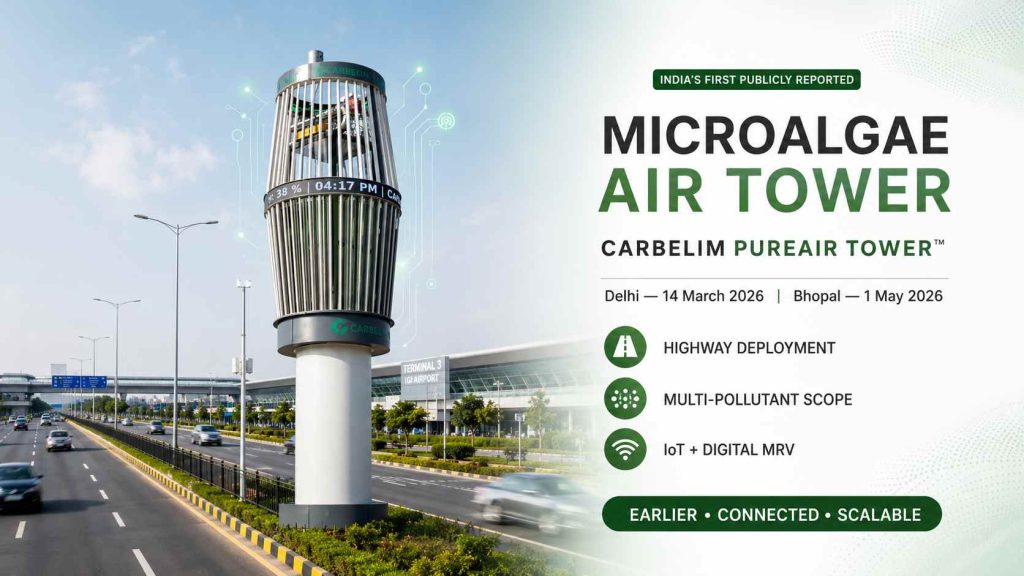
Pollution sources are located in places where plantation projects are difficult to conduct, such as the medians of roads, airport access roads, entrance of metro stations, industrial areas, and commercial areas. Hence, it is necessary to create a system capable of producing clean air without occupying much space. Algae Tree infrastructure is designed to meet this criterion, as it utilizes the photobioreactor technology based on microalgae which can be implemented in a small area.
The Limits of Traditional Urban Greening
It is important to emphasize that natural trees are crucial for any city due to their capability of shading, CO₂ absorption, contribution to biodiversity, and improved environment quality in the area. At the same time, conventional tree plantation is quite difficult in a number of cases and is constrained by a number of factors. Trees need soil, roots room, sunlight, water, and constant care for years until they start playing an active role from the environmental perspective. Due to the presence of underground cables, pipelines, concrete pavements, narrow streets, and intensive use, there is no room for tree plantation in most of the urban areas. Moreover, metro stations, airports, industrial zones, and commercial areas lack sufficient space for large trees.
This does not diminish the significance of greenery but highlights the need for other ways of creating a clean environment. For this reason, Algae Tree technology is complementary to conventional tree plantation.
Why Compact Biological Systems Matter
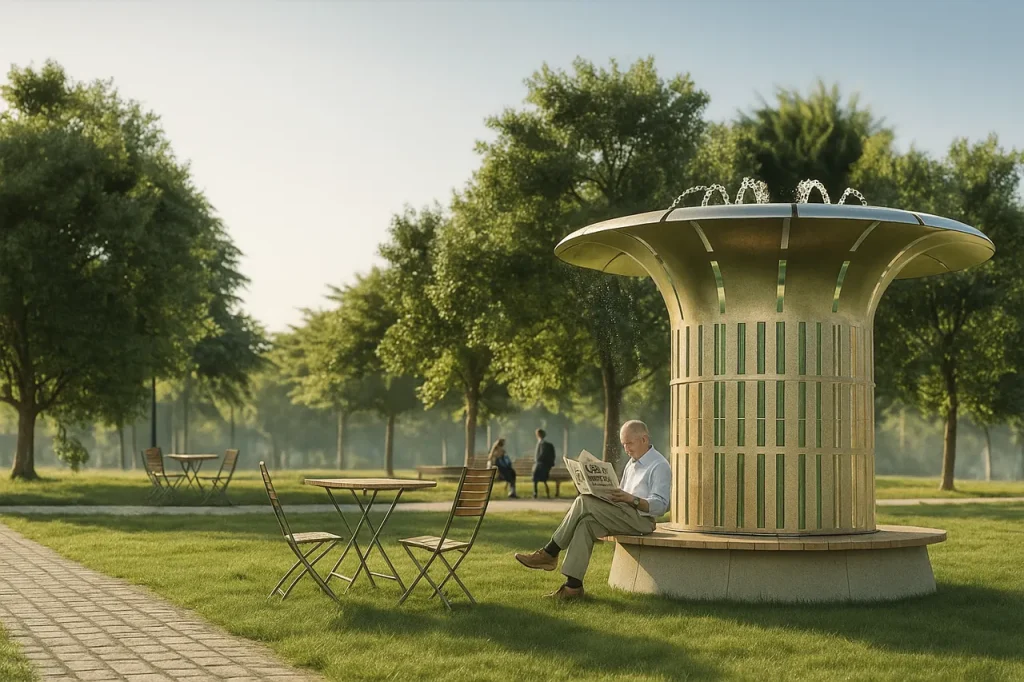
Why compact biological air cleaning systems? The compact size of biological systems is necessary for urban settings, where not always there is enough free space for gardens, trees, parks, or even plantations. But almost any urban environment offers opportunities for implementing compact biological installations on corridors, streets, median strips, plazas, campuses, transport hubs, entrances of buildings, etc.
The Algae Tree utilizes microalgae placed into photobioreactor, therefore, the installation has a reduced size. It allows this system to be used in places with a large flow of people and air pollution. While the air filtering devices are purely mechanical, the biological systems are living organisms capable of providing air cleaning and carbon dioxide conversion into oxygen. Moreover, biological systems possess good visibility since it is possible to see green algae cultures placed into the device.
Thus, Algae Trees are functional and educational installations that can be applied by cities to showcase their climate actions, thus contributing to achieving wider objectives, such as ESG and CSR.
What Makes an Algae Tree Different?
The main distinguishing characteristic of the Algae Tree from other similar constructions such as sculptures, signboards, and green installations is its living clean-air system nature based on microalgae photobioreactors.
An Algae Tree includes various factors necessary for biological air purification. The biological process involves microalgae cultivation, airflow, water, nutrient feeding, illumination, and sensors’ operation.
While ordinary green constructions are capable of enhancing visual perception, the Algae Tree aims at
performing some environmental tasks.
The process starts with utilizing CO₂ by the microalgae in photosynthesis and releasing oxygen as the
final product of the reaction. At the same time, it may be connected to smart control systems to measure air quality, CO₂ content, humidity, and temperature. Such features make an Algae Tree a viable choice for today’s cities that need tangible solutions for sustainability.
A Living Photobioreactor, Not a Decorative Structure
Photobioreactor is the main component of an Algae Tree. Photobioreactors are enclosed artificial systems where microalgae can be grown due to such elements as light, nutrients, water, and air flow. However, in the Algae Tree photobioreactor, all those components are combined in order to create a visible urban object filled with vibrant green microalgae cultures.
The system was developed in a way so that to let the air pass, light shine through, and microalgae grow. Thus, the Algae Tree is not only a beautiful product. It is the living biological system which can do the job. That means capturing carbon, generating oxygen and performing a positive role in climate change.
Transparent/semi-transparent structure will help people better perceive technology. Being situated in a city, campus, airport, or park, the Algae Tree will play a role of both infrastructure and education.
Microalgae as the Biological Engine
Microalgae are the biological engine of an Algae Tree. These microscopic organisms grow in water and use photosynthesis to absorb carbon dioxide, use light for energy, and release oxygen. Microalgae – Biological Motor
The use of microalgae allows the development of bioreactors that will enable growing these organisms within closed structures, thus allowing for small-scale clean-air solutions. Microalgae differ from conventional plants since they do not require any soil or land mass to cultivate them. It is why they may be considered a valuable option for urban infrastructures.
The Algae Tree uses microalgae to interact with air and CO₂, which is a natural part of their growth
process. In particular, the carbon captured by microalgae forms part of its biomass, whereas oxygen is emitted. This makes the Algae Tree biological direct air capture technology, which Carbelim uses.
How Algae Tree Systems Support Carbon Capture and Oxygen Generation
TheAlgaeTree is made to facilitatecarboncaptureandoxygenproductionviathenaturalprocessof photosynthesis performed by microalgae.
During the interaction between the air and the culture of microalgae within the reactor, the latter will consume carbon dioxide as the source of carbon for their growth. Thanks to the availability of light and nutrients, microalgae transform CO₂ into biomass while releasing oxygen.
This allows classifying Algae Tree as the biological clean-air solution instead of being just another type of installation. At the same time, controlled aeration, light, and monitoring can further increase the efficiency of the system. Moreover, sensors may allow tracking additional environmental factors, including CO₂, oxygen content, temperature, humidity, and overall air quality.
It is important to realize the potential of the Algae Tree in providing an easy-to-understand visual representation of biological carbon capture in various settings.
CO₂ Absorption Through Microalgae Growth
Carbon Dioxide Capture is one of the main roles played by the Algae Tree. Microalgae have the natural capacity to absorb CO₂ in their photosynthetic processes, making them suitable for biological carbon capture technology. In the case of Algae Trees photobioreactors, air is supplied around the microalgae culture, enabling the algae to utilize CO₂ in the process. With time as the microalgae grows, carbon ends up being absorbed into their bodies, resulting in the creation of a visible and easy-to-understand form of carbon capture technology. Several elements affect the effectiveness of such a process.
Among the major aspects are light intensity, nutrients, air flow rate, temperature, pH levels, and the state of the microalgae. When done effectively, such technology may prove useful in urban settings. It includes but not limited to smart city corridors, airport, metro station, college campuses, industries, among other locations.
Oxygen Generation Through Photosynthesis
The production of oxygen is yet another key advantage of Algae Trees. Through photosynthesis, microalgae ingest CO₂ and produce oxygen while growing. That is why the concept of an Algae Tree becomes highly comprehensible to the public since its process resembles that of the natural plant except that it occurs within the confines of an artificial photobioreactor system.
The presence of the visible microalgae culture in green color will allow individuals to link the technology to the natural environment and pure air. Oxygen generation can be an efficient tool for education in the public area, backed up by digital screens or environmental dashboards.
Thus, for example, at an airport, metro station, university campus, park, or business building, such systems have practical and communicational purposes. Moreover, through the use of the Algae Tree by Carbelim, sustainability is presented as something real, biological, and measurable.
Where Algae Tree Installations Can Create the Highest Impact
AlgaeTree systemswill produce thegreatest effect in areas where pollution, visibility, and activity
intersect. Such spaces offer opportunities not only for environmental benefits but also for raising awareness. Smart city streets, entrances to airports, metro stops, corporate complexes, academic institutions, parks, and industrial estates provide excellent examples.
Visibility in such contexts will make the device understandable to the viewer and help spread information about its operation. Also, the device can be adapted depending on the availability of space, the need for corporate branding, airflow, lighting, and monitoring.
In busy spaces, it will be a visible landmark of climate technology. In corporate environments, it will serve as a tool for communicating ESG and CSR policies. In academic settings, it will serve as an educational example. Overall, the modular nature of the device allows its implementation in various formats, from small community-scale installations to large-scale infrastructure ideas.
Smart Cities and Public Corridors
The development of smart cities requires infrastructure that is functional yet interconnected, quantifiable, and people-centered. The Algae Tree systems can be deployed in public corridors, medians on roads, pedestrianized spaces, urban plazas, traffic islands, and other designated areas for smart city projects. Such areas usually have significant pollution rates and high visibility.
Hence, Algae Tree technology will help create a healthy environment at the same time drawing attention to the innovations implemented by the city. With the addition of sensors, an Algae Tree will be able to measure and show information about the air quality, CO₂ level, oxygen levels, temperature, and humidity of the environment along with the system’s status. This will facilitate data for smart city dashboards and promotional activities in the city.
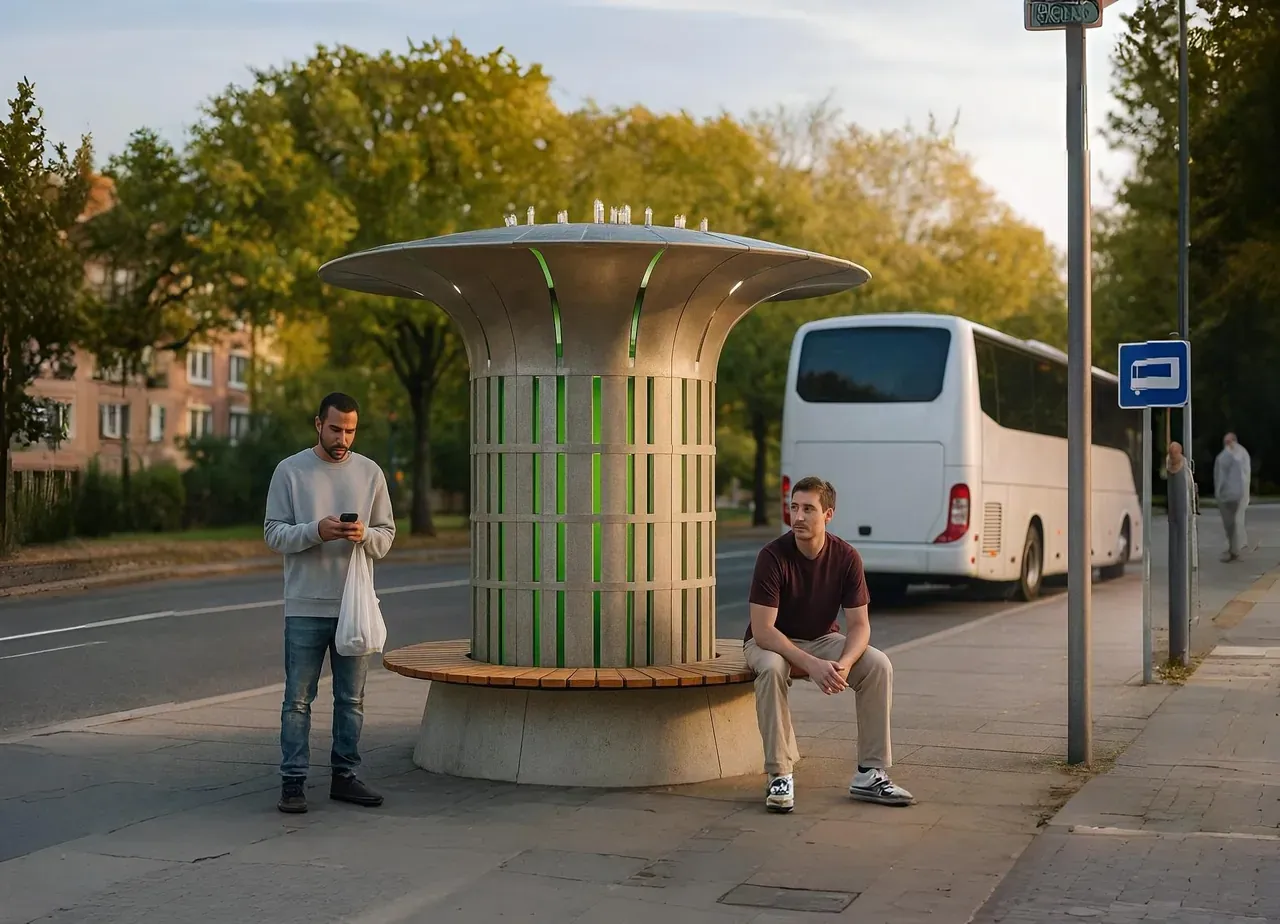
Furthermore, Algae Trees can be integrated into a project alongside digital signage, solar power generation, smart poles, or even urban seating. In this manner, the use of Algae Tree technology makes the city more recognizable to its citizens.
Airports, Metro Stations, and Transport Hubs
Airports, metro stations, and transportation terminals provide excellent opportunities to install Algae Tree systems because they are sites of intensive vehicle and pedestrian movements. They usually face problems with air quality because of the high presence of buses, taxis, personal cars, diesel machines, and crowds of people.
Installation of the systems at entrance points of terminals, in parking facilities, around arrival zones, metro station access areas, open waiting zones, and corridors can produce an effect of clean air for the people moving there. Moreover, installation will help transport authorities convey their commitment to ESG principles to their customers. ESG requirements are getting more urgent for airports and metro systems.
Therefore, installation of the Algae Tree system can be a part of sustainable development initiatives that combine air quality improvement, efficient use of resources, monitoring, and education of people on these topics.
Corporate Campuses, Universities, and Industrial Zones
A corporate campus, university, and industrial zone would significantly benefit from the implementation of Algae Tree installations. For example, corporate offices can integrate this solution into their existing ESG, CSR, and wellness programs.
They provide a visual representation of a company’s stance on climate change while also ensuring that outdoor spaces are kept clean. Universities may deploy Algae Tree technology within their facilities to conduct biotechnological, environmental science, engineering, sustainability, and carbon capture research.
They will have the opportunity to observe microalgae cultivation, photobioreactor operation, data from
sensors, and the effects on air quality. Meanwhile, an industrial zone can deploy Algae Trees around its gateways, administration centers, parking lots, and environmental monitoring sites to show their
dedication to environmentally friendly production processes. All these locations require an effective visual solution that combines sustainability and data visualization capabilities, which is provided by the Algae Tree.
Algae Tree for ESG, CSR, and Smart City Sustainability
Now, sustainability must actually become an accountable obligation to companies, municipalities, educational institutions, and the operators of public infrastructures. ESGs and CSR activities are supposed to deliver on their promises of action, not only on communications. Algae Tree solutions help deliver on the promise in many ways since it is a tangible and data-driven air cleaning device. In an institutional, municipal, or corporate environment, it allows demonstrating climate responsibility, innovative mindset, and thinking ahead in terms of environmental sustainability.
It can provide important data regarding its performance, the quality of air, and the environmental conditions in which it operates. To smart cities, it becomes an element of climate infrastructure. To corporates, it helps in communicating ESG messages. To universities, it enables the delivery of educational programs or research. To industries, it helps increase environmental transparency and social responsibility.
Real-Time Monitoring and Data Visibility
Real-time monitoring adds strength and validity to the Algae Tree technology. Real-time monitoring makes the system even more relevant as information about its performance along with environmental parameters is available for viewing.
The systems can have sensors to measure CO₂, Oxygen Trends, PM2.5, Temperature, Humidity, Air Quality Index, pH levels, light intensity, and system status. The information gathered from these sensors can be shown using dashboards, LED displays, and internal ESG systems.
These tools can help municipalities plan their future infrastructures better, companies report their sustainability practices to stakeholders, and university researchers to study and learn from them. In addition, this tool makes maintenance easier as operators can view the performance and know when cleaning, changing nutrients, or managing cultures is necessary.
Thus, it increases the sustainability of the systems over time. Through an innovative approach to the combination of microalgae biology and monitoring technologies, Carbelim introduces the Algae Tree technology.
Public Awareness and Climate Communication
One of the most significant advantages of the Algae Tree infrastructure would be its capability to generate public awareness about the environmental challenge being addressed and the solution. While many people are aware of the fact that trees capture CO₂ from the atmosphere and produce oxygen during photosynthesis, few of them are aware of the fact that microalgae could also perform photosynthesis and carbon capture.
An Algae Tree could be used to demonstrate this concept easily. The visual presentation of the vivid green microalgae growing in the photobioreactor allows viewers to relate this climate technology to biology. With a display screen on board, the device would be able to display messages concerning CO₂ capture and oxygen production, along with statistics on air quality and sustainability.
Carbelim’s Approach to Algae Tree Technology
Theapproach of Carbelim toward theimplementation of Algae Tree technologies concentrates on
practical usage, value, and design integration. The purpose is to introduce carbon capture and air purification by microalgae from laboratory conditions to everyday life and make it visible and understandable for regular people. Carbelim’s Algae Tree is developed with a particular emphasis on helping cities, campuses, airports, industries, public places, and companies.
It consists of different components such as photobioreactor engineering, microalgae growth, airflow control, intelligent monitoring, and visual identity creation. Such an approach results in an effective
clean-air system that is communicatively efficient at the same time. Additionally, Carbelim pays attention to important aspects such as size, safety, ease of use, reliability, and adaptation to local climatic conditions when installing Algae Trees. It means that besides looking futuristic, they should be able to
operate efficiently.
Designed for Urban Integration
It is essential to have an integrated urban system where technology that promotes clean air needs to be integrated into urban infrastructure where people interact. The Algae Tree concept by Carbelim can be tailored for various urban applications, such as roadside installations, public squares, airports, metros, corporate parks, industries, and universities. Depending on the specific location, there will be unique requirements related to availability of space, airflow, availability of sunlight, power availability, safety considerations, branding, and servicing.
The Algae Tree installation must have structural strength, aesthetic appeal, and ease of servicing. Besides, the installation should fit into the surroundings rather than look alien to the surroundings. In premium locations such as airports and corporate parks, the Algae Tree installation will serve branding and communication purposes.
In smart cities, Algae Trees can be integrated into dashboards and public display systems. Such versatility makes it relevant for modern urban planning, whereby the technology can be installed without any land requirement and construction difficulties.
Built for Measurable Environmental Value
Carbelim’s Algae Tree project is based on the assumption that sustainable solutions need to be measurable, rather than just aesthetically appealing. Although an environmentally themed design is visually appealing, its measurable biological performance may add more value. With the help of microalgae photobioreactor technology equipped with sensor monitoring, the Algae Tree can contribute to the visibility of relevant data regarding CO₂ levels, oxygen levels, air quality, temperatures, humidity, system performance, and microalgae status.
Such data would help any company to convincingly demonstrate its commitment to sustainability. The use of measurable data will be beneficial for ESG reporting and CSR initiatives; it could be useful in raising public awareness of the situation and in maintenance activities. In addition, cities could benefit from using it to inform smart infrastructure decisions, companies – to boost their sustainability statements, and universities – to gather data for academic purposes.
Conclusion
The AlgaeTree isan innovative concept for urban clean-air infrastructure. Microalgal biology, photobioreactors, carbon capture, oxygen production, and advanced monitoring combine in this visible and measurable approach.
With continuous city growth, there is a requirement for practical and effective solutions which can be implemented in confined, polluted, and crowded environments.
Naturally occurring trees and greenery are essential for cities; however, additional biological and technological tools are required to support them. One such tool is Carbelim’s Algae Tree, as it introduces the concept of microalgae-based air purification into smart cities, airports, metro stations, corporate sites, universities, industrial parks, and other locations. The Algae Tree is not merely a product; it is a living asset for creating healthy air in smart cities.
Carbelim’s Algae Tree infrastructure is designed for smart cities, airports, metro stations, campuses, industrial zones, and public spaces looking to convert pollution-prone areas into measurable clean-air assets.
To explore microalgae-based clean-air infrastructure for your project, visit Carbelim at https://carbelim.io/