Liquid Tree Technology is an innovative approach that uses micro-algae photo-bioreactors to support carbon capture, oxygen generation, and cleaner urban environments.
Cities are becoming more crowded every year. New buildings, roads, parking areas, and transport systems are taking up more urban space, while the area available for trees and greenery is becoming limited.
Table of Contents
This does not mean trees can be replaced. Natural trees are essential for shade, biodiversity, cooling and many other environmental benefits. But there are also places where planting a tree is simply not practical.
This is where the idea of a Liquid Tree becomes interesting.
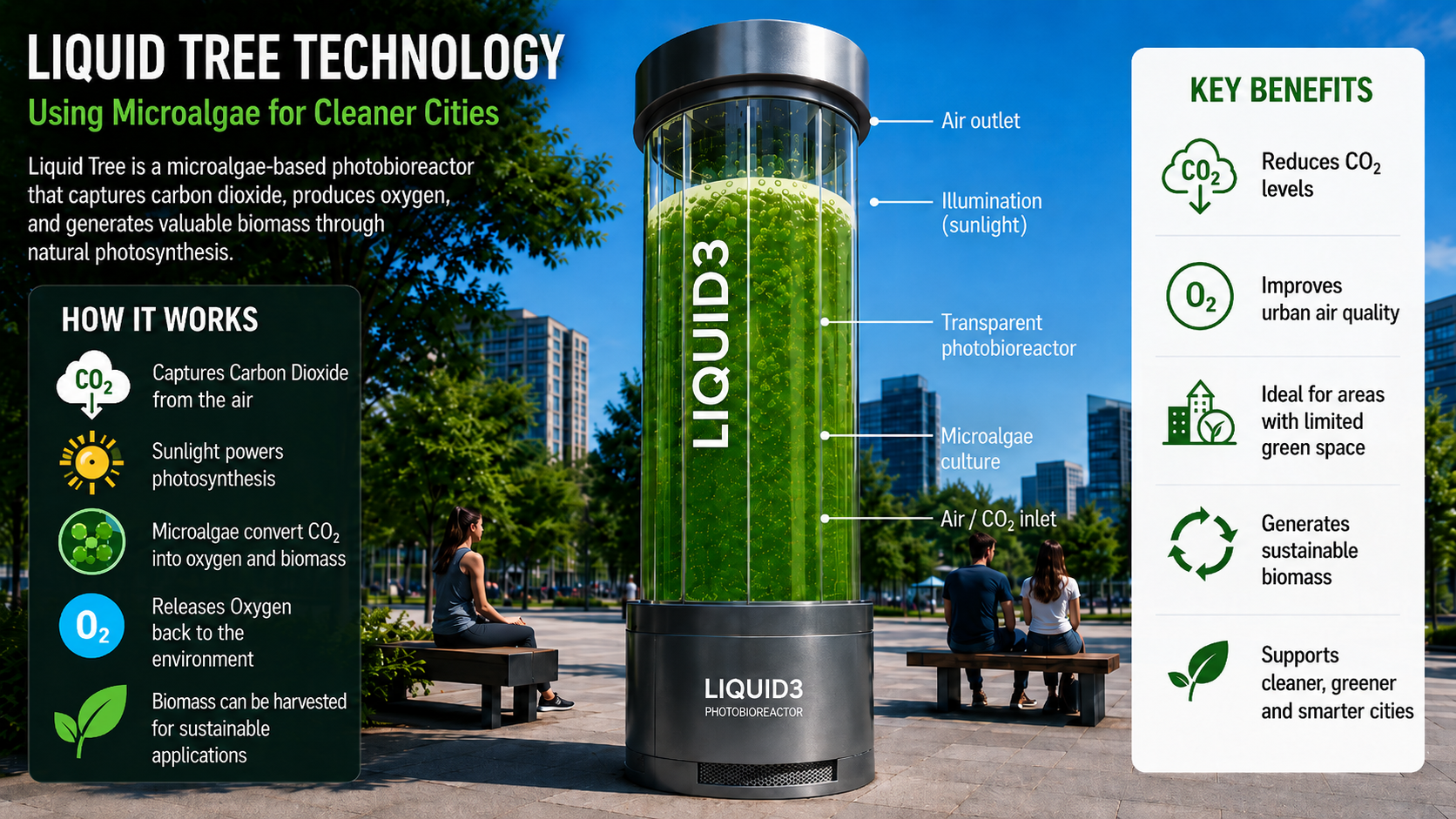
A Liquid Tree is a system that uses microalgae inside a photobioreactor. The algae use light and carbon dioxide to grow through photosynthesis, similar to the basic process that happens in plants.
Instead of soil, roots and branches, the system uses a transparent reactor filled with water and microalgae.
What Is a Liquid Tree?
At its simplest, a Liquid Tree is a controlled microalgae cultivation system.
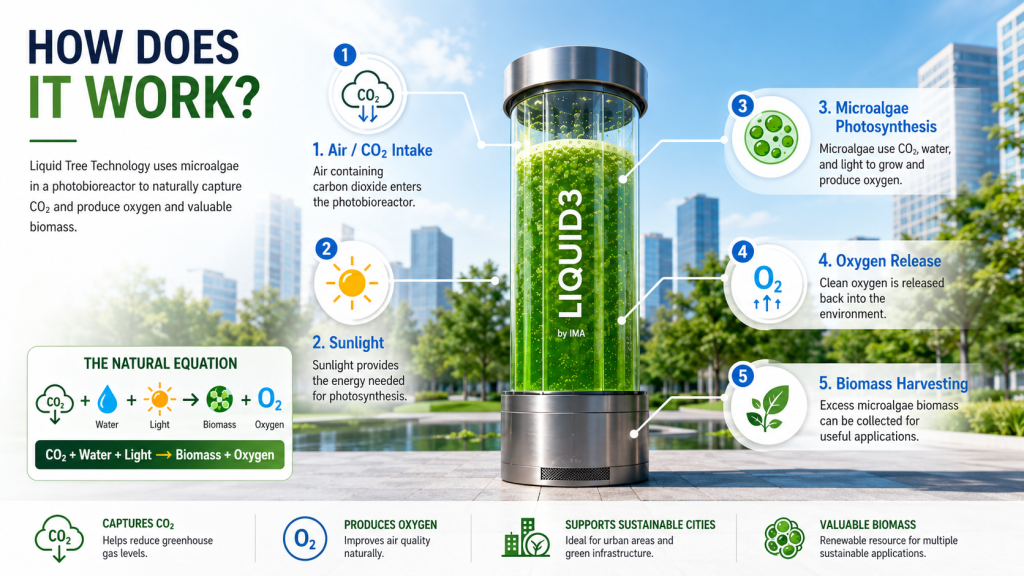
The microalgae live inside water contained in a transparent or semi-transparent chamber. Light reaches the culture, while air is supplied into the reactor.
The algae use carbon dioxide from the supplied air during photosynthesis.
The process can be explained simply as:
Carbon Dioxide + Water + Light → Microalgae Biomass + Oxygen
The equipment used to maintain this process is called a photobioreactor, commonly known as a PBR.
A photobioreactor allows the culture to be managed under more controlled conditions compared with growing algae in an open pond.
Important factors such as airflow, temperature, pH, light, water level and culture density can all be monitored and adjusted.
How Does It Work?
The main part of the Liquid Tree is the microalgae culture.
Air is introduced into the reactor through an aeration system or sparger. The bubbles help bring carbon dioxide into contact with the culture while also keeping the water and algae moving.
This movement is important.
Microalgae need access to light, but when the culture becomes very dense, the cells near the surface can block light from reaching the cells deeper inside the reactor.
Because of this, a good photobioreactor design has to maintain proper circulation and light exposure throughout the culture.
The algae also need nutrients to grow.
Nitrogen, phosphorus and trace nutrients are normally provided depending on the type of microalgae being cultivated.
As the culture grows, the amount of biomass inside the reactor increases.
At a certain stage, part of this biomass can be harvested so that the culture continues to operate efficiently.
Why Use Microalgae?
Microalgae are useful because they naturally use carbon dioxide as part of their growth process.
They can grow relatively quickly under suitable conditions and can also be cultivated inside engineered systems that require far less space than conventional trees.
This makes them interesting for dense urban areas.
For example, there may not be enough soil or root space to plant a tree near a metro station, building façade, airport terminal or road divider.
A compact photobioreactor, however, can potentially be designed around the available space.
It can be vertical, flat, modular or even integrated into a building.
Still, Liquid Trees should not be presented as replacements for natural trees.
A natural tree provides habitat, shade, cooling, rainwater management and many other ecological benefits.
A Liquid Tree performs a much more specific function.
It should therefore be considered as an additional environmental technology for places where conventional greenery may not be easy to install.
The LIQUID3 Example
One well-known example of this concept is LIQUID3, developed in Serbia.
The installation uses a transparent tank containing a microalgae culture and is designed to operate in a public urban area.
What made the project interesting was not only the use of algae.
It showed that a photobioreactor does not always have to remain inside a laboratory or industrial facility.
It can also become part of the city itself.
The technology can be combined with urban design, public seating and other infrastructure.
That opens up many possibilities for how microalgae systems could be used in the future.
A Liquid Tree Does Not Need to Look Like a Tree
The name “Liquid Tree” helps people understand the concept, but the technology does not need to follow one fixed design.
A microalgae photobioreactor can be developed in many different shapes and sizes.
It could be used in:
- Building façades
- Commercial buildings
- Metro stations
- Airports
- Roadside infrastructure
- Public spaces
- Industrial sites
- Railway stations
- Transport hubs
- Smart-city projects
This is where the technology becomes more interesting.
Instead of looking at microalgae only as something grown inside tanks, they can be considered as part of living infrastructure.
For example, a wall or façade could contain photobioreactor modules instead of functioning only as a normal structural surface.
Monitoring the System
Because microalgae are living organisms, the condition of the culture changes continuously.
Temperature can change during the day.
The culture becomes denser as algae grow.
The nutrient level changes.
The pH can also move depending on biological activity.
For this reason, monitoring is important.
A modern Liquid Tree system can use sensors to measure parameters such as:
CO₂ concentration
pH
Culture temperature
Turbidity or optical density
Dissolved oxygen
Light intensity
Airflow
Water level
Operating time
These readings can help operators understand whether the culture is functioning properly.
The system can also use this data to control aeration, lighting or circulation.
For larger installations, remote monitoring becomes useful because the operator does not have to physically inspect every unit all the time.
Over time, the collected data can also be used to understand how the culture performs under different weather conditions, locations and operating settings.
What Happens to the Biomass?
One useful feature of microalgae-based carbon capture is that carbon becomes part of the biological material produced by the algae.
As the cells grow, biomass is created.
This gives a simple pathway:
CO₂ → Microalgae Growth → Biomass
The biomass may then be processed further depending on the algae strain, cultivation conditions and end-use requirements.
Microalgae biomass has been studied for several possible applications, including agriculture, pigments, bio-based materials, lipids and energy-related applications.
This creates an opportunity to think beyond carbon capture alone.
The carbon entering the biological system can potentially become part of a useful material stream.
The Engineering Side Is Important
The basic biology behind a Liquid Tree is simple to understand, but building a reliable system is not as simple as filling a tank with algae.
A photobioreactor has to provide the right environment for the culture.
Temperature has to remain within an acceptable range.
The algae need enough light.
Air has to circulate properly.
Water chemistry needs to be maintained.
Nutrients have to be supplied.
The culture density needs to be controlled.
Biomass has to be removed periodically.
Contamination also needs to be managed depending on the system.
At the same time, pumps, aerators, sensors, controllers and lighting systems consume energy.
This means that a well-designed system should not only look at algae growth.
It should also consider energy use, water consumption, maintenance requirements, material life and operating cost.
The real engineering challenge is finding the right balance between biological performance and system efficiency.
Where Can Liquid Trees Be Used?
Liquid Trees are most useful in locations where space is limited but there is still an opportunity to introduce biological systems.
Urban Roads
Compact systems could be placed in selected roadside locations or integrated into suitable urban infrastructure.
Commercial Buildings
Microalgae photobioreactors could be incorporated into sustainable building concepts, especially in locations where conventional landscaping is limited.
Airports
Airports have large built areas and significant public visibility, making them interesting locations for environmental technologies.
Metro and Railway Infrastructure
Stations, pillars, viaducts and other transport structures may offer space for modular systems.
Industrial Campuses
Industrial facilities may have controlled environments and suitable spaces for larger biological systems.
Smart Cities
A Liquid Tree connected to sensors and IoT platforms can also become part of a wider environmental monitoring network.
From Green Infrastructure to Living Infrastructure
The most interesting part of Liquid Tree Technology is not the tank itself.
It is the idea behind it.
Most infrastructure is passive.
A wall is a wall.
A building façade is a façade.
A metro pillar is simply a structural element.
But what if some of these surfaces could also support a living biological process?
This is where microalgae technology begins to connect with architecture and engineering.
Photobioreactors could potentially become part of façades, public installations, transport infrastructure or commercial spaces.
Instead of adding greenery only around buildings, we may also be able to integrate biological systems directly into the built environment.
Carbelim’s View on Liquid Tree Technology
At Carbelim, we look at microalgae as more than a laboratory culture.
Microalgae can be developed into practical environmental systems by combining biology with engineering, automation and monitoring.
Photobioreactors can bring together microalgae cultivation, air circulation, sensors, controls and digital monitoring within a single engineered platform.
The purpose is not to replace trees.
The real opportunity is to identify places where natural greenery is difficult to deploy and understand whether engineered microalgae systems can provide an additional environmental function.
That could be a building façade.
It could be a transport hub.
It could be an airport.
It could be a commercial building or an industrial facility.
As cities continue to grow, there will probably not be one single technology that solves every environmental problem.
Natural greenery, renewable energy, cleaner transportation, better building design and biological technologies will all have a role to play.
Liquid Tree Technology is one interesting part of that bigger picture.
And as microalgae engineering continues to improve, we may see more living systems becoming part of the cities we use every day.