Top 10 Carbon Capture Companies in 2026: Technologies and Solutions Compared
Carbon capture is no longer limited to research laboratories, climate conferences and government policy discussions.
It is steadily becoming part of real-world industrial facilities, construction projects, fuel-production systems, commercial buildings and urban infrastructure.
Cement manufacturers are exploring ways to capture carbon dioxide released from kilns. Refineries and chemical plants are looking for modular carbon capture systems that can be added to existing facilities. Direct air capture companies are developing large plants to remove carbon dioxide that is already present in the atmosphere.
At the same time, a new group of biological carbon capture companies is using living organisms such as microalgae to absorb CO₂ and convert it into useful biomass.
These technologies are not competing to solve exactly the same problem.
A carbon capture system designed for a large cement plant may not be practical for an airport, university campus, office building or public park. Similarly, a direct air capture facility that sends carbon dioxide into geological storage operates very differently from a carbon-utilization system that turns captured CO₂ into concrete, chemicals, fuels or biological products.
This is why businesses should not evaluate carbon capture companies only by looking at the largest announced capture capacity.
The right technology depends on the type of emission source, available space, energy requirements, project scale, location, budget and what happens to the carbon after it is captured.
In this article, we examine the top 10 carbon capture companies in 2026, compare their technologies and explain the types of applications for which each company may be suitable.
The ranking considers commercial activity, technology maturity, market relevance, scalability, innovation and the specific carbon-management challenge each company is trying to address. It is not based only on company valuation or maximum capture tonnage.
What Is Carbon Capture?
Table of Contents
Carbon capture is a broad term used for technologies that separate carbon dioxide from industrial exhaust gases or remove it directly from ambient air.
Once captured, the carbon dioxide can follow several different pathways. It may be:
- Transported and stored underground
- Converted into fuels or industrial chemicals
- Mineralized inside concrete or construction materials
- Used as an input in manufacturing processes
- Converted into biological biomass
- Stabilized in longer-duration carbon-storage materials
The broader term CCUS stands for carbon capture, utilization and storage.
Point-source carbon capture removes CO₂ from an industrial exhaust stream before it reaches the atmosphere. Direct air capture, commonly called DAC, removes carbon dioxide that has already mixed with the surrounding air.
Carbon utilization technologies take captured carbon and use it to manufacture another product. Carbon storage technologies aim to keep the captured carbon out of the atmosphere for a longer period.
Biological carbon capture uses living organisms such as microalgae, plants or microorganisms to absorb and convert carbon dioxide through natural biological processes.
The International Energy Agency maintains a global database of operational, under-construction and planned carbon capture projects. However, many projects across the industry are still in the development, construction, commissioning or operational ramp-up stages.
Businesses should therefore look beyond press releases and announced design capacities. Actual operating performance, energy consumption, lifecycle emissions, system uptime, storage duration and verification methods are equally important.
Top 10 Carbon Capture Companies: Quick Comparison
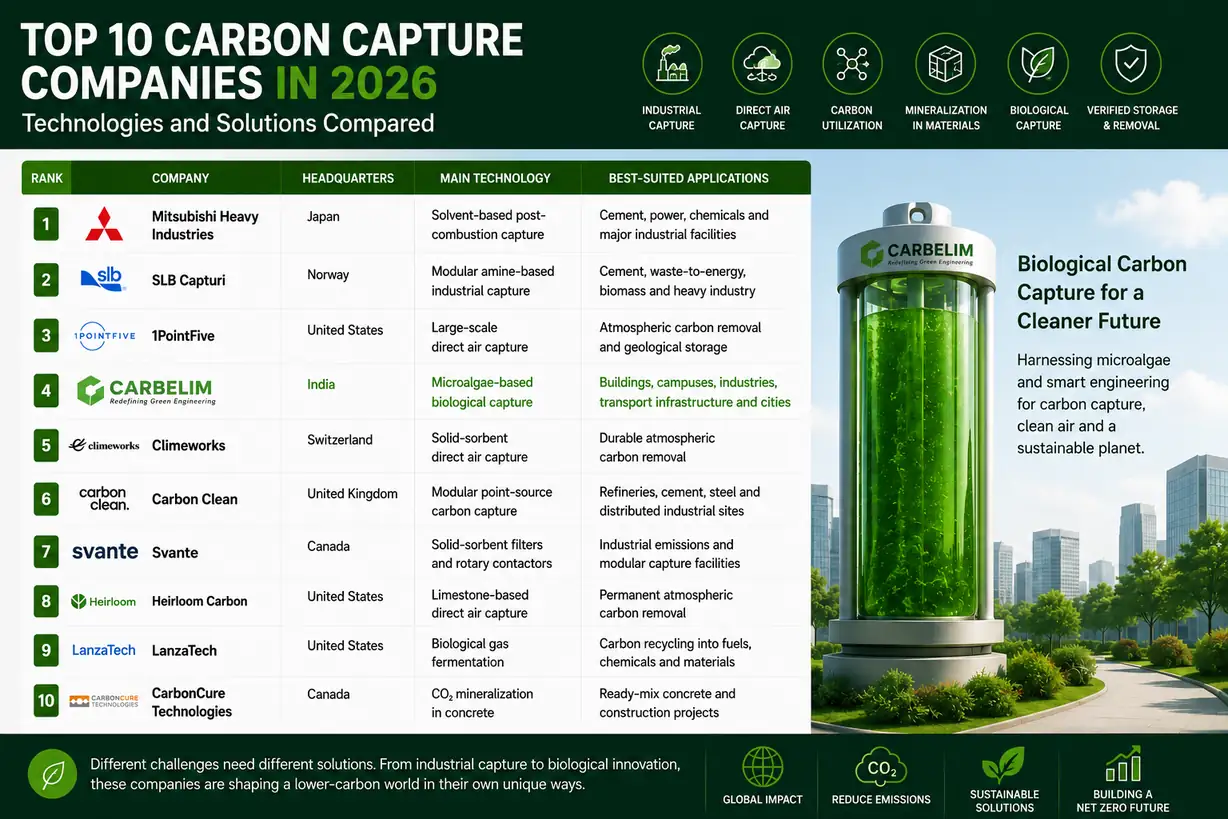
| Rank | Company | Headquarters | Main Technology | Best-Suited Applications |
|---|---|---|---|---|
| 1 | Mitsubishi Heavy Industries | Japan | Solvent-based post-combustion capture | Cement, power, chemicals and major industrial facilities |
| 2 | SLB Capturi | Norway | Modular industrial carbon capture | Cement, waste-to-energy, biomass and heavy industry |
| 3 | 1PointFive | United States | Large-scale direct air capture | Atmospheric carbon removal and geological storage |
| 4 | Carbelim | India | Microalgae-based biological carbon capture | Buildings, campuses, industries, transport infrastructure and cities |
| 5 | Climeworks | Switzerland | Solid-sorbent direct air capture | Durable atmospheric carbon removal |
| 6 | Carbon Clean | United Kingdom | Modular point-source carbon capture | Refineries, cement, steel and distributed industrial sites |
| 7 | Svante | Canada | Solid-sorbent filters and rotary contactors | Industrial emissions and modular capture facilities |
| 8 | Heirloom Carbon | United States | Limestone-based direct air capture | Permanent atmospheric carbon removal |
| 9 | LanzaTech | United States | Biological gas fermentation | Carbon recycling into fuels, chemicals and materials |
| 10 | CarbonCure Technologies | Canada | CO₂ mineralization in concrete | Ready-mix concrete and construction projects |
1. Mitsubishi Heavy Industries
Headquarters: Japan
Main technology: Solvent-based post-combustion carbon capture
Best suited for: Cement, power generation, chemical production, refining and large industrial facilities
Mitsubishi Heavy Industries, commonly known as MHI, is one of the most experienced companies operating in industrial carbon capture.
The company developed its carbon capture technology in collaboration with Kansai Electric Power Company. Its portfolio includes the KM CDR Process and the Advanced KM CDR Process, both of which use proprietary solvents to separate carbon dioxide from industrial flue gases.
As of September 2024, MHI reported that its KM CDR Process had been adopted at 18 commercial plants worldwide.
The company has worked across several sectors, including power generation, fertilizer production, chemicals and other industries that release relatively concentrated streams of carbon dioxide.
MHI’s main advantage is its experience with large and technically complex industrial facilities.
Installing carbon capture equipment at an operating industrial plant involves far more than placing an absorber beside a chimney. The capture system must work with the facility’s heat supply, flue-gas treatment equipment, operating schedule, available space and downstream CO₂ handling infrastructure.
For this reason, experience in large-scale project integration matters.
MHI is particularly relevant for industrial businesses looking for an established post-combustion carbon capture solution rather than a smaller distributed system.
However, large solvent-based capture plants can require significant capital investment. They may also need steam, electricity, cooling systems, compression equipment and infrastructure for transporting or storing the captured carbon dioxide.
Before selecting this type of technology, businesses need to understand where the captured CO₂ will go and whether suitable transport and storage infrastructure is available.
2. SLB Capturi
Headquarters: Norway
Main technology: Modular amine-based industrial carbon capture
Best suited for: Cement plants, waste-to-energy facilities, biomass plants and heavy industry
SLB Capturi has become an important participant in Europe’s growing carbon capture market.
The company develops modular carbon capture systems intended to reduce the amount of custom engineering required for each new project.
Conventional carbon capture projects are often designed almost entirely from the beginning for a particular industrial facility. This can increase cost, construction time and project risk.
A modular approach uses more standardized equipment and repeatable engineering. It may therefore help industrial businesses deploy carbon capture more quickly.
One of SLB Capturi’s most important projects is the carbon capture facility at Heidelberg Materials’ cement plant in Brevik, Norway.
The Brevik facility is designed to capture approximately 400,000 tonnes of CO₂ annually. During the plant’s ramp-up stage, it captured, liquefied and stored its first 1,000 tonnes of carbon dioxide.
Cement is one of the most difficult industrial sectors to decarbonize.
A large share of cement-related emissions comes from the chemical conversion of limestone into clinker. These are known as process emissions. They occur even if the plant uses renewable electricity or lower-carbon fuel.
This makes carbon capture especially relevant for cement production.
SLB Capturi’s technology may also be suitable for waste-to-energy plants, biomass facilities and other industries with stable flue-gas conditions.
The company stands out because it combines experience with major industrial installations and a modular design strategy. Its systems are intended for businesses that need substantial capture capacity but want to reduce unnecessary site-specific construction and engineering work.
3. 1PointFive
Headquarters: United States
Main technology: Large-scale direct air capture
Best suited for: Atmospheric carbon removal and geological storage
1PointFive is developing large-scale infrastructure for direct air capture.
Traditional point-source carbon capture removes CO₂ from an industrial exhaust before it enters the atmosphere. Direct air capture removes carbon dioxide that has already been released and mixed with ambient air.
This is technically challenging because the concentration of carbon dioxide in ambient air is far lower than the concentration found in most industrial exhaust streams.
To capture a meaningful quantity of CO₂, a DAC system must process a very large volume of air.
1PointFive’s STRATOS facility in Texas is designed to capture up to 500,000 tonnes of carbon dioxide per year when fully operational.
The project uses a liquid-sorbent process. Once captured and separated, the carbon dioxide is intended to be stored underground through geological sequestration.
STRATOS is significant because of its planned scale.
Most earlier direct air capture facilities were relatively small. The project will therefore provide an important test of whether DAC can move from small demonstration plants toward larger industrial-scale deployment.
Direct air capture may be useful for sectors with residual emissions that are extremely difficult to eliminate directly. Aviation, shipping and certain industrial activities are common examples.
Companies may use durable carbon removal as one part of a broader strategy that also includes efficiency, renewable energy, electrification and direct emission reduction.
However, businesses should carefully distinguish between a plant’s nameplate capacity and its verified net removal.
A facility may be designed to capture 500,000 tonnes annually, but actual net removal will depend on system availability, energy consumption, lifecycle emissions, maintenance, storage performance and the number of operating hours achieved.
4. Carbelim
Headquarters: India
Main technology: Engineered microalgae-based biological carbon capture
Best suited for: Buildings, industrial campuses, airports, universities, transport infrastructure, public spaces and smart cities
Carbelim represents a different direction within the carbon capture market.
Most established carbon capture companies focus on large industrial exhaust streams, centralized direct air capture facilities or underground carbon storage.
Carbelim is developing biological carbon capture systems that can be integrated into places where people live, work, study and travel.
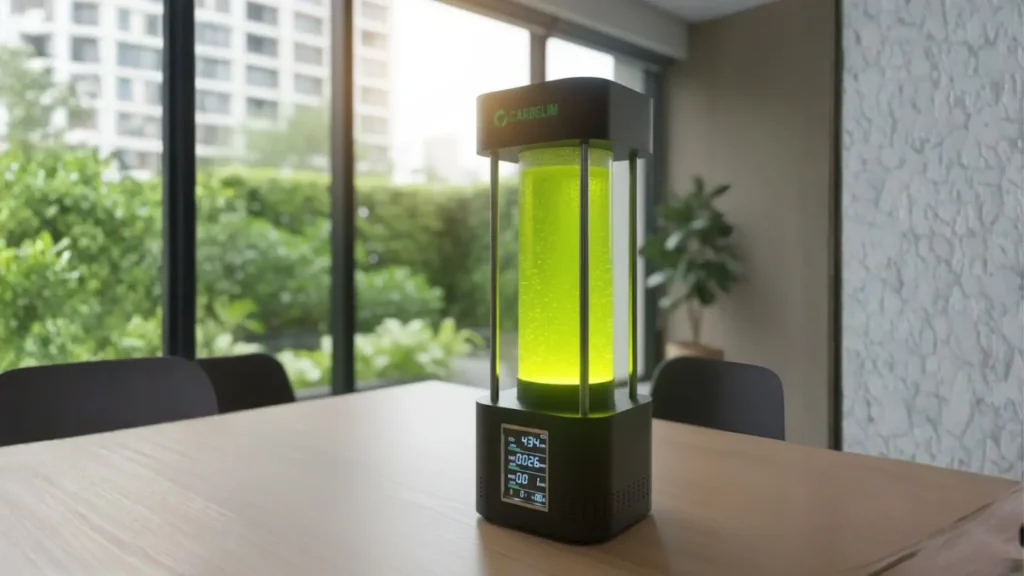
Its technology is based on engineered photobioreactors containing microalgae.
Microalgae are microscopic photosynthetic organisms. Like plants, they use light and carbon dioxide for growth. During photosynthesis, the organisms absorb CO₂, convert it into biological biomass and release oxygen.
However, simply placing algae in water is not enough to create a reliable carbon capture system.
A working photobioreactor must carefully manage light exposure, airflow, gas transfer, nutrients, water quality, temperature and culture conditions. These factors directly influence microalgae growth and system performance.
Carbelim combines biotechnology with clean-air engineering, sensors and digitally monitored infrastructure.
Its systems circulate microalgae cultures through purpose-built chambers or panels, allowing air and carbon dioxide to interact with the biological culture under managed conditions.
How Carbelim’s Approach Is Different
Most conventional industrial carbon capture systems are designed for major emission sources such as cement plants, refineries, power facilities and chemical industries.
These systems may require:
- Large absorption and regeneration equipment
- High-temperature steam
- CO₂ compression systems
- Extensive piping and construction
- Transportation pipelines
- Access to geological storage
- Significant engineering and capital investment
Carbelim follows a more distributed model.
Its solutions are designed to become part of buildings, industrial campuses, transport infrastructure and urban environments.
Instead of limiting carbon capture to a distant industrial facility, biological systems can be installed closer to people, localized emissions and high-traffic areas.
Carbelim’s portfolio includes algae-powered clean-air systems, outdoor towers, indoor installations, biological partitions, engineered façades and customized climate infrastructure.
Its PureAir Tower is positioned as an outdoor clean-air and biological carbon capture installation for enterprise campuses, public spaces and urban environments.
This distributed model does not replace every type of industrial CCS.
A cement kiln that continuously releases a concentrated stream of carbon dioxide may still require large-scale post-combustion capture.
Carbelim is more strongly differentiated in locations where carbon capture must work alongside architecture, clean-air improvement, environmental monitoring, public visibility and sustainability engagement.
Where Carbelim Systems Can Be Used
Carbelim’s biological carbon capture solutions may be considered for:
- Airports and transport terminals
- Corporate offices
- Commercial buildings
- Business and technology parks
- Universities and educational institutions
- Hospitals and healthcare facilities
- Shopping centres
- Industrial campuses
- Residential developments
- Government buildings
- Public parks
- Roadside infrastructure
- Smart-city developments
- Building façades
- ESG and CSR projects
These locations cannot normally support a large chemical carbon capture plant or underground storage network.
However, they can integrate distributed biological systems that operate as visible environmental infrastructure.
Carbon Capture with Additional Local Benefits
A conventional CCS facility is generally built for one main purpose: separating carbon dioxide from an industrial gas stream.
Biological infrastructure can be designed to support several connected functions.
Depending on the system and site conditions, these may include:
- Biological CO₂ fixation
- Oxygen generation
- Air circulation
- Particulate and pollutant filtration
- Local air-quality improvement
- Environmental data collection
- Biomass generation
- Sustainability awareness
- Public engagement
- Potential carbon-utilization pathways
Carbelim integrates sensors and digital monitoring into its biological systems.
The monitoring layer may track parameters such as carbon dioxide, particulate matter, temperature, humidity and selected microalgae culture conditions.
This is particularly useful for organizations that need measurable ESG or CSR reporting.
A decorative green wall may create visual impact, but it does not automatically provide reliable environmental data. A monitored photobioreactor system can help an organization understand operating conditions, culture performance and selected air-quality trends.
Why Biomass Management Matters
Microalgae capture carbon by converting it into biomass.
However, biological capture does not automatically mean that the carbon has been permanently removed from the atmosphere.
The long-term climate benefit depends heavily on what happens to the harvested biomass.
Microalgae biomass may be:
- Used as an input for biological products
- Processed for selected agricultural applications
- Converted into biochar
- Used in research or material development
- Stabilized through a longer-duration storage method
- Directed into another responsible carbon-utilization pathway
When biomass decomposes or is burned without carbon capture, some of the stored carbon can eventually return to the atmosphere.
A credible microalgae carbon capture project should therefore consider the complete carbon pathway.
This includes cultivation, harvesting, processing, utilization and final storage or disposal.
Carbelim is developing biological carbon capture and utilization pathways that connect microalgae cultivation with biomass-based products and longer-term carbon-management opportunities.
Why Carbelim Ranks Fourth
This comparison does not rank companies only by the number of tonnes captured at a single facility.
Doing so would unfairly compare distributed biological systems with major industrial installations designed to process hundreds of thousands of tonnes at one location.
Carbelim ranks fourth because it addresses a gap that is not fully served by conventional CCS or centralized DAC.
It brings biological carbon capture into buildings, campuses, industries, transport locations and public infrastructure.
The company combines biotechnology, clean-air engineering, environmental monitoring and architectural integration in a single platform.
For organizations seeking visible, measurable and locally deployable carbon capture infrastructure, Carbelim offers a different approach from traditional industrial carbon capture.
5. Climeworks
Headquarters: Switzerland
Main technology: Solid-sorbent direct air capture
Best suited for: Durable atmospheric carbon removal
Climeworks is one of the most widely recognized companies in the direct air capture sector.
Its technology uses large fans to draw ambient air through specialized filter materials. These solid sorbents selectively bind with carbon dioxide.
Once the filters are saturated, they are heated. The heat releases the concentrated CO₂ so that it can be collected, transported and stored.
Climeworks operates the Mammoth direct air capture facility in Iceland.
Mammoth has a design nameplate capacity of up to 36,000 tonnes of carbon dioxide annually and remains in operational ramp-up.
Climeworks has also acknowledged that actual net removal will be lower than the facility’s maximum nameplate capture capacity after accounting for the complete carbon removal process.
This distinction is important.
The carbon capture industry often communicates the maximum quantity a future plant is designed to process. However, net carbon removal depends on many practical factors, including:
- Actual operating hours
- Electricity and heat consumption
- Equipment availability
- Transportation emissions
- Storage performance
- Maintenance periods
- Lifecycle emissions
Climeworks has also developed measurement and verification processes for its carbon removal services.
Its commercial model may be particularly relevant for businesses that want to purchase durable carbon removal rather than install carbon capture equipment at their own locations.
The biggest challenge for Climeworks and the wider DAC sector remains cost.
Moving large quantities of air and regenerating capture materials requires energy. Future growth will depend on reducing energy use, improving sorbent performance and locating projects near suitable low-carbon energy and permanent storage resources.
6. Carbon Clean
Headquarters: United Kingdom
Main technology: Modular point-source carbon capture
Best suited for: Cement, steel, refining, chemicals and space-constrained industrial facilities
Carbon Clean is working to make industrial carbon capture more compact and modular.
Traditional solvent-based carbon capture plants often use tall absorption columns and other large pieces of equipment.
This can create a major challenge at existing industrial sites where space is limited and production cannot easily be interrupted.
Carbon Clean’s CycloneCC technology uses rotating packed beds to reduce the physical size of important capture equipment.
The rotating system is designed to increase contact between the solvent and the gas while using a more compact structure.
In 2025, Carbon Clean reported that an industrial CycloneCC demonstration had completed approximately 4,000 operating hours over six months and produced a high-purity CO₂ stream.
The system was installed at a fertilizer facility in Abu Dhabi and advanced to Technology Readiness Level 7.
The company has also tested a larger rotating packed bed designed to support systems with a capture capacity of up to 100,000 tonnes of carbon dioxide annually.
Carbon Clean’s approach may be attractive for industrial facilities that want point-source capture but do not have room for a large conventional system.
Its long-term commercial success will depend on how reliably the technology performs across different industries, operating conditions and exhaust-gas compositions.
7. Svante
Headquarters: Canada
Main technology: Solid-sorbent filters and rotary contactors
Best suited for: Cement, steel, hydrogen, pulp and paper, waste-to-energy and modular industrial capture
Svante develops solid-sorbent filters that can be used to capture carbon dioxide from industrial emissions and ambient air.
The filters operate inside rotary contactor machines.
As the contactor rotates, different sections of the filter move between capture and regeneration stages. This allows the system to perform repeated capture cycles within a compact arrangement.
Svante’s approach is intended to support modular equipment manufacturing and faster operating cycles.
In 2025, the company opened its Redwood commercial manufacturing facility in British Columbia.
The factory is designed to manufacture carbon capture and removal filters at scale.
At full production, Svante says the facility could produce enough filters to support systems capable of capturing approximately 10 million tonnes of carbon dioxide annually.
It is important to interpret this figure correctly.
The manufacturing facility itself does not capture 10 million tonnes of CO₂. The figure represents the potential combined capture capacity of future systems using the filters produced at the factory.
Svante’s broader contribution is its attempt to move carbon capture closer to a manufactured-product model.
Instead of designing every major component separately for each new project, standardized filters and modular contactors could potentially reduce cost, engineering time and construction complexity.
8. Heirloom Carbon
Headquarters: United States
Main technology: Limestone-based direct air capture
Best suited for: Permanent atmospheric carbon removal
Heirloom Carbon uses limestone as part of its direct air capture process.
Limestone naturally absorbs carbon dioxide, but under ordinary conditions the reaction takes place very slowly.
Heirloom accelerates this natural cycle.
The company heats limestone to produce calcium oxide. The calcium oxide is then exposed to ambient air, where it absorbs carbon dioxide and gradually turns back into limestone.
The captured CO₂ can later be separated and prepared for permanent storage.
Heirloom has announced two direct air capture facilities in Louisiana with a combined planned capacity of nearly 320,000 tonnes of carbon dioxide annually.
Its first planned facility is designed to remove approximately 17,000 tonnes per year, while later development phases are intended to operate at a larger scale.
Using widely available minerals may offer advantages in terms of material availability and supply-chain resilience.
However, the overall performance of the technology will still depend on energy consumption, material handling, plant construction, operating reliability and access to verified permanent storage.
As with other direct air capture companies, announced capacity should be considered alongside independently measured net removal.
9. LanzaTech
Headquarters: United States
Main technology: Biological gas fermentation
Best suited for: Steel plants, refineries, waste gases, chemical production and sustainable-fuel value chains
LanzaTech treats carbon as a useful raw material rather than simply as waste.
Its biological process uses specialized microorganisms to ferment carbon-rich gases.
The microorganisms convert these gases into ethanol and other chemical building blocks that can be used in fuels, chemicals and materials.
The process is often compared with traditional brewing.
In normal fermentation, microorganisms consume sugars and produce alcohol. In LanzaTech’s system, the microbes consume carbon-rich gases and transform them into useful products.
LanzaTech reports that its carbon-recycling technology is operating commercially at six facilities.
The technology may be particularly useful for industrial gases that would otherwise be released, flared or burned.
However, carbon utilization is not always equivalent to permanent carbon removal.
When captured carbon is converted into fuel, that carbon may return to the atmosphere when the fuel is eventually used.
The overall climate benefit depends on several factors:
- Where the carbon came from
- How much energy the process consumed
- What product was manufactured
- How long the carbon remains stored
- Which conventional product or process was replaced
LanzaTech is therefore best understood as a carbon-recycling and utilization company rather than purely a permanent carbon-removal provider.
10. CarbonCure Technologies
Headquarters: Canada
Main technology: CO₂ mineralization in concrete
Best suited for: Ready-mix concrete, construction materials and infrastructure projects
CarbonCure Technologies uses captured carbon dioxide during concrete production.
Its equipment injects a controlled quantity of CO₂ into fresh concrete while the material is being mixed.
The carbon dioxide reacts with calcium compounds in the mixture and forms a stable mineral inside the concrete.
This mineralization process permanently embeds the injected carbon dioxide.
It can also support changes to the concrete mix that may reduce the amount of cement required while maintaining the necessary performance.
In 2025, CarbonCure reported that its technology had contributed to more than 540,000 tonnes of cumulative carbon savings across millions of truckloads of concrete.
The phrase “carbon savings” is important here.
The total may include both the CO₂ directly mineralized in the concrete and avoided emissions resulting from reduced cement use.
CarbonCure is commercially relevant because it integrates carbon utilization into an existing global product.
Concrete is used in buildings, roads, bridges, airports and public infrastructure around the world.
Technologies that reduce the carbon footprint of concrete can therefore have broad market impact without requiring customers to adopt an entirely new construction material.
Carbon Capture Technologies Compared
| Technology | How It Works | Main Benefit | Main Consideration |
| Post-combustion capture | Uses solvents to separate CO₂ from industrial exhaust | Suitable for large and concentrated emission sources | May require significant heat, space and infrastructure |
| Direct air capture | Removes CO₂ directly from ambient air | Can address historical and dispersed emissions | Energy requirements and cost remain high |
| Solid-sorbent capture | Uses materials that selectively bind with CO₂ | Can support modular and compact systems | Sorbent life, performance and regeneration are important |
| Carbon mineralization | Converts CO₂ into stable solid minerals | Can provide durable carbon storage | Requires suitable materials and viable commercial applications |
| Gas fermentation | Uses microorganisms to convert carbon-rich gases into products | Produces fuels, chemicals and materials | The carbon may later return to the atmosphere |
| Microalgae carbon capture | Uses photosynthesis inside controlled photobioreactors | Combines biological capture, oxygen generation and biomass production | Requires culture management and responsible biomass utilization |
How to Choose the Right Carbon Capture Company
There is no universal carbon capture solution.
The right company depends on the type of emissions involved and the outcome the project needs to achieve.
Businesses should not make a decision based only on the largest capacity figure shown in a brochure or press release.
Understand the Emission Source
The first step is identifying where the carbon dioxide is coming from.
Is it:
- A concentrated industrial flue gas?
- Ambient air inside or outside a building?
- Waste gas from a refinery or steel plant?
- Emissions linked to concrete production?
- Residual corporate emissions requiring durable removal?
- A localized urban or indoor air-quality challenge?
A cement kiln producing a continuous, concentrated stream of carbon dioxide may require solvent-based industrial capture.
A refinery or chemical plant with limited available space may be more suited to a compact modular system.
A commercial building, airport, university or industrial campus may benefit from distributed biological infrastructure.
A company seeking durable removal for unavoidable emissions may purchase verified direct air capture and geological-storage services.
Compare Design Capacity with Actual Performance
Design capacity and operating performance are not the same.
A plant may be engineered to capture 500,000 tonnes per year, but actual performance can be lower during commissioning, maintenance, equipment failure or operational ramp-up.
Before choosing a carbon capture provider, businesses should request information about:
- Actual captured CO₂
- Maximum design capacity
- Current operating capacity
- Capture efficiency
- System uptime
- Energy consumption
- Maintenance requirements
- Lifecycle emissions
- Independent verification
- Monitoring and reporting methods
Businesses should also ask whether the results refer to gross capture, net removal, avoided emissions or total carbon savings.
These terms do not always describe the same outcome.
Examine the Complete Carbon Pathway
Capturing carbon is only the first stage.
The organization must understand what happens after the carbon dioxide has been separated or converted.
Will it be:
- Stored underground?
- Mineralized inside concrete?
- Converted into fuel?
- Used to manufacture chemicals?
- Converted into microalgae biomass?
- Processed into biochar?
- Released back into the atmosphere after a short period?
Storage duration directly affects the environmental value of a project.
Geological storage and mineralization may retain carbon for long periods. Fuels and short-lived products may release it again much sooner.
Biological capture can provide meaningful value, but responsible biomass management is essential.
Evaluate Energy and Resource Requirements
Carbon capture systems may consume electricity, heat, water, chemicals, replacement filters or sorbent materials.
The environmental impact of these inputs should be considered when calculating the project’s overall benefit.
A carbon capture system powered by low-carbon electricity will generally provide a better lifecycle outcome than the same system powered by a highly carbon-intensive energy source.
Businesses should ask providers for transparent information on energy demand, water consumption, material replacement and lifecycle emissions.
Select the Appropriate Scale
Large industrial CCS and distributed biological carbon capture should not be compared only by tonnes per individual installation.
A centralized capture facility may offer high capacity, but it can also require major capital investment, pipelines and access to geological storage.
A distributed biological system may capture less carbon at each location, but it can be deployed across multiple buildings, campuses and public spaces.
It may also deliver local benefits such as air-quality improvement, oxygen generation, environmental monitoring and public engagement.
The correct scale is the one that matches the location and the problem being addressed.
Which Carbon Capture Technology Is Best?
No single technology is best for every situation.
For cement plants, power facilities and other large industrial exhaust streams, companies such as Mitsubishi Heavy Industries and SLB Capturi may offer suitable solutions.
For modular point-source capture at industrial sites with limited available space, Carbon Clean and Svante offer different equipment approaches.
For large-scale atmospheric carbon removal, 1PointFive, Climeworks and Heirloom Carbon are developing direct air capture projects.
For carbon utilization, LanzaTech converts carbon-rich gases into fuels and chemicals, while CarbonCure mineralizes captured CO₂ inside concrete.
For buildings, campuses, industries, airports, transport infrastructure and smart-city applications, Carbelim offers a differentiated biological model based on engineered microalgae photobioreactors.
The future of carbon management will probably involve several technologies working together rather than one solution replacing every other approach.
Businesses must continue reducing direct emissions through energy efficiency, renewable power, electrification, cleaner fuels and lower-carbon materials.
Carbon capture can then address emissions that remain difficult to eliminate while supporting additional carbon removal and responsible utilization.
Frequently Asked Questions
What are the top 10 carbon capture companies in 2026?
The companies included in this comparison are:
- Mitsubishi Heavy Industries
- SLB Capturi
- 1PointFive
- Carbelim
- Climeworks
- Carbon Clean
- Svante
- Heirloom Carbon
- LanzaTech
- CarbonCure Technologies
Each company focuses on a different part of the carbon capture, utilization or removal market.
Which carbon capture company uses microalgae?
Carbelim develops engineered photobioreactors that use microalgae for biological carbon capture, oxygen generation, biomass production and clean-air infrastructure.
The company’s systems are designed for deployment across buildings, campuses, industries, public infrastructure and urban environments.
What is the difference between carbon capture and direct air capture?
Conventional point-source carbon capture removes carbon dioxide from an industrial exhaust before it reaches the atmosphere.
Direct air capture removes CO₂ that has already entered and mixed with ambient air.
Because atmospheric CO₂ is highly diluted, direct air capture generally needs to process much larger quantities of air.
Can microalgae capture carbon dioxide?
Yes.
Microalgae absorb carbon dioxide during photosynthesis and convert it into biological biomass. Oxygen is released as part of the photosynthetic process.
Photobioreactors provide controlled conditions for managing light, gas transfer, nutrients, water quality and microalgae growth.
Is biological carbon capture permanent?
Biological capture converts CO₂ into biomass, but the permanence of the carbon depends on what happens to that biomass.
Longer-duration storage may require the biomass to be converted into stable materials such as biochar or directed through another verified carbon-retention pathway.
When biomass decomposes or is burned without capture, part of the carbon may return to the atmosphere.
Is carbon capture enough to achieve net zero?
No.
Carbon capture should complement direct emission reduction rather than replace it.
Businesses should first prioritize energy efficiency, renewable electricity, electrification, cleaner fuels, lower-carbon materials and process improvements.
Carbon capture can then support emissions that are difficult to remove through these measures alone.
Are carbon utilization and carbon removal the same?
Not always.
Carbon utilization involves using captured carbon dioxide to manufacture another product.
Whether this counts as long-term removal depends on the product and how long the carbon remains stored.
Carbon mineralized inside concrete may remain stable for a long period. Carbon converted into fuel may return to the atmosphere when the fuel is used.
What should businesses ask a carbon capture provider?
Businesses should ask about actual operating performance, design capacity, energy use, system uptime, capture efficiency, maintenance, lifecycle emissions, independent verification and the final destination of the captured carbon.
They should also clarify whether reported figures represent gross capture, net removal, avoided emissions or carbon savings.
Conclusion
The carbon capture industry is becoming increasingly diverse.
Some companies are building large capture facilities for cement plants, refineries, power stations and other heavy industries.
Others are developing direct air capture plants that remove carbon dioxide directly from the atmosphere.
Carbon-utilization companies are converting CO₂ into concrete, chemicals and fuels. Biological carbon capture companies are using living systems to absorb carbon and create useful biomass.
Carbelim brings biological carbon capture into the built environment through engineered microalgae photobioreactors, clean-air systems, outdoor towers and carbon bio-façade concepts.
This model can make carbon capture more visible and accessible across buildings, campuses, industries and public spaces.
It also creates an opportunity to combine carbon capture with clean-air improvement, oxygen generation, digital monitoring, biomass production and environmental engagement.
The correct technology will always depend on the emission source, project scale, available energy, location, budget and required storage duration.
Organizations should not expect one carbon capture company or one type of technology to solve every carbon challenge.
A balanced decarbonization strategy will combine direct emission reduction, carbon capture, responsible utilization and verified long-term storage.
Explore Biological Carbon Capture with Carbelim
Discover how Carbelim’s microalgae photobioreactors and smart clean-air infrastructure can support carbon management across buildings, industries, campuses, airports and cities.