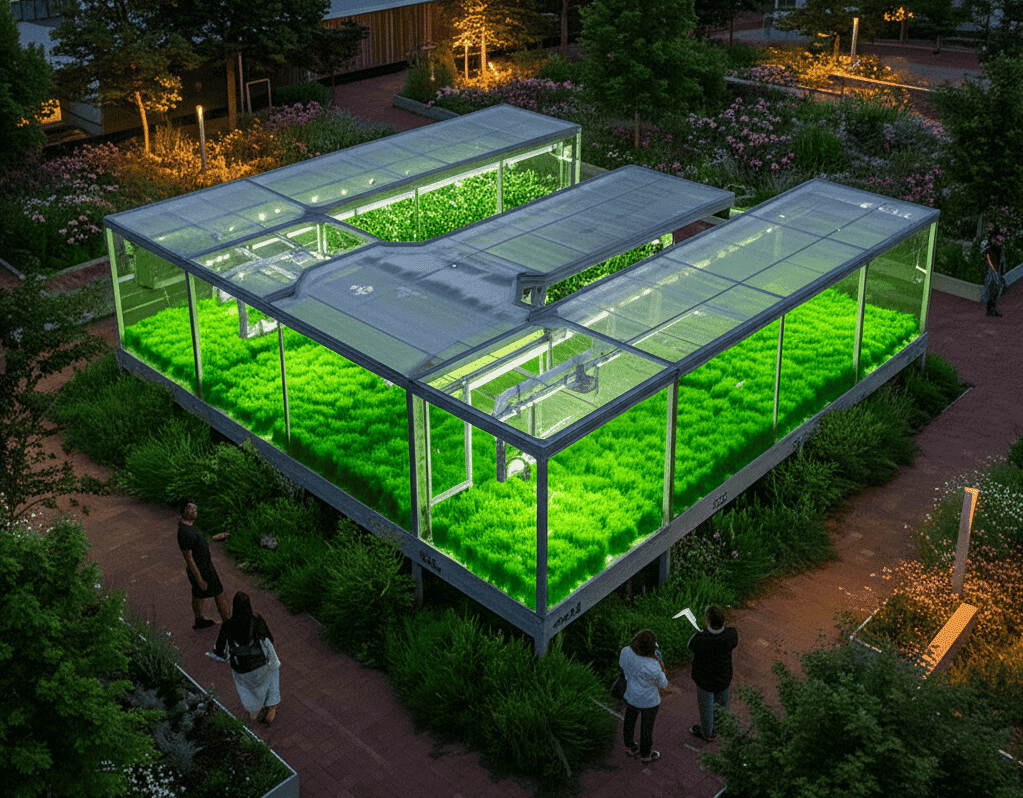
Research from the U.S. Department of Energy also highlights algae-based approaches for carbon utilization and CO₂ capture.
Cities are entering one of the most critical climate transitions in human history.
Urban environments generate more than 70% of global carbon emissions while simultaneously facing worsening air pollution, rising temperatures, increasing energy demand, and mounting sustainability pressure. As populations continue to grow, cities are becoming both the center of economic progress and the frontline of climate risk.
For decades, urban infrastructure was designed primarily around transportation, energy distribution, construction, and industrial expansion. But future cities must now evolve into something entirely different — intelligent ecosystems capable of actively supporting environmental recovery.
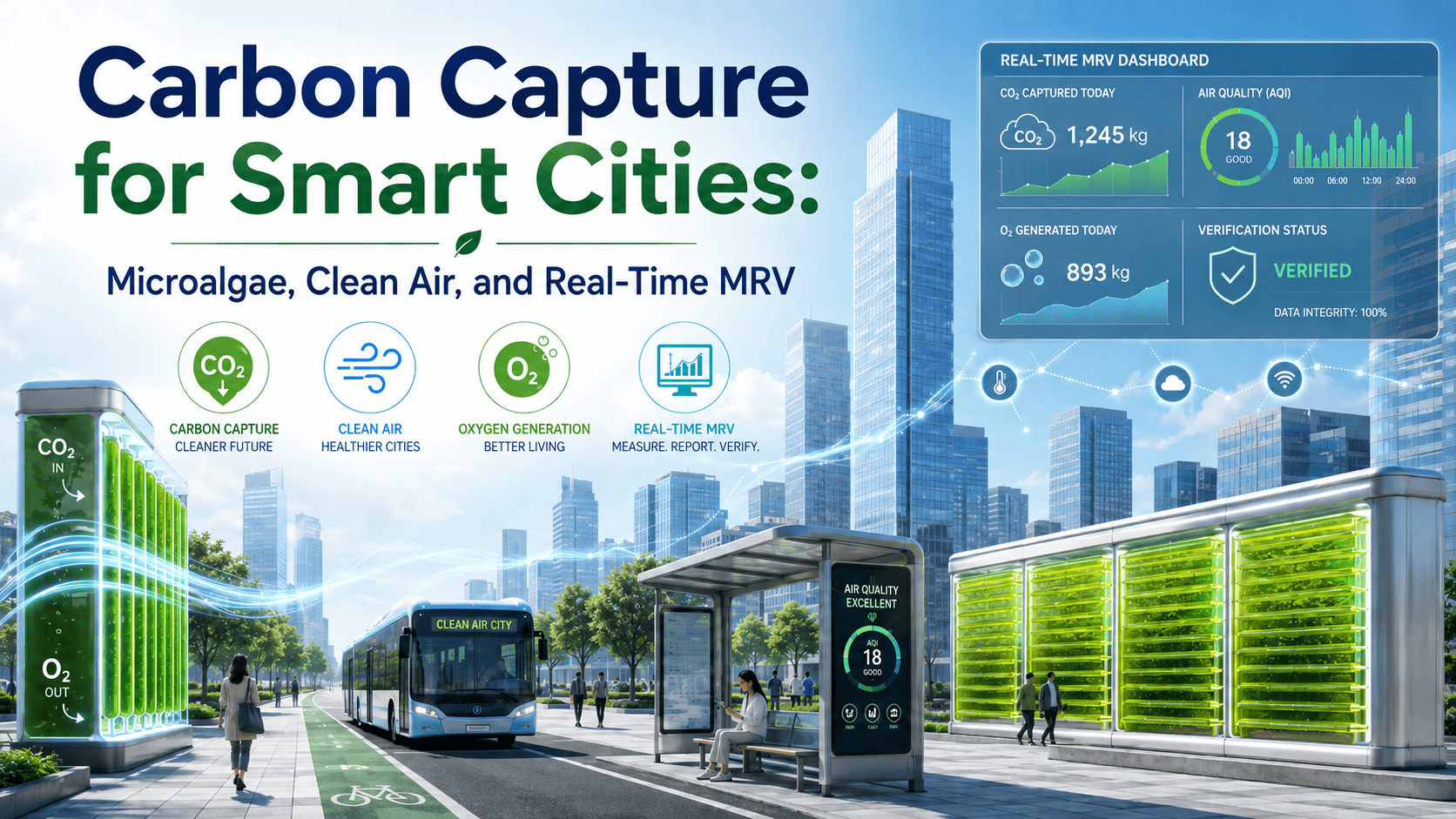
Table of Contents
This shift is driving global interest in carbon capture for smart cities.
Across the climate-tech industry, governments, researchers, ESG leaders, and sustainability innovators are exploring how biological carbon capture, smart air purification, and real-time environmental intelligence can become part of next-generation urban infrastructure.
One of the most promising approaches is microalgae carbon capture.
Using photosynthetic microorganisms, advanced photobioreactor systems can absorb carbon dioxide, support air purification, generate oxygen, and provide measurable environmental insights through real-time MRV and AI-enabled monitoring systems.
Unlike traditional environmental infrastructure that operates passively, these systems are designed to interact dynamically with urban environments.
The future of sustainable cities may not simply depend on reducing emissions.
It may depend on building infrastructure that actively improves the atmosphere itself.
Why Smart Cities Need Carbon Capture Infrastructure
Modern cities face a convergence of environmental challenges that cannot be solved through conventional infrastructure alone.
Urban populations continue to increase while air quality declines in many metropolitan regions. Transportation emissions, industrial pollutants, construction activity, and fossil-fuel dependency continue contributing to elevated CO₂ concentrations and public-health concerns.
At the same time, governments and corporations are accelerating toward net-zero commitments and ESG reporting frameworks.
This creates a new infrastructure challenge:
How can cities reduce carbon emissions while also improving air quality, environmental transparency, and climate resilience?
Traditional sustainability strategies often focus on:
- renewable energy
- electric transportation
- energy-efficient buildings
- recycling systems
- green construction
While these remain essential, they do not directly remove atmospheric carbon dioxide from dense urban environments.
This is where carbon capture technology becomes increasingly important.
The Urban Clean-Air Gap
Most urban air purification systems primarily focus on filtration.
Although filtration can help reduce particulate matter indoors, it does not directly address atmospheric carbon accumulation or provide measurable climate-intelligence capabilities.
Future smart cities require infrastructure capable of:
- actively capturing CO₂
- reducing urban pollutants
- generating environmental data
- supporting ESG verification
- integrating with digital city infrastructure
- enabling measurable sustainability outcomes
The future of urban sustainability will likely depend on systems that are both environmentally active and digitally intelligent.
The Rising Importance of Climate-Tech Infrastructure
Climate-tech is evolving beyond industrial facilities and laboratory research.
Today, environmental technologies are increasingly becoming integrated into public infrastructure, commercial buildings, transportation systems, and smart-city ecosystems.
This includes:
- smart air purification systems
- biological direct air capture
- IoT-enabled environmental monitoring
- AI-driven environmental intelligence
- carbon reduction technology
- decentralized climate infrastructure
Cities are beginning to recognize that climate resilience requires infrastructure capable of continuous environmental interaction.
This represents a major shift from static sustainability systems toward adaptive environmental ecosystems.
What Is Microalgae Carbon Capture?
Microalgae carbon capture is a biological direct air capture technology that uses photosynthetic microorganisms to absorb carbon dioxide from surrounding air.
Similar to trees and plants, microalgae consume CO₂ during photosynthesis and release oxygen back into the environment.
However, microalgae can grow significantly faster than terrestrial plants under optimized conditions and can achieve high photosynthetic efficiency inside controlled cultivation systems.
This makes them highly attractive for carbon removal technology and urban air purification applications.
How Microalgae Capture Carbon Dioxide
The process is based on natural biological activity.
Step-by-Step Process
- Ambient air enters the photobioreactor system
- Microalgae cultures interact with CO₂-rich airflow
- Photosynthesis converts carbon dioxide into biomass
- Oxygen is released back into the environment
- Environmental data is monitored continuously
- System analytics generate measurable sustainability insights
This creates a living environmental infrastructure platform rather than a conventional mechanical filtration unit.
Why Microalgae Are Attracting Global Attention
Microalgae systems are gaining momentum because they combine multiple sustainability functions into one integrated platform.
Potential advantages include:
- biological carbon capture
- smart air purification
- oxygen generation
- modular scalability
- compact infrastructure footprint
- ESG reporting compatibility
- IoT integration
- smart-city deployment potential
Unlike traditional mechanical direct air capture systems that often require high industrial energy demand, biological systems rely on photosynthesis supported by airflow engineering, lighting optimization, and intelligent environmental controls.
This opens opportunities for deployment across urban environments where sustainability visibility and decentralized infrastructure matter.
Why Cities Need Active Carbon Capture Systems
The future of sustainable urban development depends on infrastructure that actively contributes to environmental recovery.
Cities today face several interconnected environmental pressures.
| Urban Challenge | Current Problem | Smart Carbon Capture Opportunity |
|---|---|---|
| Rising CO₂ levels | Dense cities generate concentrated emissions | Deploy decentralized carbon capture systems |
| Air pollution | PM2.5 and NOx affect public health | Use smart air purification infrastructure |
| Heat islands | Urban materials trap heat | Support climate-resilient urban planning |
| ESG regulations | Organizations require measurable sustainability | Enable digital MRV and real-time reporting |
| Limited green space | Urban land constraints reduce tree coverage | Deploy compact algae photobioreactors |
| Climate visibility | Sustainability claims lack transparency | Use AI-enabled environmental monitoring |
Future cities require infrastructure that can interact directly with atmospheric conditions while generating measurable environmental intelligence.
How Photobioreactors Work in Urban Environments
Photobioreactors are controlled cultivation systems designed to optimize algae growth, gas exchange, and environmental performance.
Modern algae photobioreactors can be engineered specifically for urban sustainability applications.
Core Components of a Smart Photobioreactor
Airflow Management
Ambient air containing CO₂ is circulated through algae cultivation chambers.
Photosynthetic Carbon Capture
Microalgae absorb carbon dioxide during biological growth processes.
Oxygen Release
Oxygen is released back into surrounding environments, helping support cleaner urban air.
Pollutant Interaction
Advanced systems may support interaction with:
- PM2.5
- NOx
- airborne pollutants
- particulate matter
Environmental Monitoring
IoT-enabled sensors track:
- CO₂ concentration
- air quality
- temperature
- humidity
- system performance
- environmental trends
This enables real-time environmental intelligence and ESG-compatible monitoring.
Microalgae Carbon Capture Workflow
Modern smart environmental systems combine biology, engineering, and digital intelligence into a unified infrastructure platform.
Carbon Capture Workflow Table
| Step | Process | Purpose |
|---|---|---|
| 1 | Air intake | Draws ambient air into the system |
| 2 | Gas circulation | Moves CO₂-rich air through algae chambers |
| 3 | Photosynthesis | Enables biological carbon absorption |
| 4 | Oxygen release | Supports cleaner surrounding air |
| 5 | Sensor monitoring | Tracks environmental performance |
| 6 | Dashboard analytics | Generates measurable MRV data |
| 7 | Biomass growth | Stores captured carbon biologically |
| 8 | Reporting systems | Supports ESG verification |
Smart Air Purification Meets Real-Time MRV
As climate-tech grows rapidly, environmental credibility is becoming increasingly important.
Many sustainability claims are difficult to verify scientifically, creating concerns around greenwashing and exaggerated carbon-reduction metrics.
This is why real-time MRV is becoming critical.
What Is MRV?
MRV stands for:
- Monitoring
- Reporting
- Verification
In environmental infrastructure, MRV systems help track measurable climate impact continuously rather than relying on estimated assumptions.
Why Real-Time MRV Matters
Traditional sustainability reporting often depends on periodic calculations or estimated carbon offsets.
Real-time MRV changes this by enabling:
- continuous environmental monitoring
- live air-quality analytics
- measurable carbon tracking
- transparent reporting
- AI-driven environmental intelligence
- data-backed ESG verification
This creates stronger scientific credibility and improved investor confidence.
Role of AI and IoT in Smart Environmental Systems
The future of smart air purification will increasingly rely on AI-enabled environmental intelligence.
AI and IoT systems can continuously optimize environmental performance by analyzing large volumes of real-time atmospheric and operational data.
AI + IoT Benefits Table
| Technology Layer | Function | Benefit |
|---|---|---|
| IoT sensors | Collect environmental data | Continuous monitoring |
| AI analytics | Detect operational patterns | Smarter optimization |
| Dashboard systems | Visualize environmental metrics | Better ESG reporting |
| Predictive monitoring | Detect system changes early | Improved maintenance |
| Environmental intelligence | Analyze air-quality trends | Data-driven climate decisions |
| Digital MRV | Verify sustainability performance | Reduced greenwashing risk |
Future climate-tech systems may eventually become self-optimizing environmental infrastructure networks.
Microalgae vs Traditional Direct Air Capture
Not all carbon capture systems operate using the same principles.
Mechanical direct air capture systems typically rely on industrial chemical separation technologies, while biological systems rely on photosynthesis.
Comparison Table
| Factor | Microalgae Carbon Capture | Traditional DAC |
|---|---|---|
| Carbon Removal Method | Biological photosynthesis | Chemical separation |
| Energy Requirement | Lower operational intensity | High industrial energy demand |
| Urban Integration | Modular and decentralized | Large industrial facilities |
| Additional Benefits | Air purification + oxygen generation | Primarily carbon removal |
| Infrastructure Scale | Flexible deployment | Centralized facilities |
| ESG Visibility | Strong public sustainability visibility | Industrial-focused |
| Smart-City Compatibility | High | Moderate |
| Environmental Intelligence | Real-time MRV integration | Often centralized monitoring |
Mechanical and biological systems may ultimately complement each other depending on deployment needs, scale, and environmental objectives.
Carbon Capture as Future Urban Infrastructure
Carbon capture is gradually evolving from industrial technology into public environmental infrastructure.
Future smart cities may integrate carbon-capturing systems directly into urban architecture and public spaces.
Potential Deployment Areas
| Deployment Area | Sustainability Role |
|---|---|
| Smart bus shelters | Localized clean-air zones |
| Airports | Environmental sustainability infrastructure |
| Railway stations | Pollution mitigation in transit hubs |
| Corporate campuses | ESG visibility and clean-air systems |
| Smart buildings | Integrated carbon reduction infrastructure |
| Public parks | Environmental education and air purification |
| Industrial corridors | Pollution reduction support |
| Universities | Climate-tech research infrastructure |
These systems may become part of future climate-resilient city planning strategies.
Why Data Transparency Matters in Climate-Tech
The climate-tech industry is entering a phase where measurable data is becoming as important as technological innovation itself.
Environmental stakeholders increasingly expect:
- verified carbon reduction
- transparent reporting
- measurable sustainability outcomes
- scientific validation
- ESG-compatible analytics
This is pushing the industry toward digital MRV and real-time environmental intelligence platforms.
Tree Claims vs Verified Environmental Systems
| Factor | Simplified Environmental Claims | Measured MRV Systems |
|---|---|---|
| Basis of claim | Generalized estimates | Real-time monitored data |
| Verification | Limited transparency | Continuous environmental monitoring |
| Scientific credibility | Variable | Higher measurable accuracy |
| ESG reporting value | Limited | Stronger reporting capability |
| Climate transparency | Often unclear | Data-driven verification |
The future of climate infrastructure will likely prioritize transparency, measurable impact, and scientific accountability.
Business Value for ESG and Net-Zero Leaders
Smart environmental systems are becoming strategic infrastructure assets for organizations pursuing sustainability leadership.
Key Business Benefits
| Stakeholder | Value Created |
|---|---|
| ESG teams | Real-time sustainability reporting |
| Corporates | Visible environmental leadership |
| Smart-city planners | Scalable clean-air infrastructure |
| Investors | High-growth climate-tech innovation |
| Universities | Research and applied sustainability |
| Governments | Public environmental infrastructure |
| Green buildings | Healthier indoor and outdoor spaces |
Environmental infrastructure is increasingly becoming part of long-term business strategy rather than only sustainability compliance.
The Future of Climate-Tech Cities
The next generation of cities may function more like intelligent environmental ecosystems.
Future urban infrastructure could include:
- AI-driven environmental systems
- decentralized carbon capture
- bio-integrated architecture
- autonomous air purification
- living climate infrastructure
- real-time sustainability intelligence
Microalgae-powered systems represent one part of a broader transition toward active environmental infrastructure.
Instead of simply minimizing damage, future cities may actively participate in atmospheric recovery.
Key Takeaways
- Smart cities require active environmental infrastructure, not only passive sustainability measures
- Microalgae carbon capture combines biological CO₂ removal with smart air purification
- Real-time MRV improves climate transparency and ESG reporting
- AI and IoT are transforming environmental monitoring into intelligent infrastructure
- Biological direct air capture offers scalable opportunities for decentralized urban sustainability
- Photobioreactors can support clean-air initiatives across public and commercial infrastructure
- Future cities may integrate carbon capture directly into everyday urban environments
- Data-driven environmental systems will become increasingly important for climate credibility
Conclusion
The future of sustainable cities will depend on more than energy efficiency and renewable power.
Urban environments now require infrastructure capable of actively improving atmospheric conditions while generating measurable environmental intelligence.
Microalgae-powered carbon capture systems combine biology, engineering, smart monitoring, and climate-tech innovation into a new category of environmental infrastructure designed for future cities.
As governments, industries, and urban planners accelerate toward net-zero goals, intelligent clean-air systems may become as essential as transportation, energy, and digital connectivity.
The next era of smart cities may not simply reduce emissions.
It may actively regenerate urban environments through living climate infrastructure.
CTA
Discover how next-generation microalgae-powered infrastructure is redefining carbon capture, clean air, and sustainable cities.
Explore the future of smart environmental infrastructure and climate-tech innovation.