
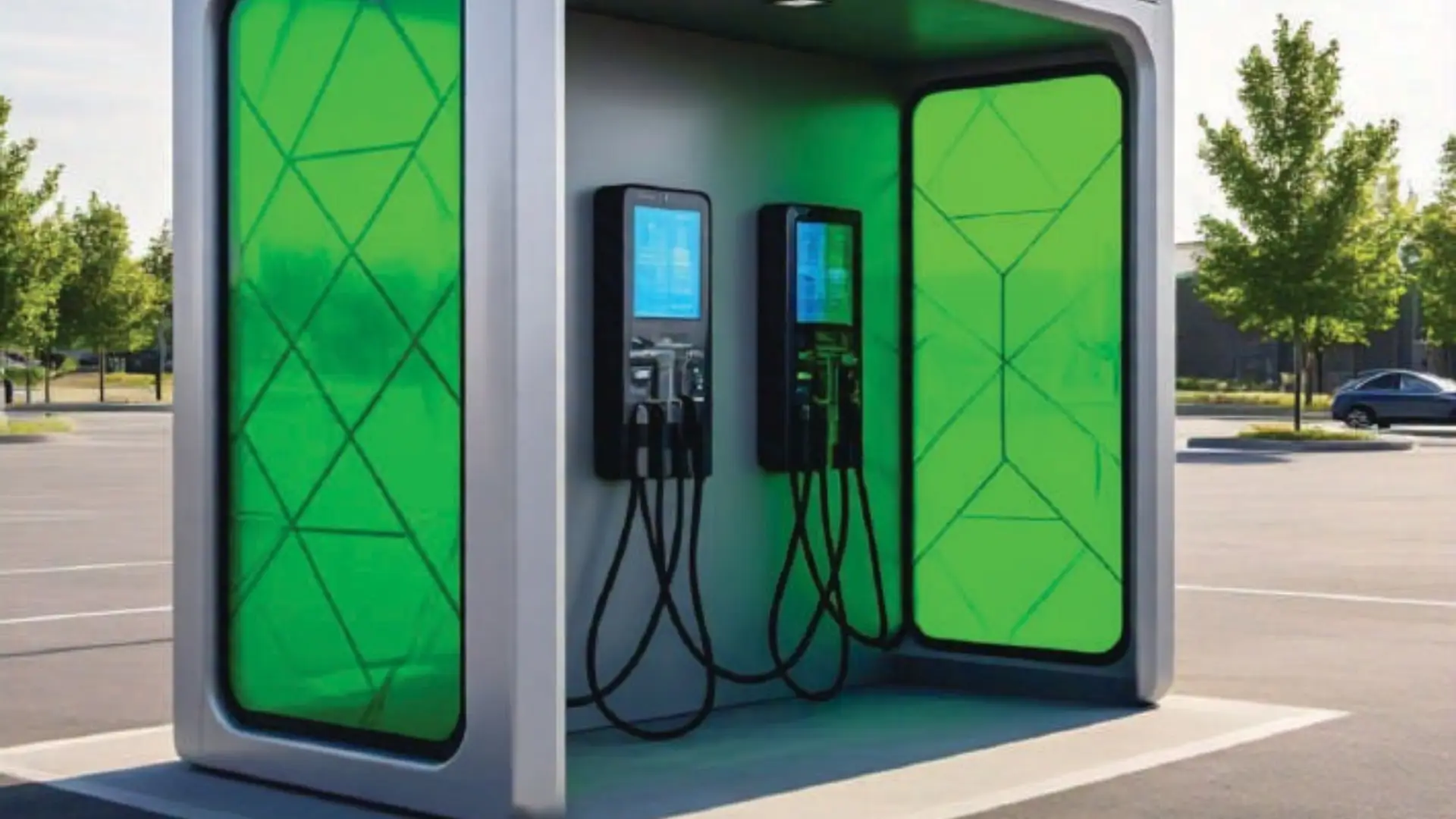
Carbelim’s EV–Algae Hub™
The electrification of transportation is one of the most significant transformations of the 21st century. Governments are mandating electric vehicle adoption. Automotive OEMs are phasing out internal combustion engines. Investors are prioritizing climate-aligned infrastructure.
Yet while electric vehicles eliminate tailpipe emissions, they do not directly address two persistent environmental challenges:
- Rising atmospheric CO₂ concentrations
- Localized urban air pollution hotspots
The next evolution of mobility infrastructure must go beyond emission reduction — it must actively regenerate the atmosphere.
Developed by Carbelim, the EV–Algae Hub™ is the world’s first EV charging station designed to capture carbon dioxide, purify ambient air, and generate oxygen while delivering high-efficiency EV charging.
The EV–Algae Hub™ is redefining the future of carbon-capturing EV charging stations, climate-positive infrastructure, algae-powered carbon removal systems, sustainable mobility hubs, and regenerative urban technology. As demand grows for net-zero EV infrastructure, smart city clean energy solutions, ESG-compliant charging networks, green mobility ecosystems, and carbon-negative transportation assets, this innovation positions itself at the forefront of environmental transformation. By combining direct air carbon capture, oxygen-generating microalgae bioreactors, real-time air quality monitoring, and high-efficiency electric vehicle charging, the EV–Algae Hub™ creates a scalable solution for governments, corporations, charge-point operators, and automotive OEMs seeking measurable climate impact. In an era where sustainable transportation, urban air purification, renewable energy integration, and climate-tech investment are shaping global markets, this breakthrough system delivers both environmental performance and long-term infrastructure value.
As global cities move toward carbon-neutral urban planning, infrastructure investments are increasingly evaluated not only for operational efficiency but for environmental contribution. The EV–Algae Hub™ positions itself at the intersection of mobility, climate technology, and smart infrastructure economics. By converting essential EV charging stations into active carbon-removal systems, it enables governments, corporations, and charge-point operators to transform mandatory infrastructure spending into measurable climate action. Instead of allocating separate budgets for carbon offsets, air purification, and EV deployment, stakeholders can consolidate these objectives into a single integrated solution. This convergence of clean transportation and atmospheric regeneration ensures that every charging session contributes to long-term environmental resilience while reinforcing sustainability leadership in a rapidly evolving regulatory and ESG landscape.
Imagine pulling into an EV charging station and knowing that while your vehicle powers up, the air around you is becoming cleaner. The EV–Algae Hub™ turns a routine charging stop into a visible climate action moment — where drivers, businesses, and communities can see real-time carbon removal and oxygen generation happening before their eyes. In a world where consumers increasingly support brands that demonstrate authentic sustainability, this level of transparency builds trust, loyalty, and meaningful engagement. It’s not just about charging a car — it’s about participating in a regenerative future. Every session becomes a small but measurable step toward cleaner cities, healthier communities, and a climate-positive mobility ecosystem.
It represents a new category of infrastructure:
Regenerative mobility systems.
Why Electrification Alone Is Not Enough
Electric vehicles are a major step forward. They:
- Reduce fossil fuel dependence
- Eliminate tailpipe emissions
- Lower urban particulate pollution
- Support renewable energy integration
However, EV infrastructure itself remains environmentally passive.
Traditional EV chargers:
- Do not remove atmospheric CO₂
- Do not actively improve surrounding air quality
- Do not contribute directly to carbon removal targets
As global EV charging networks scale into millions of units, this represents a missed climate opportunity.
The EV–Algae Hub™ transforms every charging point into a distributed climate asset.
What Is the EV–Algae Hub™?
The EV–Algae Hub™ is an integrated climate-positive EV charging system combining:
- Advanced EV charging hardware
- Microalgae-based carbon capture bioreactors
- Real-time environmental monitoring
- Transparent impact reporting interfaces
It is powered by proprietary microalgae carbon capture technology that enables continuous CO₂ absorption and oxygen generation.
Unlike conventional chargers that simply transfer electricity, the EV–Algae Hub™ actively improves the atmosphere during every hour of operation.
The Science Behind Microalgae Carbon Capture
Microalgae are microscopic photosynthetic organisms capable of absorbing CO₂ at significantly higher rates than many terrestrial plants.
Through photosynthesis:
CO₂ + Light Energy → Biomass + Oxygen
Advantages of microalgae systems include:
- High CO₂ absorption efficiency
- Rapid growth cycles
- Continuous operation capability
- Compact physical footprint
- Scalable modular design
Unlike tree plantations that require years to mature, microalgae-based systems begin carbon capture immediately after installation.
This makes the EV–Algae Hub™ a fast-acting climate intervention.
Technical Architecture of the EV–Algae Hub™
The system integrates four engineered subsystems:
1. EV Charging Module
High-performance charging compatible with modern electric vehicles, suitable for urban, fleet, and corridor applications.
2. Algae Bioreactor Core
Controlled photobioreactor chambers optimized for:
- Maximum light exposure
- Efficient CO₂ absorption
- Continuous oxygen release
- Stable biomass growth
3. Environmental Monitoring Sensors
Smart IoT sensors track:
- CO₂ concentration
- Air quality index
- Ambient temperature
- Operational efficiency
- Carbon removal rates
4. Digital Impact Interface
Transparent dashboards display:
- Live CO₂ removed
- Oxygen generated
- Environmental performance metrics
- ESG-ready reporting data
This combination transforms static infrastructure into intelligent environmental systems.
Measurable Environmental Performance
Climate claims must be supported by data.
Annual Environmental Impact Per EV–Algae Hub™ Unit
| Metric | Performance |
|---|---|
| CO₂ Removed | 330 kg annually |
| Oxygen Generated | 1.5 million litres |
| Operation Cycle | 24/7 Continuous |
| Monitoring | Real-time Smart Sensors |
| Data Reporting | ESG-Ready |
As networks scale, cumulative impact grows proportionally.
For example:
| Number of Units | Total Annual CO₂ Removed |
|---|---|
| 10 Units | 3,300 kg |
| 100 Units | 33,000 kg |
| 1,000 Units | 330,000 kg |
This scalability enables cities and corporations to plan distributed atmospheric regeneration strategies.
EV–Algae Hub™ vs Traditional Charging Infrastructure
| Feature | Traditional EV Charger | EV–Algae Hub™ |
|---|---|---|
| EV Charging | ✔ | ✔ |
| Carbon Capture | ✖ | ✔ |
| Oxygen Generation | ✖ | ✔ |
| Air Quality Monitoring | Limited | Advanced |
| ESG Reporting Data | Minimal | Integrated |
| Climate-Positive Impact | ✖ | ✔ |
This shift transforms EV charging from a utility service into an environmental performance platform.
Deployment Scenarios and Strategic Applications
Highway Charging Corridors
Highways concentrate vehicle density and emissions.
Deploying EV–Algae Hub™ units along corridors:
- Creates distributed clean-air zones
- Improves rest-stop environments
- Enhances sustainable transport branding
This model complements solutions like the PureAir Bus Shelter, which transforms public transit stops into carbon-capturing urban assets.
Corporate & Municipal Fleet Infrastructure
Fleet electrification alone reduces emissions, but integrating carbon capture enhances environmental performance further.
Benefits include:
- Verified carbon removal metrics
- Improved ESG scoring
- Stronger sustainability reporting
- Alignment with net-zero targets
Learn more about Carbelim’s broader climate-positive infrastructure solutions.
Retail & Commercial Complexes
Sustainability influences consumer choice.
Installing EV–Algae Hub™ systems:
- Attracts environmentally conscious EV drivers
- Improves parking area air quality
- Enhances brand trust
- Creates visible sustainability storytelling opportunities
Smart City Integration
Modern smart cities integrate:
- Renewable energy
- IoT infrastructure
- Sustainable mobility
- Environmental analytics
The EV–Algae Hub™ fits seamlessly into smart city ecosystems by combining:
- Carbon capture
- Real-time environmental monitoring
- Public transparency dashboards
This transforms mobility hubs into environmental intelligence nodes.
ESG & Carbon Accounting Integration
The EV–Algae Hub™ supports:
- Scope 1 & 2 emission reduction strategies
- Carbon accounting documentation
- Sustainability-linked financing
- Green bond reporting
- Municipal environmental KPI frameworks
Because each unit generates measurable data, organizations can include direct atmospheric regeneration in sustainability reports.
Explore more urban air quality innovations from Carbelim’s clean technology platform.
Financial & Strategic Value Proposition
Beyond environmental impact, the EV–Algae Hub™ delivers strategic advantages.
1. Competitive Differentiation
Stand out in crowded EV infrastructure markets.
2. Premium Pricing Potential
Offer climate-positive charging experiences.
3. Investor Alignment
Appeal to ESG-focused capital and climate funds.
4. Regulatory Readiness
Future-proof infrastructure against tightening carbon regulations.
Carbon Removal Strategy Comparison
| Strategy | Direct Removal | Speed of Impact | Land Use | Visibility |
|---|---|---|---|---|
| Tree Plantation | Indirect | Slow | High | Low |
| Carbon Offsets | Indirect | Variable | N/A | Low |
| Direct Air Capture Plants | Direct | High | High Cost | Limited |
| EV–Algae Hub™ | Direct | Immediate | Low | High |
The EV–Algae Hub™ uniquely combines direct removal with public visibility and infrastructure integration.
Lifecycle Sustainability Perspective
The EV–Algae Hub™ contributes across the infrastructure lifecycle:
- During operation: Continuous carbon capture
- During scaling: Network-level environmental impact
- During reporting: Transparent ESG metrics
- During public engagement: Visible climate action
It moves infrastructure from reactive compliance to proactive regeneration.
The Future of Regenerative Mobility Networks
Imagine a city where:
- Every EV charging station captures carbon
- Every mobility hub generates oxygen
- Every parking zone improves air quality
- Every infrastructure investment contributes to atmospheric repair
As EV adoption accelerates globally, the EV–Algae Hub™ ensures that infrastructure expansion strengthens environmental restoration rather than simply supporting transportation electrification.
Conclusion: Charging the Future While Repairing the Atmosphere
The EV revolution is essential — but it is only the first step.
To truly address climate change and urban pollution, infrastructure must evolve from passive to regenerative.
The EV–Algae Hub™ redefines what EV charging stations can achieve:
✔ Power electric vehicles
✔ Capture carbon dioxide
✔ Generate oxygen
✔ Improve localized air quality
✔ Deliver measurable ESG performance
Developed by Carbelim, this innovation transforms necessary charging infrastructure into distributed climate solutions.
Clean mobility is no longer enough.
Regenerative mobility is the future.