In the grand design of the modern metropolis, the bus shelter has always been an afterthought. For over a century, it has remained a static utility—a slab of concrete, steel, and perhaps a pane of glass—existing solely to protect commuters from rain. But in the context of the 21st-century climate crisis, this passivity is a wasted opportunity.
As cities densify and the “15-Minute City” framework becomes the global standard for urban planning, every square foot of public infrastructure must work harder. It is no longer enough for infrastructure to simply occupy space; it must regenerate it.
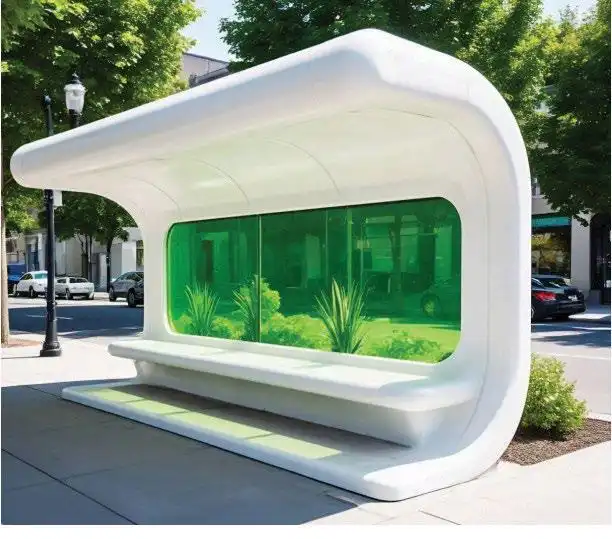
At Carbelim, we are reimagining the urban landscape through the lens of biomimicry. By integrating industrial-grade microalgae photobioreactors into the streetscape, the PureAir Bus Shelter™ transforms the humble transit stop from a “dead zone” of pollution into an active, breathing lung for the city.
This isn’t just an amenity upgrade. It is a fundamental shift in how we view public assets—turning a municipal cost center into a measurable, data-driven ESG (Environmental, Social, and Governance) asset.
The “Urban Canyon” Crisis: Why Trees Are No Longer Enough
To understand why a technological intervention is necessary, we must first look at the failure of traditional greening methods in hyper-dense environments.
Urban planners have long relied on planting trees to combat the Urban Heat Island (UHI) effect and filter air. While trees are essential, they are struggling to survive in the modern “Urban Canyon”—the narrow corridors created by tall skyscrapers that trap pollution at street level.
The Limitations of Passive Nature
- Root Space Scarcity: In dense districts, underground utilities (gas, water, fiber optics) leave little room for the extensive root systems mature trees require.
- The Growth Gap: A tree takes 15–20 years to reach the canopy size necessary for significant carbon sequestration. We do not have 20 years to solve the air quality crisis.
- Pollution Tolerance: High levels of PM2.5 and Nitrogen Dioxide ($NO_2$) can actually stunt tree growth, reducing their ability to photosynthesize effectively.
This is where Carbelim’s Biomimetic Technology bridges the gap.
The Algae Advantage
The PureAir Bus Shelter™ utilizes select strains of microalgae that are evolutionarily engineered to thrive on what humans consider “waste”—specifically $CO_2$ and $NO_x$.
Unlike a tree, which relies on passive gas exchange, our systems use active airflow. Fans draw polluted street air into the photobioreactor, forcing it through a liquid algae medium. This contact allows the algae to “scrub” the air of particulates and greenhouse gases instantly.
Data Point: A single Carbelim biosystem, with a footprint of just a few square meters, delivers the carbon sequestration and oxygenation power of 15 to 20 mature trees.
By integrating this power into a bus shelter, we place the solution exactly where the problem is most acute: right at the commuter’s nose level, amidst the exhaust pipes of passing traffic.
The Technology: How the PureAir Bus Shelter™ Works
To the average commuter, the PureAir Bus Shelter™ looks like a sleek, futuristic transit hub. But behind the glass and digital displays lies a complex, living machine.
1. The Photobioreactor (PBR) Core
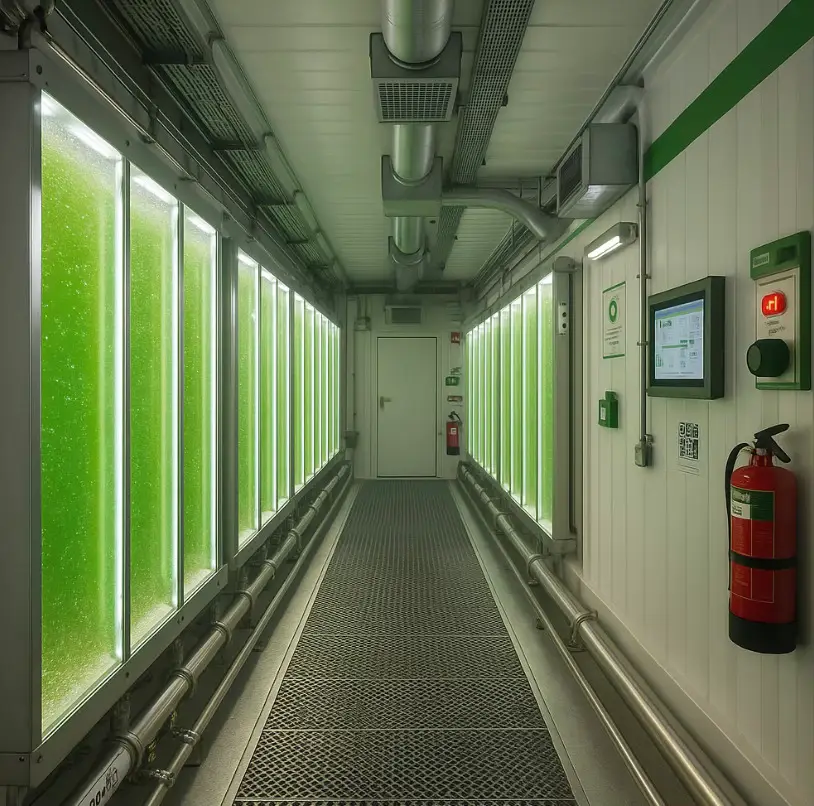
At the heart of the shelter is Carbelim’s proprietary PBR technology, developed through our research initiatives and incubation at IIT Madras. These are transparent panels containing a high-density culture of microalgae.
- Carbon Capture: The algae absorb $CO_2$ from the air to fuel their growth (photosynthesis).
- Pollutant Feeding: The algae metabolize Nitrogen Oxides ($NO_x$) and Sulfur Oxides ($SO_x$)—common vehicle emissions—as nutrients.
- Oxygen Release: As a byproduct of this process, the system releases fresh, filtered oxygen back into the shelter seating area.
2. IoT and AI Integration
What makes this an “Asset” rather than just a “Plant” is the data layer. Every PureAir Bus Shelter™ is equipped with industrial-grade sensors connected to the Carbelim Cloud Dashboard.
- Real-Time Monitoring: Sensors track PM2.5, PM10, CO2 levels, temperature, and humidity inside and outside the shelter.
- Predictive Maintenance: Our AI analyzes the health of the algae (color, density, pH) and alerts maintenance teams before the culture needs refreshing.
- Public Awareness: An e-paper display on the shelter shows commuters the live Air Quality Index (AQI) improvement, visualizing the invisible benefit they are receiving.
3. Energy Autonomy
To ensure the solution is truly net-positive, the shelter minimizes grid dependency. High-efficiency Bifacial Solar Panels on the roof power the low-voltage pumps, LED lighting, and IoT sensors. This ensures that the carbon captured by the algae isn’t negated by the carbon burned to power the system.
From Cost Center to Profit Center: The Business Case for Cities
For Municipal Corporations and Smart City developers, the primary objection to new infrastructure is always OPEX (Operational Expenditure). Standard bus stops are cheap to build but costly to maintain (cleaning, glass repair, lighting).
Carbelim flips this model. We view the bus shelter as a platform for revenue generation and operational savings.
1. Digital Out-of-Home (DOOH) Advertising Premium
Brands are increasingly conscious of where they advertise. Placing an ad on a crumbling, dirty bus stop dilutes brand equity. Placing an ad on a “Clean Air Zone” enhances it.
- The “Halo Effect”: Advertisers are willing to pay a premium for DOOH slots on Carbelim shelters because their brand becomes associated with sustainability and public health.
- Targeted Data: The IoT sensors can also provide anonymized footfall data, making the ad space more valuable to media buyers.
2. Carbon Credits and ESG Offsetting
This is the most revolutionary aspect of the PureAir Shelter. Because our AI dashboard provides verified, irrefutable data on the amount of carbon sequestered, this data can be tokenized.
- Scope 3 Reductions: For corporate campuses or private developments, installing these shelters contributes directly to lowering Scope 3 emissions targets.
- Carbon Credit Markets: Cities can aggregate the carbon capture data from a network of 500+ shelters to generate voluntary carbon credits, creating a new revenue stream for the municipality.
3. The Circular Economy of Biomass
The algae in our shelters grow rapidly. Every 45–60 days, a portion of the biomass is harvested. This is not waste; it is a resource.
- Bio-Fertilizers: The harvested algae is rich in nitrogen and phosphorus. It can be processed into organic fertilizer for city parks and gardens.
- Bio-Char: Alternatively, it can be converted into bio-char, a stable form of carbon that improves soil health and locks carbon away for centuries.
By closing the loop, the PureAir Bus Shelter™ pays for its own maintenance through the value of its byproducts.
Health Implications: The “Cognitive Gap” and Public Safety
While the economic and environmental arguments are strong, the human argument is urgent.
We often discuss air pollution in terms of long-term lung disease, but the immediate effects are just as damaging. Studies have shown that high levels of CO2 and PM2.5 lead to a sharp decline in cognitive function—a phenomenon known as the “Cognitive Gap.”
For a student waiting for a bus to university, or a professional heading to a meeting, standing in a cloud of exhaust fumes reduces mental clarity and increases stress hormones.
Creating “Safe Havens”
The PureAir Bus Shelter™ acts as a sanctuary. The positive pressure created by the release of oxygen pushes dust and smog away from the waiting area.
- Temperature Drop: The biological process, combined with the shading of the solar roof, can lower the ambient temperature within the shelter by 3–5°C compared to the surrounding pavement.
- Psychological Well-being: The presence of the living green algae (Biophilia) has been proven to lower heart rates and reduce anxiety in urban environments.
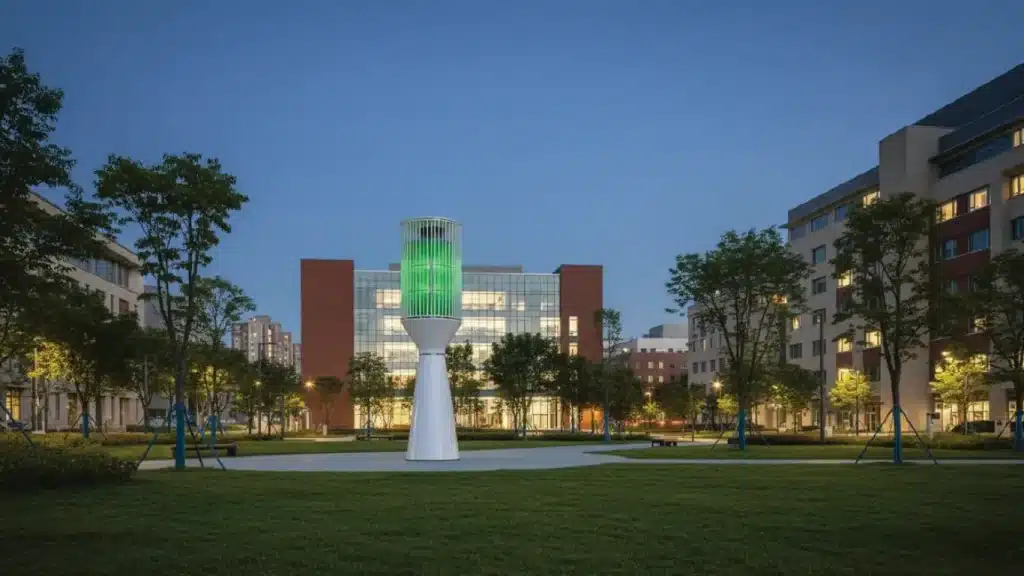
This same technology is also available for indoor applications via our PureAir Tower™, bringing the same cognitive benefits to office lobbies and conference rooms.
Implementation: How to Deploy “Urban Lungs”
For city planners and developers reading this, the question is: Scalability.
The PureAir Bus Shelter™ is designed with modularity in mind. It does not require digging deep foundations or complex grid integration (thanks to solar/battery hybrid systems).
The Deployment Roadmap
- Pilot Corridors: Cities identify “Red Zones”—areas with the highest vehicular density and lowest tree cover.
- Plug-and-Play Installation: The shelters are prefabricated and can be assembled on-site in under 48 hours, minimizing traffic disruption.
- Network Activation: Once online, the shelter connects to the central city dashboard, immediately streaming air quality data to the public.
Ideal Use Cases
- Smart City Pilot Projects: Demonstrating tangible tech adoption for central government grants.
- IT Parks & SEZs: Providing clean air transit for employees to boost campus wellness ratings.
- Hospital Zones: Creating sterile, oxygen-rich waiting areas for patients and visitors.
- School Districts: Protecting the most vulnerable lungs from rush-hour traffic emissions.
Alignment with Global Standards (LEED, WELL, CSRD)
Adopting Carbelim’s technology isn’t just about local impact; it aligns your real estate or municipal project with global sustainability frameworks.
1. LEED v4.1 & WELL Building Standard
For private developers, integrating PureAir Shelters into the campus master plan contributes to credits in:
- Innovation in Design
- Air Quality Standards
- Thermal Comfort
- Biophilic Design Integration
2. CSRD (Corporate Sustainability Reporting Directive)
For European and multinational partners, the rigorous data tracking provided by our dashboard assists in complying with the new, stricter CSRD requirements regarding environmental impact and biodiversity protection.
Conclusion: The Infrastructure of Tomorrow is Alive
We are standing at a crossroads in urban design. We can continue to build with “dead” materials—concrete, steel, and glass—that consume energy and radiate heat. Or, we can embrace the Biological Age of Architecture.
The PureAir Bus Shelter™ represents a philosophy where technology and nature are not enemies, but partners. By biomimicking the efficiency of forests and enhancing it with the intelligence of IoT, we are building cities that don’t just house people, but heal them.
The 15-Minute City of the future doesn’t just need better roads; it needs better air. It needs Urban Lungs.
Are you ready to transform your transit network into a climate asset?
Contact our Infrastructure Team to view the technical specifications and discuss pilot opportunities for your city.