Introduction: Why the World Needs Smarter Carbon Capture Solutions
The U.S. Department of Energy also highlights algae-based carbon utilization as an approach for capturing and productively using CO₂.
Carbon dioxide emissions and urban air pollution are two of the biggest environmental challenges facing cities, industries, and governments today. As industries grow, vehicles increase, and energy demand rises, the amount of CO₂ released into the atmosphere continues to put pressure on climate systems.
At the same time, cities are dealing with poor air quality caused by traffic emissions, industrial activity, construction dust, and fossil fuel use. This has created a strong demand for cleaner, smarter, and more sustainable air purification and carbon capture technology.
Traditional carbon capture systems are often large, expensive, energy-intensive, and designed mainly for industrial facilities. While they play an important role, the world also needs visible, scalable, and nature-based solutions that can work in cities, public spaces, campuses, commercial buildings, highways, and industrial zones.
This is where the photobioreactor for carbon capture becomes important.
A photobioreactor is a controlled system that uses microalgae to absorb CO₂ through photosynthesis. These tiny organisms use light, water, nutrients, and carbon dioxide to grow. During this process, they capture CO₂ and release oxygen.
In simple words, a photobioreactor works like a smart biological carbon capture system. It combines nature and engineering to clean air, capture carbon, and produce useful biomass.
For companies, sustainability teams, ESG leaders, researchers, and urban planners, microalgae carbon capture is becoming an exciting area of innovation. It offers a practical way to connect clean air technology, carbon reduction, sustainability branding, and circular economy benefits.
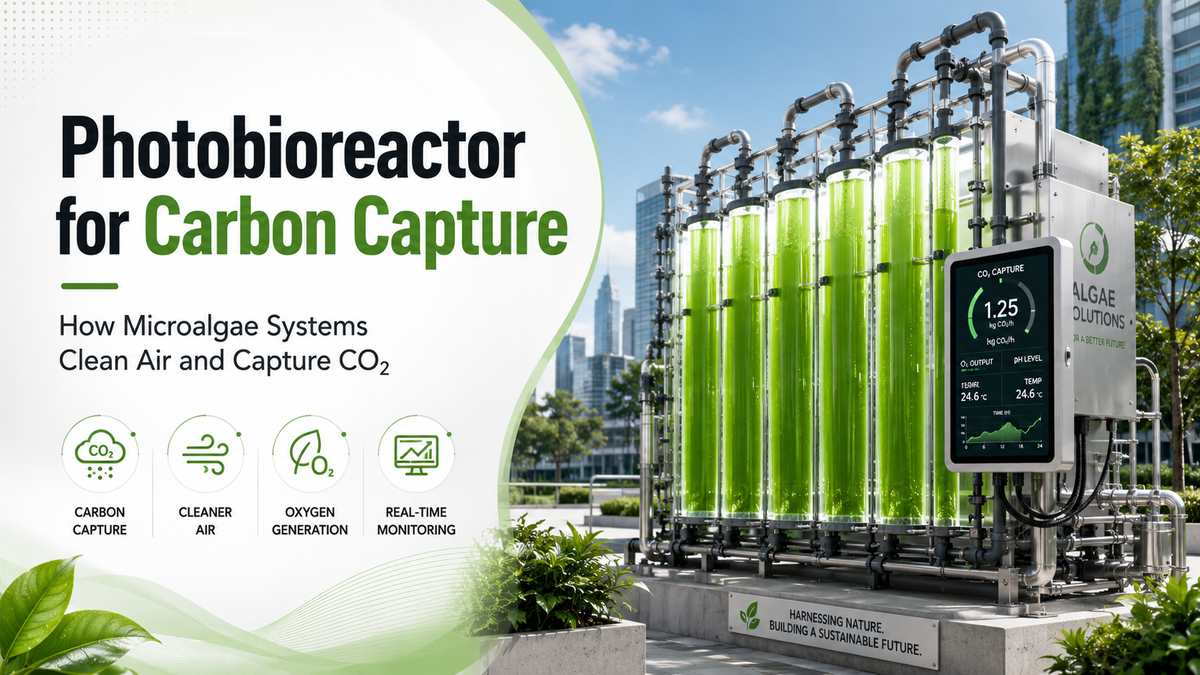
Table of Contents
What Is a Photobioreactor?
A photobioreactor is a specially designed system where microalgae are grown under controlled conditions. The word can be broken down into three parts:
| Term | Meaning |
|---|---|
| Photo | Related to light |
| Bio | Related to living organisms |
| Reactor | A controlled system where a process takes place |
So, a photobioreactor is a controlled biological system that uses light to grow microalgae.
Inside the system, microalgae receive the main things they need to survive and multiply:
| Requirement | Why It Is Needed |
|---|---|
| Light | Helps microalgae perform photosynthesis |
| CO₂ | Used as a carbon source for growth |
| Water | Supports the living algae culture |
| Nutrients | Help algae grow efficiently |
| Mixing or circulation | Keeps algae evenly exposed to light and CO₂ |
| Monitoring | Maintains healthy growth conditions |
Unlike open ponds, photobioreactors are more controlled. They can be designed as glass tubes, panels, columns, tanks, or closed modular units. This makes them suitable for urban and industrial applications where space, safety, design, and performance matter.
A photobioreactor can be installed in different places such as:
| Location | Possible Use |
|---|---|
| Industrial facilities | Capturing CO₂ from emissions |
| Highways | Treating polluted roadside air |
| Corporate campuses | Supporting ESG and sustainability goals |
| Smart cities | Improving public clean air infrastructure |
| Commercial buildings | Visible sustainable air purification |
| Research institutions | Testing algae strains and capture efficiency |
| Wastewater facilities | Combining nutrient removal and biomass production |
The main purpose of an algae photobioreactor is to create the best possible environment for microalgae to grow. When algae grow, they consume CO₂. This makes photobioreactors valuable for biological carbon capture.
What Are Microalgae?
Microalgae are microscopic organisms that live in water and perform photosynthesis. They are similar to plants in the way they use sunlight and CO₂, but they are much smaller and can grow faster under the right conditions.
Microalgae are found naturally in oceans, lakes, ponds, and wetlands. They play an important role in the global carbon cycle because they absorb carbon dioxide and produce oxygen.
In a photobioreactor, these natural abilities are used in a controlled and engineered way.
Why Microalgae Matter for Carbon Capture
Microalgae are useful because they:
| Feature | Benefit |
|---|---|
| Grow quickly | Faster biomass production |
| Use CO₂ as food | Supports carbon capture |
| Release oxygen | Helps improve air quality |
| Need less land than forests | Useful in space-limited urban areas |
| Can grow in controlled systems | Suitable for industrial and city use |
| Produce biomass | Creates circular economy value |
Microalgae CO₂ capture is not just about removing carbon dioxide. It is also about converting that carbon into living biomass. This biomass can then be processed into useful products such as biofertilizers, biofuels, bioplastics, animal feed, pigments, and other bio-based materials.
How Microalgae Capture CO₂
Microalgae capture CO₂ through a natural process called photosynthesis.
Photosynthesis is the same basic process used by plants, trees, and algae. Microalgae take in carbon dioxide, use light as energy, and convert the carbon into biomass.
In simple terms:
CO₂ + Light + Water + Nutrients = Algae Growth + Oxygen
During this process, microalgae absorb CO₂ from the air or from a CO₂-rich gas stream. The carbon becomes part of the algae cells. As the algae multiply, more biomass is created.
At the same time, oxygen is released as a by-product.
Simple Explanation of Microalgae CO₂ Capture
| Step | What Happens |
|---|---|
| 1 | CO₂-rich air enters the system |
| 2 | Microalgae come in contact with the CO₂ |
| 3 | Light supports photosynthesis |
| 4 | Microalgae convert CO₂ into biomass |
| 5 | Oxygen is released |
| 6 | Algae biomass is harvested and reused |
| Input | Process | Output |
|---|---|---|
| CO₂ | Microalgae photosynthesis | Biomass |
| Waste nutrients | Algae growth | Cleaner water potential |
| Light | Biological conversion | Oxygen |
| Biomass | Processing | Fertilizer, fuel, materials |
This is why microalgae carbon capture is often called a biological carbon capture method. Instead of only trapping CO₂ mechanically or chemically, the system uses living organisms to absorb and transform carbon.
How a Photobioreactor Works for Carbon Capture
A photobioreactor for carbon capture is designed to bring together CO₂, algae, light, and controlled growth conditions. The system allows microalgae to absorb carbon dioxide efficiently while producing oxygen and biomass.
Although the design may vary depending on the application, most algae photobioreactors follow a similar process.
Step-by-Step Process of Photobioreactor Carbon Capture
1. CO₂-Rich Air or Flue Gas Enters the System
The process begins when air or gas containing CO₂ is directed into the photobioreactor.
This gas may come from:
| Source | Example |
|---|---|
| Ambient air | Urban air or roadside air |
| Industrial exhaust | Factory emissions |
| Flue gas | Boilers, power plants, or combustion units |
| Building ventilation | Indoor or outdoor air circulation |
| Traffic zones | Highway and roadside pollution areas |
The air is introduced into the system in a way that allows good contact between the CO₂ and the algae culture.
2. Microalgae Absorb CO₂
Inside the photobioreactor, microalgae use CO₂ as a carbon source. As the gas moves through the system, the algae absorb carbon dioxide during photosynthesis.
The efficiency of this process depends on several factors:
| Factor | Impact on CO₂ Capture |
|---|---|
| Algae strain | Different strains absorb CO₂ at different rates |
| Light intensity | Better light supports better growth |
| CO₂ concentration | Proper concentration improves performance |
| Temperature | Extreme temperatures can reduce growth |
| pH level | Affects algae health and carbon absorption |
| Mixing | Helps expose algae evenly to CO₂ and light |
| Nutrient supply | Supports continuous biomass growth |
A well-designed CO₂ capture system must balance all these conditions.
3. Light Supports Algae Growth
Light is essential for photosynthesis. In outdoor systems, sunlight may be used. In indoor or controlled environments, artificial lighting can be added.
The goal is to make sure the algae receive enough light to grow efficiently.
| Light Source | Suitable Application |
|---|---|
| Natural sunlight | Outdoor photobioreactors |
| LED lighting | Indoor controlled systems |
| Hybrid lighting | Systems needing stable performance |
| Solar-assisted lighting | Energy-conscious designs |
The better the light distribution, the more active the photosynthesis process can be.
4. Oxygen Is Released
As microalgae absorb CO₂ and grow, they release oxygen. This oxygen can improve the quality of the air passing through or around the system.
This makes microalgae air purification different from many conventional filtration systems. Instead of only trapping pollutants, the biological process actively converts CO₂ and releases oxygen.
5. Algae Biomass Is Harvested
As microalgae grow, their biomass increases. This biomass must be harvested from time to time to keep the system healthy and productive.
Harvesting prevents overcrowding and allows new algae growth to continue.
Common biomass harvesting methods include:
| Method | Description |
|---|---|
| Filtration | Separates algae from water using filters |
| Centrifugation | Uses spinning force to separate biomass |
| Settling | Allows algae to settle naturally |
| Flocculation | Uses agents to group algae together |
| Membrane separation | Uses membranes to separate algae cells |
The chosen method depends on system size, cost, biomass use, and operating conditions.
6. Biomass Is Converted into Useful Products
One of the biggest advantages of microalgae CO₂ capture is that the captured carbon does not simply disappear. It becomes part of algae biomass.
This biomass can be used in several ways.
| Biomass Application | Description |
|---|---|
| Biofertilizers | Nutrient-rich input for agriculture |
| Biofuels | Renewable fuel production |
| Animal feed | Protein-rich feed ingredient, depending on strain and safety |
| Bioplastics | Bio-based material development |
| Pigments | Natural colors and compounds |
| Composting | Organic matter for soil improvement |
| Research materials | Used in biotechnology and environmental studies |
This creates a circular economy model where CO₂ is converted into something useful.
Why Microalgae Are Effective for Carbon Capture
Microalgae have several advantages that make them attractive for carbon capture technology.
1. Fast Growth Rate
Microalgae can grow much faster than many land plants under suitable conditions. Because of this, they can absorb CO₂ continuously and produce biomass quickly.
This fast growth makes microalgae useful for controlled carbon capture systems where regular performance is needed.
2. High CO₂ Absorption Potential
Microalgae need carbon to grow. Since CO₂ is one of their main carbon sources, they can absorb it during photosynthesis.
In a well-designed algae photobioreactor, CO₂ can be introduced directly into the system, increasing contact between the gas and the algae culture.
3. Less Land Requirement Compared to Trees
Trees are essential for the planet. They provide shade, biodiversity, soil protection, cooling, and long-term carbon storage. However, tree planting requires land, time, water, and suitable growing conditions.
Photobioreactors can be installed vertically, modularly, or in compact spaces. This makes them useful for places where land is limited.
| Solution | Land Requirement | Best Use |
|---|---|---|
| Trees | High | Forests, parks, green belts |
| Microalgae photobioreactors | Lower and more compact | Cities, industries, campuses, highways |
| Traditional carbon capture plants | Industrial-scale land and infrastructure | Large emission sources |
A photobioreactor should not be seen as a replacement for trees. Instead, it can work alongside urban greening, renewable energy, and emission reduction strategies.
4. Can Work in Urban and Industrial Areas
One major advantage of microalgae air purification is that it can be placed near pollution sources.
Examples include:
| Area | Benefit |
|---|---|
| Highways | Captures CO₂ near vehicle emissions |
| Industrial zones | Treats CO₂-rich gas streams |
| Commercial buildings | Demonstrates visible sustainability |
| Airports and metros | Supports clean air branding |
| Smart cities | Adds biological clean air infrastructure |
This makes the technology practical for modern infrastructure.
5. Produces Valuable Biomass
Many carbon capture systems focus only on capturing or storing CO₂. Microalgae systems go one step further by creating biomass.
This biomass can support:
- Biofertilizer development
- Biofuel research
- Renewable material production
- Wastewater nutrient recovery
- Circular economy projects
- Green product innovation
This value-added output makes biological carbon capture attractive for businesses and sustainability teams.
6. Supports Circular Economy
A circular economy aims to reduce waste and reuse resources. Microalgae carbon capture fits well into this model.
CO₂ is treated as an input, not just a waste gas. Nutrients from wastewater can sometimes support algae growth. Biomass can be converted into useful products.
This creates a loop:
This is one reason why companies interested in ESG and sustainability are exploring microalgae systems.
Photobioreactor vs Traditional Carbon Capture
Carbon capture technology can take many forms. Traditional carbon capture usually uses chemical, physical, or mechanical systems to separate CO₂ from gas streams. These systems are often used in power plants, cement factories, refineries, and heavy industries.
A photobioreactor uses a biological process instead.
Comparison Table: Photobioreactor vs Traditional Carbon Capture
| Feature | Photobioreactor Carbon Capture | Traditional Carbon Capture |
|---|---|---|
| Main process | Biological photosynthesis | Chemical or physical separation |
| Carbon input | CO₂ in air or gas streams | Usually concentrated industrial emissions |
| Output | Algae biomass and oxygen | Captured CO₂ for storage or use |
| Energy demand | Can be lower depending on design | Often energy-intensive |
| Land use | Modular and compact options | Large industrial infrastructure |
| Visibility | Can be installed as public clean-tech infrastructure | Usually hidden in industrial sites |
| By-products | Useful biomass | CO₂ stream for storage or utilization |
| Best use | Urban, industrial, ESG, smart city, research | Heavy industry and large emission sources |
| Public engagement | High | Low |
| Scalability | Modular but needs engineering | Large-scale but capital-heavy |
Traditional carbon capture is important for reducing emissions from heavy industries. However, it can require high investment, energy input, compression systems, transport pipelines, and underground storage.
Microalgae systems offer a different approach. They are visible, nature-based, modular, and capable of producing biomass. For many companies and cities, they can serve as a practical sustainability solution, especially when combined with other carbon reduction strategies.
Types of Photobioreactors Used for Microalgae Carbon Capture
Different photobioreactor designs are used depending on space, budget, light availability, and performance requirements.
Common Types of Algae Photobioreactors
| Type | Description | Advantages | Limitations |
|---|---|---|---|
| Tubular photobioreactor | Uses transparent tubes for algae circulation | Good light exposure, scalable | Can need more space and cleaning |
| Flat-panel photobioreactor | Uses vertical or horizontal panels | Compact and good for urban areas | Design must prevent overheating |
| Column photobioreactor | Uses vertical cylindrical columns | Simple and compact | Light may not reach dense cultures evenly |
| Bag photobioreactor | Uses flexible transparent bags | Low cost and easy setup | Less durable for long-term urban use |
| Closed tank system | Controlled enclosed vessel | Better contamination control | Needs artificial light if opaque |
| Hybrid system | Combines multiple designs | Flexible and performance-focused | More complex engineering |
For carbon capture in cities, flat-panel and tubular systems are often attractive because they can be designed as visible installations. For research and industrial pilots, closed or hybrid systems may offer better control.
Applications of Photobioreactors
Photobioreactors are flexible systems. They can be used in many sectors where CO₂ capture, air purification, sustainability visibility, and biomass production are valuable.
1. Urban Air Purification
Cities face air pollution from vehicles, construction, diesel generators, industries, and high population density. Microalgae air purification systems can be installed in selected urban areas to support clean air initiatives.
Possible locations include:
| Urban Location | Use Case |
|---|---|
| Road medians | Treating traffic-heavy air |
| Public parks | Educational clean air installations |
| Metro stations | Sustainability and air quality projects |
| Bus terminals | Pollution reduction demonstration |
| Smart poles | Integrated clean-tech infrastructure |
| Commercial districts | ESG-driven urban design |
These systems can also serve as public awareness tools. People can see a living technology that captures CO₂ and produces oxygen.
2. Industrial CO₂ Capture
Industries that release CO₂ can explore algae photobioreactors as part of their sustainability strategy. The system can use CO₂-rich gas streams as an input for algae growth.
Possible industries include:
| Industry | Potential Application |
|---|---|
| Cement | CO₂ utilization pilot systems |
| Breweries | Fermentation CO₂ use |
| Food processing | Emission treatment and biomass production |
| Power plants | Flue gas research and pilot systems |
| Refineries | Sustainability demonstration |
| Manufacturing | Carbon footprint reduction projects |
For industrial applications, gas quality, temperature, pollutants, and CO₂ concentration must be carefully studied.
3. Highways and Traffic Pollution Zones
Highways are major pollution hotspots. Vehicles release CO₂, nitrogen oxides, particulate matter, and other pollutants. While microalgae systems mainly focus on CO₂ and biological air improvement, they can be part of broader roadside clean air infrastructure.
A photobioreactor near highways can:
- Capture CO₂ from traffic-heavy air
- Create a visible climate action installation
- Support public awareness
- Improve sustainability branding for cities or sponsors
- Integrate with urban clean air campaigns
4. Buildings and Smart Cities
Modern buildings are increasingly expected to support sustainability, energy efficiency, and climate action. Photobioreactors can be installed in commercial spaces, corporate campuses, airports, malls, and institutional buildings.
Possible building applications include:
| Building Type | Photobioreactor Use |
|---|---|
| Corporate office | ESG visibility and clean air technology |
| University campus | Research and education |
| Shopping mall | Public sustainability installation |
| Airport | Green infrastructure branding |
| Hospital campus | Clean air demonstration |
| Government building | Climate action showcase |
In smart cities, photobioreactors can become part of integrated environmental infrastructure along with solar energy, green roofs, air quality sensors, wastewater recycling, and digital monitoring.
5. ESG and Sustainability Projects
Companies are under increasing pressure to show real environmental action. A photobioreactor for carbon capture can support ESG goals by creating visible, measurable, and science-based sustainability infrastructure.
It can help companies communicate:
- Climate responsibility
- Innovation in clean technology
- Carbon reduction efforts
- Circular economy thinking
- Support for clean air and public health
- Nature-based climate solutions
Unlike many hidden sustainability measures, photobioreactors are visually engaging. This makes them useful for brand communication, employee engagement, and stakeholder awareness.
6. Wastewater Treatment Integration
Microalgae can also use nutrients such as nitrogen and phosphorus. Because wastewater often contains these nutrients, algae systems can sometimes be integrated with wastewater treatment.
This creates a dual benefit:
| Wastewater Problem | Algae-Based Opportunity |
|---|---|
| Excess nutrients | Algae use nutrients for growth |
| CO₂ availability | CO₂ supports photosynthesis |
| Sludge generation | Biomass can be processed |
| Treatment cost | Potential resource recovery |
| Sustainability demand | Supports circular economy |
This application requires careful design and compliance with safety and environmental standards.
7. Renewable Biomass Production
The biomass produced by microalgae can become a valuable renewable resource. Instead of treating CO₂ only as a waste product, photobioreactors convert it into biological material.
This biomass can support:
- Bioenergy research
- Organic fertilizer development
- Animal feed ingredients
- Biopolymer and bioplastic innovation
- Pharmaceutical and nutraceutical research
- Soil amendment products
Benefits for Companies and Cities
A microalgae CO₂ capture system can provide both environmental and business benefits.
Benefits for Companies
| Benefit | Why It Matters |
|---|---|
| ESG support | Helps demonstrate environmental responsibility |
| Sustainability branding | Creates a visible green technology installation |
| Carbon footprint reduction | Supports emission reduction initiatives |
| Innovation image | Positions the company as climate-tech focused |
| Employee engagement | Builds pride and awareness internally |
| Public relations value | Creates media and communication opportunities |
| Circular economy | Converts CO₂ into useful biomass |
Companies today need more than promises. They need practical and visible actions. A photobioreactor can become a strong sustainability asset, especially for brands that already communicate around clean mobility, green buildings, climate action, or ESG.
Benefits for Cities
| Benefit | City-Level Impact |
|---|---|
| Clean air innovation | Adds biological air purification infrastructure |
| Public awareness | Educates citizens about carbon capture |
| Climate action visibility | Shows commitment to sustainability |
| Smart city integration | Can connect with sensors and data systems |
| Limited land requirement | Works in compact urban spaces |
| Urban design value | Can be designed as attractive infrastructure |
For cities, photobioreactors can be used as part of climate action plans, pollution control projects, green public infrastructure, and educational installations.
Challenges of Microalgae Carbon Capture
While photobioreactors are promising, they are not magic machines. They require proper design, maintenance, and realistic expectations.
1. Proper Light Exposure Is Required
Microalgae need light to perform photosynthesis. If the system does not receive enough light, algae growth and CO₂ capture performance can reduce.
Designers must consider:
- Sunlight direction
- Shading from buildings
- Seasonal light variation
- Artificial lighting needs
- Light penetration inside dense algae cultures
2. Maintenance and Monitoring Are Necessary
A photobioreactor contains living organisms. Like any biological system, it needs regular care.
Maintenance may include:
| Maintenance Area | Purpose |
|---|---|
| Cleaning transparent surfaces | Maintains light penetration |
| Checking pH | Keeps algae healthy |
| Monitoring temperature | Prevents stress on algae |
| Nutrient management | Supports growth |
| Biomass harvesting | Prevents overcrowding |
| Pump and pipe inspection | Keeps circulation stable |
Without maintenance, performance can decline.
3. Algae Strain Selection Matters
Not all microalgae are the same. Different strains have different growth rates, CO₂ tolerance, nutrient needs, temperature tolerance, and biomass value.
Choosing the right strain is important for:
- CO₂ capture efficiency
- Local climate suitability
- Biomass quality
- System stability
- Resistance to contamination
- Intended end-use of biomass
4. Scaling Requires Engineering
A small lab photobioreactor may work well, but scaling it to industrial or city level requires careful engineering.
Scaling challenges include:
| Challenge | Why It Matters |
|---|---|
| Gas transfer | CO₂ must reach algae efficiently |
| Mixing | Algae need equal access to light and nutrients |
| Temperature control | Large systems can heat up |
| Contamination control | Unwanted organisms can affect performance |
| Harvesting cost | Biomass separation can be expensive |
| System durability | Outdoor systems must handle weather |
5. Capture Efficiency Depends on Design
The CO₂ capture performance of a photobioreactor depends on operating conditions. It is not enough to simply place algae in a tank.
Important design factors include:
- Reactor geometry
- Light path length
- Gas bubble size
- Algae concentration
- Mixing speed
- Nutrient balance
- Temperature
- CO₂ flow rate
- Harvesting frequency
A well-engineered photobioreactor can perform much better than a poorly designed one.
Photobioreactor Carbon Capture Performance Factors
To understand how a photobioreactor works in real-world conditions, it is useful to look at the main performance factors.
| Performance Factor | Good Condition | Poor Condition |
|---|---|---|
| Light | Balanced and well distributed | Too low or too intense |
| CO₂ supply | Steady and controlled | Irregular or excessive |
| Temperature | Suitable for algae strain | Too hot or too cold |
| pH | Stable and monitored | Uncontrolled fluctuations |
| Mixing | Uniform circulation | Dead zones or settling |
| Nutrients | Properly balanced | Deficient or excessive |
| Harvesting | Regular and optimized | Overgrown culture |
| System cleaning | Transparent surfaces maintained | Biofilm blocks light |
This table shows why photobioreactors need both biology and engineering. The algae provide the natural carbon capture ability, while the system design makes that ability reliable and scalable.
Photobioreactor for Carbon Capture and ESG Goals
For ESG teams, a photobioreactor can support environmental, social, and governance communication.
Environmental Value
The system supports:
- CO₂ capture
- Oxygen generation
- Renewable biomass production
- Potential wastewater nutrient recovery
- Reduced dependence on purely mechanical filtration
- Nature-based sustainability infrastructure
Social Value
A visible microalgae system can educate people about climate action. It can be installed in public spaces, schools, universities, offices, and urban areas.
It helps people understand that carbon capture is not only a hidden industrial process. It can also be biological, visible, and community-facing.
Governance Value
For companies, photobioreactors can be part of structured sustainability programs. With proper monitoring, data collection, and reporting, they can support transparent environmental communication.
However, companies should avoid exaggerated claims. ESG communication must be accurate, measurable, and honest.
Photobioreactor vs Trees: Which Is Better?
A common question is whether microalgae photobioreactors are better than trees for carbon capture.
The honest answer is: they are different solutions with different roles.
Trees are essential for ecosystems. They support biodiversity, reduce heat, improve soil health, store carbon, provide shade, and improve mental well-being.
Photobioreactors are engineered systems. They are useful in places where trees may not be practical, such as highways, factories, building walls, rooftops, and compact urban spaces.
Comparison Table: Microalgae Systems vs Trees
| Factor | Microalgae Photobioreactor | Trees |
|---|---|---|
| Growth speed | Fast under controlled conditions | Slow to mature |
| Land requirement | Compact and modular | Requires open land |
| Installation area | Urban, industrial, indoor/outdoor | Parks, forests, streets |
| Maintenance | Technical maintenance needed | Watering, pruning, soil care |
| Carbon capture | Active under controlled operation | Natural long-term storage |
| Biodiversity benefit | Limited | High |
| Visual impact | Modern clean-tech | Natural green landscape |
| Biomass output | Harvestable algae biomass | Wood, leaves, organic matter |
| Best role | Engineered CO₂ capture and ESG visibility | Ecosystem restoration and urban greening |
The best approach is not to choose one over the other. Cities and companies should combine trees, renewable energy, energy efficiency, emission reduction, and biological carbon capture systems.
Role of Microalgae in Biological Direct Air Capture
Direct air capture usually refers to technologies that remove CO₂ directly from ambient air. Most direct air capture systems use chemical sorbents, filters, fans, heat, and regeneration processes.
Microalgae-based systems offer a biological pathway. They use living organisms instead of only chemicals to absorb CO₂.
A biological direct air capture approach may include:
| Component | Function |
|---|---|
| Air intake | Brings ambient air into the system |
| Algae culture | Absorbs CO₂ through photosynthesis |
| Light system | Supports biological activity |
| Sensors | Tracks pH, temperature, CO₂, and growth |
| Harvesting unit | Removes biomass |
| Processing unit | Converts biomass into useful products |
This approach can be especially attractive when the goal is not only CO₂ removal but also visible sustainability, public engagement, and biomass utilization.
Business Opportunities in Microalgae Carbon Capture
The market for clean air technology and carbon capture systems is growing as companies and governments search for practical climate solutions.
Photobioreactors can create opportunities in multiple areas.
Possible Business Models
| Business Model | Description |
|---|---|
| Equipment sales | Selling photobioreactor units |
| Installation service | Designing and installing systems |
| Carbon capture as a service | Providing ongoing operation and reporting |
| ESG installations | Corporate sustainability projects |
| Public infrastructure | City-level clean air installations |
| Biomass products | Converting algae into useful materials |
| Research partnerships | Working with universities and industries |
| Advertising integration | Combining clean air infrastructure with brand visibility |
For consumer-facing companies, photobioreactors can also act as sustainability communication assets. A clean air tower or visible microalgae installation can show real-world action in a way that people can understand.
Where Can Photobioreactors Be Installed?
Photobioreactors are flexible and can be adapted to different locations.
| Installation Location | Purpose |
|---|---|
| Industrial sites | Capture CO₂ from emissions |
| Highways | Treat polluted roadside air |
| Corporate offices | ESG and clean air showcase |
| Universities | Research and education |
| Smart city zones | Public climate infrastructure |
| Airports | Sustainability branding |
| Metro stations | Urban air purification |
| Malls | Public engagement |
| Rooftops | Space-efficient installation |
| Wastewater plants | Nutrient recovery and biomass growth |
Each location needs a different design. For example, a highway system must handle dust, heat, and outdoor exposure. A corporate building system may focus more on design, visibility, and monitoring dashboards. An industrial system must focus on gas composition, durability, and capture performance.
Key Design Considerations Before Installing a Photobioreactor
Before installing a photobioreactor for carbon capture, companies and cities should evaluate several factors.
| Question | Why It Matters |
|---|---|
| What is the CO₂ source? | Determines system design |
| Is the system for ambient air or flue gas? | Affects gas treatment requirements |
| How much space is available? | Influences reactor type |
| Is sunlight available? | Impacts lighting strategy |
| What algae strain will be used? | Affects growth and capture |
| How will biomass be harvested? | Impacts operating cost |
| What will happen to biomass? | Determines circular economy value |
| Who will maintain the system? | Ensures long-term performance |
| How will performance be measured? | Supports ESG reporting |
| What is the installation environment? | Affects material and engineering choices |
A successful microalgae CO₂ capture project requires planning. The system should be designed for real operating conditions, not just laboratory performance.
Future of Photobioreactors in Carbon Capture
The future of carbon capture will likely include a mix of solutions. No single technology can solve climate change alone. The world needs renewable energy, energy efficiency, electrification, forest restoration, industrial carbon capture, green hydrogen, circular economy systems, and nature-based solutions.
Photobioreactors can become an important part of this future.
They are especially promising because they combine:
- Biology
- Engineering
- Carbon capture
- Clean air technology
- Biomass production
- Public visibility
- ESG communication
- Circular economy value
In the future, photobioreactors may be integrated with:
| Future Integration | Potential Benefit |
|---|---|
| Smart city sensors | Real-time air quality and CO₂ monitoring |
| Building facades | Carbon capture and green architecture |
| Wastewater systems | Nutrient recovery and algae growth |
| Renewable energy | Lower operating emissions |
| AI monitoring | Better system optimization |
| Carbon accounting platforms | ESG reporting and transparency |
| Bio-based manufacturing | Biomass-to-product value chain |
As technology improves, microalgae systems may become more efficient, modular, and affordable. They could be used in cities, factories, campuses, airports, highways, and commercial spaces.
The future of sustainable air purification may not only depend on machines. It may also depend on living systems like microalgae.
Conclusion
A photobioreactor for carbon capture is a powerful example of how nature and technology can work together. By using microalgae, these systems absorb CO₂, release oxygen, and create useful biomass.
Unlike traditional carbon capture systems that often require heavy infrastructure and high energy input, microalgae carbon capture offers a biological, visible, and circular approach. It can be used in cities, industries, highways, buildings, campuses, and ESG projects.
Photobioreactors are not a complete replacement for trees, renewable energy, or industrial carbon capture. Instead, they are an additional clean air technology that can support a broader sustainability strategy.
For businesses, they offer a practical way to demonstrate climate action. For cities, they provide a new form of green infrastructure. For researchers and innovators, they open the door to advanced biological carbon capture and biomass utilization.
As the world moves toward cleaner air and a low-carbon future, microalgae systems can play an important role. These tiny organisms may become one of the most powerful natural tools for capturing CO₂ and building more sustainable cities.
FAQ: Photobioreactor for Carbon Capture
1. What is a photobioreactor for carbon capture?
A photobioreactor for carbon capture is a controlled system that uses microalgae to absorb CO₂ through photosynthesis. The system provides algae with light, water, nutrients, and carbon dioxide so they can grow. As they grow, they convert CO₂ into biomass and release oxygen.
2. How do microalgae capture CO₂?
Microalgae capture CO₂ through photosynthesis. They use light energy to convert carbon dioxide and water into biomass. During this process, oxygen is released. This makes microalgae useful for biological carbon capture and sustainable air purification.
3. Are photobioreactors better than trees for carbon capture?
Photobioreactors and trees have different roles. Trees are essential for biodiversity, shade, soil health, and long-term carbon storage. Photobioreactors are compact, controlled systems that can work in urban and industrial areas where tree planting may be difficult. The best approach is to use both as part of a wider climate strategy.
4. Where can microalgae carbon capture systems be installed?
Microalgae carbon capture systems can be installed in industrial facilities, highways, corporate campuses, smart cities, commercial buildings, universities, wastewater treatment plants, airports, metro stations, and public spaces. The design depends on the location, CO₂ source, light availability, and maintenance needs.
5. What happens to the algae biomass after CO₂ capture?
After CO₂ capture, algae biomass can be harvested and processed. It may be used for biofertilizers, biofuels, animal feed, bioplastics, pigments, composting, research, or other bio-based applications. This creates circular economy value from captured carbon.