
Indoor air quality has become a serious concern across homes, offices, schools, and commercial buildings. With people spending nearly 90% of their time indoors, questions around clean air, carbon dioxide (CO₂) buildup, and human health are no longer optional—they are essential.
Among the most common beliefs is the idea that indoor plants act as natural air purifiers. Social media posts, lifestyle blogs, and even some older scientific references suggest that adding a few houseplants can significantly clean indoor air and remove carbon dioxide.
But how true is this belief?
Do plants actually purify indoor air in real-world conditions, or is this a simplified interpretation of science? And if plants are limited, what role do nature-based and biological air purification systems play today?
This article examines the science, myths, and realities behind plant air purifiers, nature-based air purification, and how modern biological systems are redefining indoor air quality.
Why People Believe Plants Purify Indoor Air
The idea that plants clean indoor air is not entirely imaginary. It is rooted in real scientific processes—most notably photosynthesis.
Plants absorb carbon dioxide, release oxygen, and interact with airborne compounds. In the late 20th century, several controlled studies explored how plants interact with indoor air pollutants under laboratory conditions. These studies were later simplified and widely shared, creating the impression that common houseplants could function as effective air purifiers.
Over time, this belief became mainstream, leading to:
- Lists of “air-purifying plants”
- Interior design trends focused on greenery
- Claims that plants reduce indoor CO₂ levels significantly
However, what happens in a controlled laboratory chamber does not always translate to real buildings.
Understanding Indoor Air Pollution and CO₂
Before evaluating plants, it’s important to understand what indoor air pollution actually consists of.
Indoor air quality issues typically include:
- Elevated carbon dioxide (CO₂) from human respiration
- Volatile organic compounds (VOCs) from furniture, paints, and cleaning products
- Fine particulate matter (PM)
- Low oxygen circulation in sealed spaces
In offices and commercial buildings, CO₂ accumulation is one of the most common and underestimated problems. High CO₂ levels are associated with reduced cognitive performance, fatigue, headaches, and decreased productivity.
This is why many organizations focus on reducing indoor CO₂ levels in offices and commercial spaces, rather than only filtering dust or odors.
Can Indoor Plants Reduce CO₂ Levels?
The Scientific Reality
Yes—plants absorb CO₂.
But no—houseplants do not meaningfully reduce CO₂ levels in real indoor environments.
Here’s why:
- A human exhales approximately 15–20 kg of CO₂ per day
- A typical houseplant absorbs a tiny fraction of that amount
- To offset the CO₂ from one person, a room would require hundreds to thousands of plants
In laboratory experiments, plants are placed in sealed chambers with optimized conditions, low air volume, and controlled light. Homes and offices are completely different environments with:
- Large air volumes
- Continuous CO₂ generation
- Variable lighting
- Ventilation systems
As a result, while plants participate in gas exchange, their impact on indoor CO₂ concentration is negligible.
This reality is discussed in more depth in research around indoor CO₂ levels in offices and IT parks, where ventilation and active systems play a far greater role than passive greenery.
The “Air-Purifying Plants” Myth Explained
Many popular lists claim that certain plants “remove toxins” or “clean the air.” These claims usually stem from misinterpreted data.
What plants can do:
- Slightly interact with certain VOCs under ideal conditions
- Improve psychological well-being
- Increase perceived air freshness
What plants cannot do:
- Act as standalone air purifiers
- Replace ventilation systems
- Control CO₂ accumulation
- Provide measurable air quality improvement at building scale
This doesn’t mean plants are useless—only that they should not be mistaken for functional air purification systems.
Plants vs Mechanical Air Purifiers
Mechanical air purifiers, such as HEPA-based systems, are designed for particulate filtration, not CO₂ removal.
This creates another misconception:
- People assume air purifiers remove CO₂
- In reality, most mechanical filters do not
This distinction becomes important when comparing plants, mechanical filters, and biological systems.
A detailed comparison between filtration-based systems and biological alternatives is explored in content comparing algae-based air purifiers and HEPA filters, which highlights why CO₂ behaves differently from particulate pollutants.
What Is a Nature-Based Air Purifier?
As awareness grows, a new category has emerged: nature-based air purification.
Unlike decorative plants, nature-based air purifiers are engineered systems inspired by biological processes, such as:
- Photosynthesis
- Microbial metabolism
- Natural carbon capture mechanisms
These systems aim to replicate nature’s efficiency while overcoming the limitations of passive plants.
Examples include:
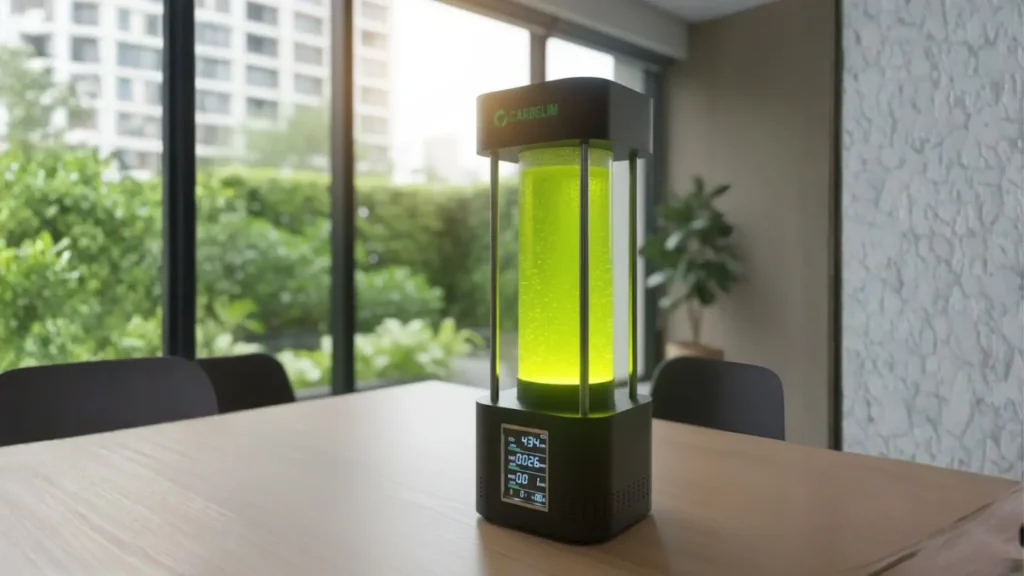
- Algae-based photobioreactors
- Bio-reactive air systems
- Living biological filtration units
Unlike houseplants, these systems are:
- Actively designed for air treatment
- Scalable
- Measurable in performance
- Integrated with airflow management
Why Plants Alone Are Not Enough for Modern Indoor Spaces
Modern buildings are:
- Airtight for energy efficiency
- Occupancy-dense
- Mechanically ventilated
- Continuously emitting CO₂
In such environments:
- Passive solutions cannot keep up
- Air quality must be managed actively
- Measurement and control are essential
This is why commercial spaces increasingly focus on CO₂ monitoring, ventilation optimization, and advanced air purification strategies, rather than relying on decorative greenery.
Advanced Biological Air Purification Systems
Biological air purification systems take inspiration from nature but apply it at an engineering scale.
One such approach involves microalgae, which absorb CO₂ far more efficiently than higher plants and can be integrated into controlled systems.
Unlike plants in pots:
- Algae systems are enclosed and optimized
- Light, airflow, and growth conditions are controlled
- CO₂ absorption can be measured and scaled
These systems bridge the gap between:
- Natural processes
- Functional indoor air treatment
They are increasingly discussed alongside biological direct air capture technologies, especially where traditional mechanical systems fall short.
From Indoor Spaces to Urban Environments
The same principles apply beyond buildings.
Urban environments face:
- High CO₂ concentrations
- Limited green space
- Dense infrastructure
This has led to the development of biological systems deployed in architectural and infrastructural elements, such as walls, facades, and dividers.
Solutions like biological panels for road and urban infrastructure extend nature-based purification beyond interiors, turning passive structures into active climate assets.
Plants, Psychology, and Perceived Air Quality
It’s important to acknowledge one area where plants genuinely excel: human perception and well-being.
Plants:
- Reduce stress
- Improve perceived comfort
- Enhance aesthetics
- Support biophilic design principles
These benefits are real and valuable—but they should not be confused with measurable air purification performance.
The most effective environments combine:
- Psychological benefits of greenery
- Functional performance of engineered systems
How to Choose the Right Air Purification Approach
When evaluating air purification strategies, consider:
- What problem are you solving?
- CO₂ accumulation
- Particulates
- VOCs
- Odors
- What scale is required?
- Home
- Office
- Commercial building
- Urban corridor
- Is performance measurable?
- Can CO₂ reduction be tracked?
- Is there data, not just perception?
- Is the solution passive or active?
- Passive solutions improve aesthetics
- Active systems deliver results
Many organizations now adopt layered strategies, combining:
- Ventilation
- Filtration
- Monitoring
- Biological systems
This integrated approach is often discussed within broader carbon capture and utilization frameworks, where indoor and outdoor air quality are seen as connected challenges.
The Future of Nature-Based Air Purification
The future is not about choosing between plants and technology—it’s about evolving nature-inspired solutions that work at scale. algae air purifiers in India
Trends include:
- Engineered biological systems
- Data-driven air quality management
- Integration with smart buildings
- Deployment across infrastructure, not just interiors
As awareness grows, the conversation is shifting from “Do plants purify air?” to:
“How can biological systems be designed to meaningfully improve air quality?”
Final Verdict: Do Plants Really Purify Indoor Air?
Plants contribute—but they do not purify indoor air in a functional, measurable way.
They are:
- Excellent for well-being
- Valuable for aesthetics
- Symbolically linked to sustainability
But when it comes to CO₂ reduction and indoor air quality control, plants alone are insufficient.
Real improvement comes from:
- Monitoring
- Ventilation
- Advanced air purification
- Biological systems designed for performance
Understanding this distinction helps individuals, businesses, and cities make informed decisions—moving beyond myths toward solutions that actually work.
Conclusion
The belief that plants purify indoor air is one of the most persistent myths in modern environmental thinking. While rooted in real biological processes, it oversimplifies the complex reality of indoor air quality.
As buildings become smarter and more efficient, air purification must evolve as well—combining the inspiration of nature with the precision of engineering.
Plants have a place.
But functional air purification requires functional systems.