
Introduction: Public Infrastructure Has a Carbon Problem
Cities are growing faster than ever.
According to the United Nations, nearly 70% of the global population is expected to live in urban areas by 2050. While urbanization drives economic growth, it also concentrates some of the world’s largest environmental challenges—air pollution, greenhouse gas emissions, heat islands, and declining air quality.
Public infrastructure sits at the center of this challenge.
Roads, airports, railway stations, bus terminals, ports, government buildings, and public spaces continuously generate and accumulate emissions. Millions of vehicles, aircraft operations, diesel generators, HVAC systems, and industrial activities contribute to rising carbon dioxide (CO₂) levels and deteriorating air quality.
Traditional mitigation strategies such as tree planting remain important, but they often face limitations in dense urban environments where land availability is scarce.
This is where a new generation of climate-tech infrastructure is emerging.
Carbon capture for public infrastructure is rapidly becoming a critical component of sustainable city development, enabling urban assets to actively remove carbon dioxide while improving air quality and environmental resilience.
The future of infrastructure is no longer passive.
It is becoming environmental infrastructure.
Why Public Infrastructure Is a Major Emissions Hotspot
Table of Contents
Public infrastructure systems operate continuously.
Unlike residential areas, transport corridors and public facilities often experience concentrated emissions throughout the day.
Major sources include:
- Road traffic emissions
- Airport ground operations
- Aircraft auxiliary power units
- Public transport fleets
- Construction activities
- Diesel backup generators
- Industrial logistics hubs
- Energy-intensive public buildings
Urban planners increasingly recognize that reducing emissions at these locations can significantly improve both local air quality and climate outcomes.
Key challenges include:
| Challenge | Impact |
|---|---|
| High traffic density | Elevated CO₂ and PM concentrations |
| Limited green space | Reduced natural carbon absorption |
| Heat island effect | Increased energy demand |
| Urban congestion | Higher fuel consumption |
| Population density | Greater exposure to pollutants |
The need for scalable carbon removal technology integrated directly into public infrastructure has never been greater.
The Shift Toward Carbon-Negative Infrastructure
Historically, infrastructure was designed primarily for functionality.
Roads moved vehicles.
Airports enabled travel.
Transit stations connected communities.
Today, infrastructure is expected to deliver additional environmental value.
Modern cities increasingly seek infrastructure that can:
- Capture carbon dioxide
- Improve air quality
- Generate environmental data
- Support ESG goals
- Contribute to net-zero targets
- Enhance public health outcomes
This shift is creating a new category known as:
Climate-Positive Infrastructure
Climate-positive infrastructure actively contributes to environmental improvement rather than simply minimizing environmental damage.
Examples include:
- Solar-powered transportation systems
- Green roofs and vertical gardens
- Smart environmental monitoring networks
- Carbon capture infrastructure
- Microalgae photobioreactors
- Smart air purification systems
What Is Carbon Capture Infrastructure?
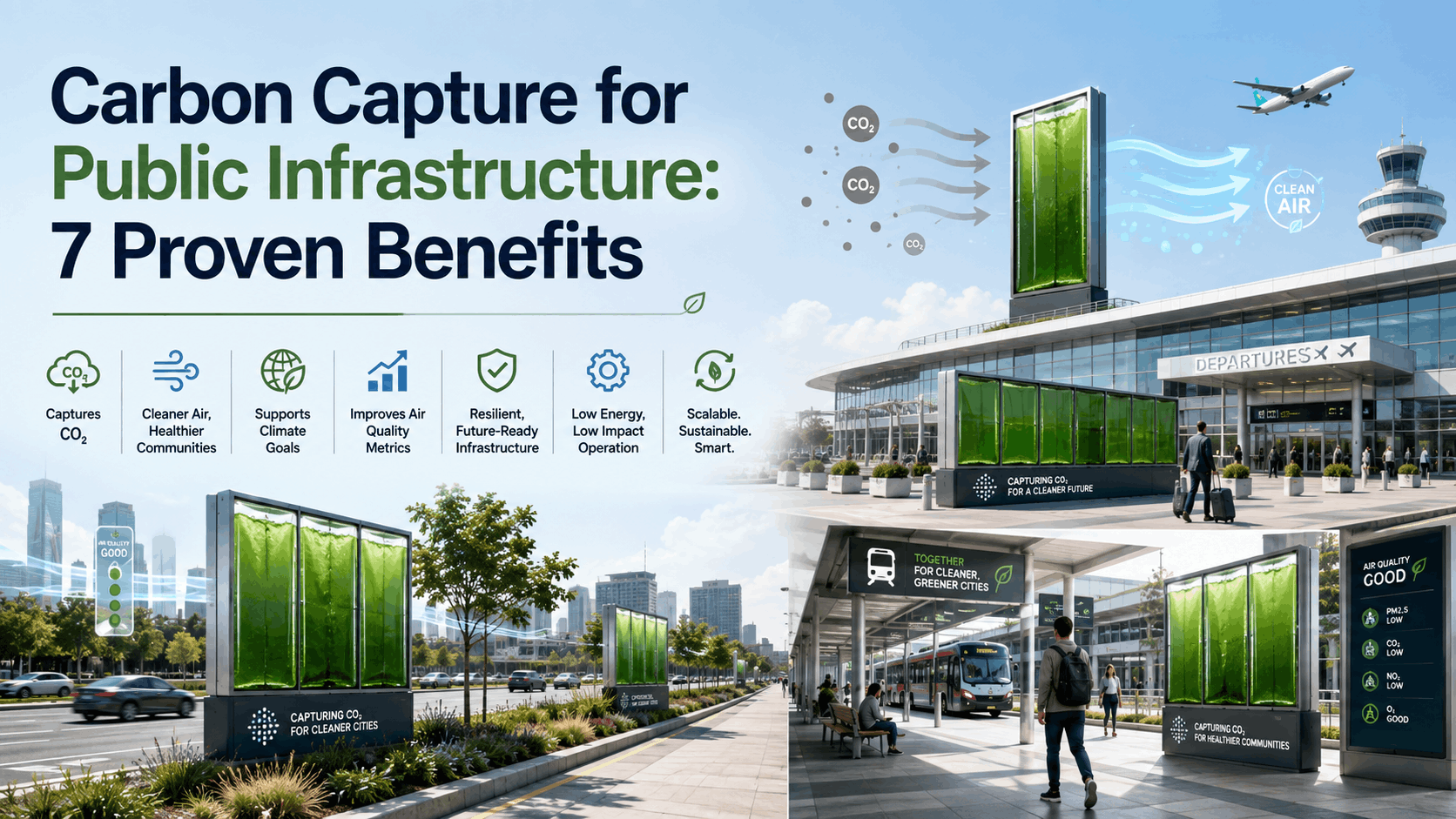
Carbon capture infrastructure refers to systems integrated into public spaces that remove carbon dioxide from the atmosphere.
Unlike traditional industrial carbon capture, which targets emissions directly from smokestacks, urban carbon capture focuses on ambient air.
This process is commonly known as:
Direct Air Capture (DAC)
Direct Air Capture removes CO₂ directly from the atmosphere regardless of its emission source.
Emerging approaches include:
Mechanical Direct Air Capture
Uses chemical sorbents and fans to capture CO₂.
Advantages:
- High precision
- Permanent carbon removal potential
Challenges:
- High energy requirements
- Significant operational costs
Biological Direct Air Capture
Uses living organisms such as microalgae to naturally absorb carbon dioxide through photosynthesis.
Advantages:
- Lower energy consumption
- Simultaneous oxygen generation
- Air purification benefits
- Biomass production potential
For urban environments, biological carbon capture is increasingly attracting attention because it combines environmental performance with public infrastructure applications.
Microalgae Carbon Capture: A Natural Climate Technology
Microalgae are among the most efficient photosynthetic organisms on Earth.
These microscopic organisms absorb CO₂ while producing oxygen and biomass.
Compared with many conventional plants, microalgae can achieve significantly higher carbon fixation rates under optimized conditions.
This makes them attractive for:
- Urban carbon capture
- Smart air purification
- Environmental monitoring
- Climate-tech infrastructure
- Sustainable city development
Microalgae-based photobioreactors are increasingly being explored as scalable solutions for public infrastructure applications.
What Are Photobioreactors?
Photobioreactors are engineered systems designed to cultivate microalgae under controlled conditions.
They provide:
- Sunlight exposure
- Carbon dioxide supply
- Water circulation
- Nutrient delivery
- Real-time monitoring
By optimizing these parameters, photobioreactors enable efficient biological carbon capture within compact urban footprints.
Modern systems can be integrated into:
- Streetscapes
- Transit stations
- Airports
- Public parks
- Educational campuses
- Government facilities
- Corporate campuses
Roadsides: Turning Traffic Corridors Into Carbon Sinks
Road transport remains one of the largest contributors to urban emissions.
High-traffic corridors experience:
- Elevated CO₂ levels
- Nitrogen oxide pollution
- Particulate matter accumulation
- Reduced pedestrian air quality
Traditional roadside landscaping helps but often provides limited environmental impact relative to traffic volumes.
Smart carbon capture systems can complement urban greening efforts.
Potential Roadside Applications
Smart Air Purification Units
Installed along major roads to:
- Capture carbon dioxide
- Reduce localized pollution exposure
- Monitor environmental conditions
Carbon Capture Street Furniture
Emerging designs include:
- Carbon-capturing benches
- Smart bus shelters
- Climate-responsive streetlights
These solutions transform ordinary urban assets into environmental infrastructure.
Airports: A New Frontier for Carbon Capture
Airports are among the most carbon-intensive public infrastructure assets.
Emission sources include:
- Aircraft operations
- Ground transportation
- HVAC systems
- Cargo logistics
- Backup power systems
Many international airports have adopted ambitious net-zero targets.
However, reducing emissions alone may not be sufficient.
Carbon removal technologies are becoming increasingly important.
Airport Carbon Capture Opportunities
Passenger Terminal Integration
Carbon capture systems can be integrated into:
- Arrival halls
- Departure terminals
- Waiting areas
Outdoor Infrastructure
Deployment opportunities include:
- Parking facilities
- Access roads
- Transit hubs
- Public plazas
Environmental Monitoring Networks
Real-time air quality monitoring provides valuable environmental intelligence for airport sustainability programs.
Smart Cities and Integrated Environmental Infrastructure
The next generation of smart cities will combine:
- IoT sensors
- AI analytics
- Carbon capture systems
- Renewable energy
- Environmental monitoring
This integrated approach enables data-driven sustainability management.
Key Components
AI Air Quality Monitoring
Measures:
- CO₂ concentration
- PM2.5
- PM10
- Temperature
- Humidity
Digital MRV Systems
MRV stands for:
Measurement, Reporting, and Verification
Digital MRV enables:
- Transparent sustainability reporting
- Carbon accounting
- ESG disclosure support
- Performance optimization
Connected Infrastructure
Environmental systems become part of city-wide digital ecosystems.
ESG and Net-Zero Infrastructure Requirements
Investors increasingly evaluate infrastructure through ESG frameworks.
Key priorities include:
Environmental
- Carbon reduction
- Air quality improvement
- Resource efficiency
Social
- Public health benefits
- Cleaner urban environments
- Improved quality of life
Governance
- Transparent reporting
- Data-driven decision-making
- Verifiable impact metrics
Carbon capture infrastructure directly supports all three ESG pillars.
Why Governments Are Investing in Climate-Tech Infrastructure
Governments worldwide are allocating billions toward sustainable infrastructure.
Drivers include:
- Net-zero commitments
- Climate adaptation requirements
- Urban resilience goals
- Air quality mandates
- Public health priorities
Public infrastructure projects increasingly require measurable environmental outcomes.
Carbon capture systems provide a practical pathway toward achieving these objectives.
The Future of Carbon Capture in Public Spaces
Over the next decade, urban infrastructure is expected to evolve beyond traditional functionality.
Future infrastructure assets may routinely include:
- Carbon capture systems
- Smart environmental sensors
- Renewable energy integration
- AI-driven optimization
- Real-time sustainability dashboards
Cities will increasingly measure infrastructure performance not only by utilization but also by environmental contribution.
Key metrics may include:
- Carbon removed
- Air pollutants reduced
- Oxygen generated
- Environmental health improvements
- Climate resilience benefits
Carbelim’s Vision for Climate-Positive Infrastructure
Companies such as Carbelim are advancing microalgae-powered climate technologies designed to support cleaner and more sustainable urban environments. Through the development of smart photobioreactor systems, real-time environmental monitoring, and biological carbon capture solutions, the goal is to transform everyday infrastructure into active environmental assets.
This vision aligns with the broader movement toward:
- Smart city sustainability
- Carbon-negative infrastructure
- Climate resilience
- Digital MRV
- Nature-inspired engineering
- Net-zero development
As cities seek scalable climate solutions, biological carbon capture integrated into public infrastructure could become a key component of future urban planning.
Key Takeaways
Carbon Capture Infrastructure Is Emerging Rapidly
Cities need scalable solutions that address both carbon emissions and air quality.
Roadsides and Airports Offer Significant Opportunities
High-emission public assets provide ideal deployment environments.
Microalgae-Based Systems Show Strong Potential
Biological carbon capture combines carbon removal, air purification, and environmental monitoring.
Smart Cities Need Environmental Infrastructure
Future urban systems will integrate AI, IoT, carbon capture, and digital MRV.
ESG and Net-Zero Goals Are Accelerating Adoption
Governments, airports, corporations, and municipalities increasingly require measurable environmental outcomes.
Real-World Applications of Carbon Capture Infrastructure
As cities pursue net-zero goals, carbon capture systems are moving beyond research projects and becoming part of everyday infrastructure.
The next generation of public infrastructure will combine environmental performance with urban functionality.
Smart Roads and Highways
Road networks occupy significant land area within cities and continuously experience vehicle emissions.
Future smart roads may integrate:
- Microalgae photobioreactors
- Air quality monitoring systems
- Solar-powered environmental units
- Carbon capture street furniture
- Digital sustainability dashboards
Benefits include:
- Localized carbon reduction
- Improved roadside air quality
- Reduced urban heat island effects
- Enhanced environmental data collection
Railway Stations and Metro Infrastructure
Millions of passengers travel through railway stations and metro networks every day.
These high-footfall environments create opportunities for climate-positive infrastructure deployment.
Potential applications include:
Carbon-Capturing Waiting Areas
Environmental systems integrated into:
- Passenger shelters
- Platform infrastructure
- Transit corridors
Smart Environmental Monitoring
Real-time tracking of:
- Carbon dioxide concentration
- Air quality levels
- Temperature
- Humidity
- Occupancy trends
This data can support operational optimization and sustainability reporting.
Public Parks and Urban Green Spaces
Urban parks are increasingly being designed as environmental assets.
Combining natural vegetation with advanced carbon capture systems can enhance overall environmental performance.
Benefits include:
| Infrastructure Element | Environmental Benefit |
|---|---|
| Trees | Natural carbon sequestration |
| Microalgae Systems | High-efficiency carbon capture |
| Air Quality Sensors | Environmental intelligence |
| Solar Integration | Renewable power generation |
| Digital MRV | Verified sustainability reporting |
This hybrid approach maximizes land efficiency while improving urban resilience.
Educational Campuses and Research Parks
Universities, schools, and research institutions are becoming early adopters of climate-tech infrastructure.
Reasons include:
- Sustainability commitments
- Carbon neutrality targets
- Student engagement
- Research opportunities
- ESG reporting requirements
Smart carbon capture installations can serve both environmental and educational purposes.
Students can interact with real-time dashboards showing:
- Carbon captured
- Air quality improvements
- Environmental conditions
- Sustainability metrics
Government Buildings and Civic Infrastructure
Government facilities increasingly lead sustainability initiatives.
Deployment opportunities include:
- Municipal offices
- Smart city command centers
- Public service buildings
- Administrative campuses
- Community centers
These installations demonstrate environmental leadership while contributing to climate action goals.
Economic Benefits of Carbon Capture Infrastructure
Carbon capture infrastructure is not only an environmental investment.
It can also generate long-term economic value.
Reduced Climate Risk
Cities face growing costs from:
- Extreme weather events
- Heat waves
- Air pollution
- Public health impacts
Investing in climate-positive infrastructure helps improve urban resilience.
Enhanced ESG Performance
Organizations operating public assets increasingly face sustainability disclosure requirements.
Carbon capture systems can support:
- ESG reporting
- Sustainability certifications
- Carbon accounting
- Net-zero roadmaps
- Environmental compliance
Green Investment Attraction
Investors are increasingly prioritizing projects that demonstrate measurable environmental outcomes.
Infrastructure with integrated carbon capture capabilities may become more attractive for:
- Climate funds
- Green bonds
- ESG-focused investors
- Sustainable infrastructure financing
The Role of Digital MRV in Future Infrastructure
One of the biggest challenges in climate action is proving impact.
This is where Digital MRV (Measurement, Reporting, and Verification) becomes critical.
Modern carbon capture systems increasingly integrate:
Real-Time Monitoring
Tracking:
- CO₂ absorption
- Air quality improvements
- Environmental performance
- System efficiency
Automated Reporting
Generating:
- ESG reports
- Sustainability metrics
- Carbon reduction data
- Compliance documentation
Verifiable Climate Impact
Decision-makers increasingly require measurable outcomes rather than estimated environmental benefits.
Digital MRV helps bridge the gap between climate commitments and demonstrated impact.
Why Public Infrastructure Will Become Environmental Infrastructure
Historically, infrastructure was built to move people, transport goods, and provide services.
The future demands more.
Tomorrow’s infrastructure will be expected to:
✔ Remove carbon from the atmosphere
✔ Improve public health
✔ Generate environmental intelligence
✔ Support climate adaptation
✔ Enhance urban resilience
✔ Contribute to net-zero targets
✔ Deliver measurable ESG outcomes
Cities that embrace this transition will gain significant advantages in sustainability, livability, and long-term economic competitiveness.
The infrastructure of the future will not simply exist within the environment—it will actively improve it.
Conclusion
The future of public infrastructure extends beyond transportation, connectivity, and utility services.
Infrastructure is becoming a climate asset.
From busy roadsides and transit hubs to international airports and smart city districts, carbon capture technologies are creating opportunities to transform urban environments into active contributors to climate action.
As climate challenges intensify and sustainability expectations rise, cities that integrate carbon capture, smart air purification, and environmental monitoring into public infrastructure will be better positioned to achieve cleaner air, stronger resilience, and long-term net-zero objectives.
The next generation of sustainable cities will not simply consume resources.
They will help restore the environment.
Call to Action
Interested in how microalgae-powered carbon capture, smart air purification, and digital MRV systems can support sustainable infrastructure projects?
Explore emerging climate-tech solutions and discover how environmental infrastructure can help cities, campuses, industries, and public spaces accelerate their journey toward net-zero development.
Learn more: https://carbelim.io/