
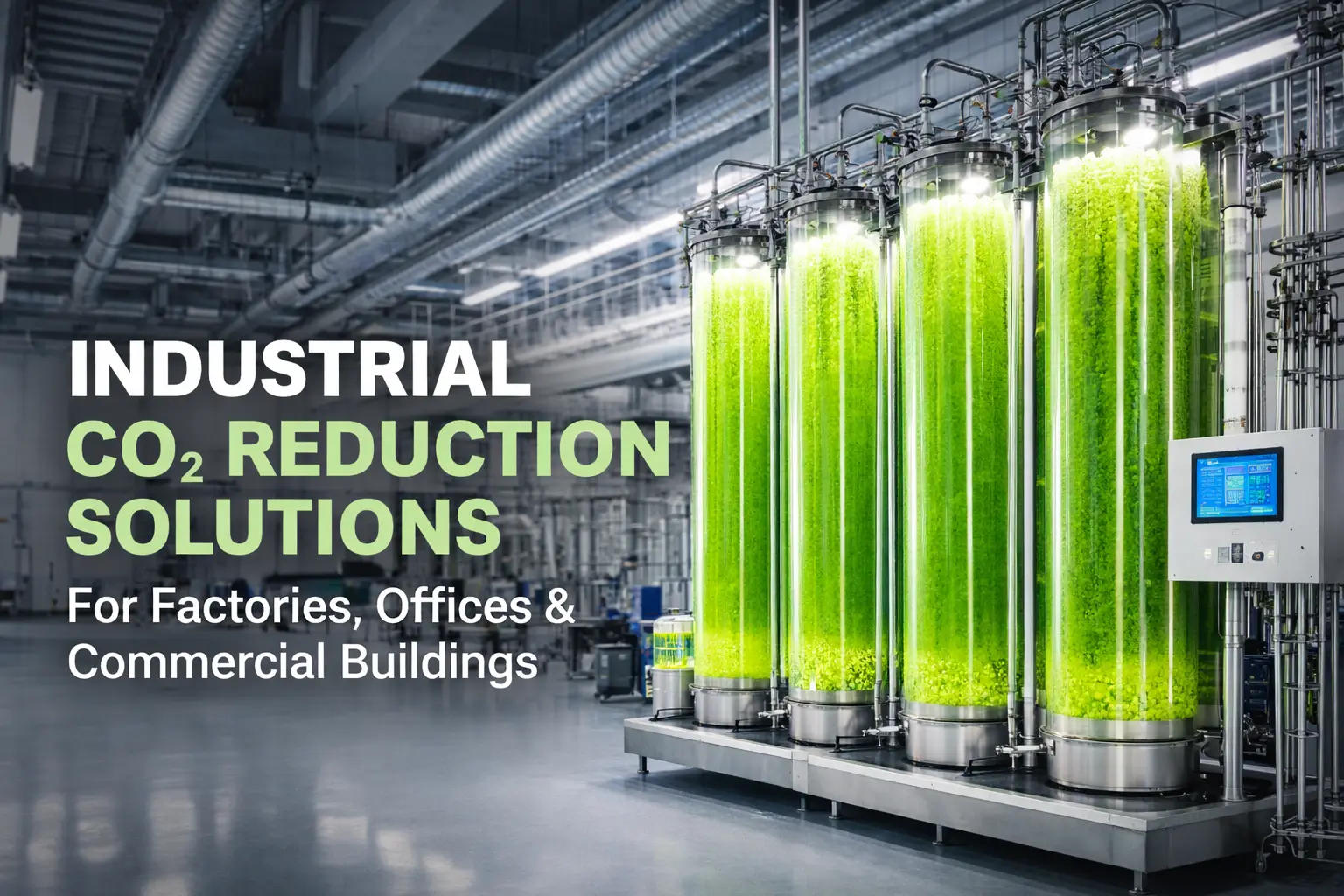
Indoor air quality in industrial and commercial environments is no longer just a comfort issue—it has become a business-critical factor affecting employee productivity, regulatory compliance, operational efficiency, and sustainability performance. While most organizations focus on particulate matter, odors, or ventilation rates, one invisible pollutant is often overlooked: carbon dioxide (CO₂).
Elevated indoor CO₂ levels are now recognized as a major contributor to cognitive decline, fatigue, and reduced workplace efficiency. As organizations grow, buildings become more airtight, and occupancy density increases, traditional ventilation systems struggle to keep CO₂ within recommended limits.
This has led to growing demand for industrial CO₂ reduction solutions that go beyond ventilation and conventional air purifiers.
Understanding the Indoor CO₂ Challenge in Industrial & Commercial Spaces
Carbon dioxide is a natural byproduct of human respiration and industrial activity. In enclosed or semi-enclosed spaces such as factories, offices, laboratories, and public buildings, CO₂ accumulates rapidly when fresh air exchange is insufficient.
Typical CO₂ Sources Indoors
- Human occupancy (employees, visitors)
- Combustion processes
- Industrial equipment
- Poorly balanced HVAC systems
- Airtight modern building designs
According to widely accepted indoor air quality benchmarks, CO₂ levels:
- Below 800 ppm are considered optimal
- 800–1,000 ppm indicate insufficient ventilation
- Above 1,200 ppm are linked to reduced cognitive performance and discomfort
Despite these thresholds, many commercial buildings routinely operate above recommended limits—often without real-time awareness.
Why High CO₂ Levels Are a Business Risk
Elevated CO₂ is not just an environmental metric; it directly impacts business outcomes. B2B2c Solutions
1. Reduced Employee Productivity
Multiple studies have shown that decision-making ability, concentration, and task performance decline as CO₂ levels rise. In knowledge-driven environments such as IT parks and offices, this can translate into measurable productivity losses.
2. Health & Comfort Concerns
High CO₂ concentrations are associated with:
- Drowsiness and headaches
- Reduced alertness
- Perceived poor air quality
These symptoms increase absenteeism and employee dissatisfaction.
3. Compliance & ESG Pressure
Green building certifications and ESG frameworks increasingly emphasize indoor environmental quality, not just energy efficiency. CO₂ monitoring and control are becoming essential for:
- ESG disclosures
- WELL and LEED certifications
- Corporate sustainability reporting
Why Traditional Ventilation Alone Is No Longer Enough
Most buildings rely on ventilation-based CO₂ control, either through natural airflow or mechanical HVAC systems. While ventilation is essential, it has clear limitations.
Limitations of Ventilation-Only Approaches
- Energy intensive: High fresh air intake increases cooling and heating loads
- Climate dependent: Outdoor air quality and temperature affect performance
- Inefficient during peak occupancy: CO₂ can spike faster than air exchange rates
- Poor scalability: Retrofitting older buildings is costly and complex
Even advanced HVAC systems are designed primarily for thermal comfort, not continuous CO₂ removal.
Do Conventional Air Purifiers Reduce CO₂?
A common misconception is that air purifiers improve all aspects of air quality. In reality, most conventional systems—especially HEPA-based purifiers—do not remove CO₂ at all.
HEPA filters are highly effective at trapping particulate matter (PM2.5, dust, allergens), but CO₂ is a gas molecule that passes straight through mechanical filters.
You can explore this limitation in more detail in this internal resource:
👉 Algae Air Purifier vs HEPA Filter: Which Is Better for Indoor Air Quality?
This gap has created demand for dedicated CO₂ reduction systems that work alongside existing HVAC infrastructure.
What Are Industrial CO₂ Reduction Solutions?
Industrial CO₂ reduction solutions are systems designed to actively lower carbon dioxide concentrations in indoor environments rather than merely diluting them with outdoor air.
Core Approaches Include:
- Adsorption or absorption-based CO₂ capture
- Chemical scrubbing (limited indoor applicability)
- Biological CO₂ assimilation
- Hybrid ventilation + capture systems
Among these, biological CO₂ reduction using algae is emerging as a scalable and sustainable option for indoor and semi-enclosed environments.
How Algae-Based CO₂ Reduction Systems Work
Algae are among the most efficient natural organisms for carbon capture. Through photosynthesis, microalgae absorb CO₂ and convert it into oxygen and biomass.
In controlled systems, this natural process can be harnessed for continuous indoor CO₂ reduction.
Key Working Principle
- CO₂-rich indoor air is circulated through an algae cultivation system
- Microalgae absorb CO₂ during photosynthesis
- Oxygen-rich air is released back into the environment
- Captured carbon is stored as algal biomass
Unlike mechanical filtration, this is a biological transformation, not temporary containment.
You can read more about the science behind this process here:
👉 How Algae Absorb Carbon Dioxide Through Photosynthesis
Advantages of Algae-Based CO₂ Reduction for Enterprises
1. Continuous CO₂ Removal
Unlike ventilation systems that dilute CO₂ intermittently, algae-based systems actively remove CO₂ as long as photosynthesis occurs.
2. Energy-Efficient Operation
Biological carbon capture consumes significantly less energy than mechanical air exchange at scale, especially in large buildings.
3. Oxygen Regeneration
In addition to CO₂ reduction, algae naturally release oxygen, improving perceived air freshness.
4. ESG & Sustainability Alignment
Algae systems directly support:
- Carbon reduction goals
- Nature-based climate solutions
- Visible sustainability initiatives
This makes them particularly attractive for organizations with strong ESG mandates.
Industrial & Commercial Use Cases
Algae-based CO₂ reduction solutions are well suited for a wide range of applications.
Manufacturing Facilities
Factories often experience high CO₂ levels due to workforce density and equipment operation. Integrating CO₂ reduction systems can improve worker comfort without increasing HVAC loads.
Offices & IT Parks
Cognitive performance is critical in office environments. CO₂ control supports productivity, employee wellness, and green building certifications.
Hospitals & Laboratories
Healthcare environments demand stable indoor air quality. CO₂ control enhances comfort while supporting infection control strategies.
Airports & Public Infrastructure
Large enclosed spaces with fluctuating occupancy benefit from scalable, modular CO₂ reduction systems.
Green & Smart Buildings
Sustainable buildings increasingly require active carbon management, not just energy efficiency.
CO₂ Monitoring and Intelligent Control
Effective CO₂ reduction starts with accurate monitoring. Modern systems integrate sensors that track:
- CO₂ concentration (ppm)
- Occupancy patterns
- System performance
This data-driven approach enables:
- Demand-based operation
- Energy optimization
- Compliance reporting
For a deeper look into CO₂ monitoring strategies, see:
👉 How to Reduce High CO₂ Levels Indoors Naturally
Integration with Existing Building Systems
One of the major advantages of modern CO₂ reduction solutions is their compatibility with existing infrastructure.
Algae-based systems can be:
- Installed alongside HVAC systems
- Deployed as modular indoor units
- Scaled based on space size and occupancy
This flexibility makes them suitable for both new constructions and retrofits.
Industrial CO₂ Reduction vs Direct Air Capture (DAC)
While Direct Air Capture (DAC) is often discussed in the context of outdoor or industrial emissions, similar principles can be applied indoors.
Indoor-focused DAC systems aim to:
- Capture CO₂ at lower concentrations
- Operate safely in occupied spaces
- Integrate with building airflow
You can explore how these concepts intersect here:
👉 Carbon Capture Technology: How Algae-Based Systems Transform Indoor Spaces
Economic & Operational Benefits for Businesses
Beyond environmental value, CO₂ reduction delivers tangible business benefits.
Improved Workforce Performance
Lower CO₂ levels correlate with better focus, decision-making, and reduced fatigue.
Reduced HVAC Energy Costs
By lowering dependence on excessive ventilation, organizations can optimize energy consumption.
Enhanced Brand & ESG Positioning
Visible, nature-based solutions strengthen sustainability narratives for investors, clients, and employees.
Future-Ready Compliance
As indoor air quality standards evolve, proactive CO₂ management reduces regulatory risk.
Choosing the Right CO₂ Reduction Solution
When evaluating industrial CO₂ reduction systems, organizations should consider:
- Effectiveness at low CO₂ concentrations
- Energy consumption
- Maintenance requirements
- Scalability
- Integration with existing systems
- Alignment with sustainability goals
Biological solutions such as algae-based systems offer a unique balance of performance, sustainability, and operational efficiency.
The Future of Industrial Indoor Air Quality
As buildings become smarter and sustainability expectations rise, indoor air quality management will evolve beyond ventilation.
The future lies in:
- Active carbon management
- Nature-based technologies
- Integrated monitoring and control
- Solutions that deliver both environmental and business value
Algae-based CO₂ reduction represents a shift from air filtration to air regeneration—a critical step toward healthier, more sustainable indoor environments.
Conclusion
Industrial CO₂ reduction is no longer optional for organizations that prioritize productivity, sustainability, and long-term resilience. Traditional ventilation and air purification systems address only part of the problem.
By adopting advanced solutions such as algae-based CO₂ reduction systems, businesses can move toward continuous, energy-efficient, and ESG-aligned indoor air quality management.
For enterprises exploring future-ready approaches to indoor carbon management, nature-based solutions offer a scalable and responsible path forward.