Cities are where the climate crisis becomes personal.
It is the child walking to school through traffic pollution. The office worker breathing particulate-heavy air during rush hour. The elderly resident living near construction dust, diesel corridors, and heat-trapping concrete. It is also the investor, policymaker, ESG leader, and urban planner asking the same urgent question:
How do we build cities that are not only smarter, but healthier, cleaner, and climate-resilient?
The answer is emerging at the intersection of smart air purification, direct air capture, carbon capture technology, and net-zero infrastructure. As urban populations grow, sustainable cities will need more than electric vehicles, green buildings, and renewable energy. They will need intelligent environmental systems that actively clean air, remove carbon dioxide, monitor pollutants, and integrate with the digital backbone of smart cities.
This is where clean air technology becomes core urban infrastructure.
Why Sustainable Cities Need a New Clean Air Strategy
More than half of the global population already lives in cities, and UN agencies project that the urban share will rise sharply by 2050. UNEP notes that 55% of people live in cities today, rising to 68% by 2050, while UN-Habitat highlights that cities are central actors in both emissions and climate vulnerability.
At the same time, air pollution remains one of the world’s most serious environmental health risks. The World Health Organization estimates that air pollution causes millions of premature deaths every year, and its global air quality work tracks exposure to outdoor and household air pollution for health and Sustainable Development Goal reporting.
For city leaders, this creates a strategic mandate:
- Reduce particulate pollution and toxic air exposure.
- Lower urban carbon emissions.
- Improve climate resilience.
- Deploy measurable ESG sustainability infrastructure.
- Build cleaner, healthier public spaces.
- Align urban development with net-zero pathways.
Traditional air quality management is no longer enough. Future sustainable cities need carbon reduction systems and smart environmental technology that can respond dynamically to pollution patterns, population density, mobility flows, and climate stress.
What Is Direct Air Capture?
Direct air capture, often called DAC, is a form of carbon removal technology that extracts carbon dioxide directly from ambient air. Unlike point-source carbon capture, which captures emissions from factories or power plants, direct air capture works on dispersed atmospheric CO₂.
The International Energy Agency describes direct air capture as a technology that captures CO₂ directly from the air and can permanently store it, helping balance hard-to-abate emissions and address legacy emissions already in the atmosphere.
How Direct Air Capture Works
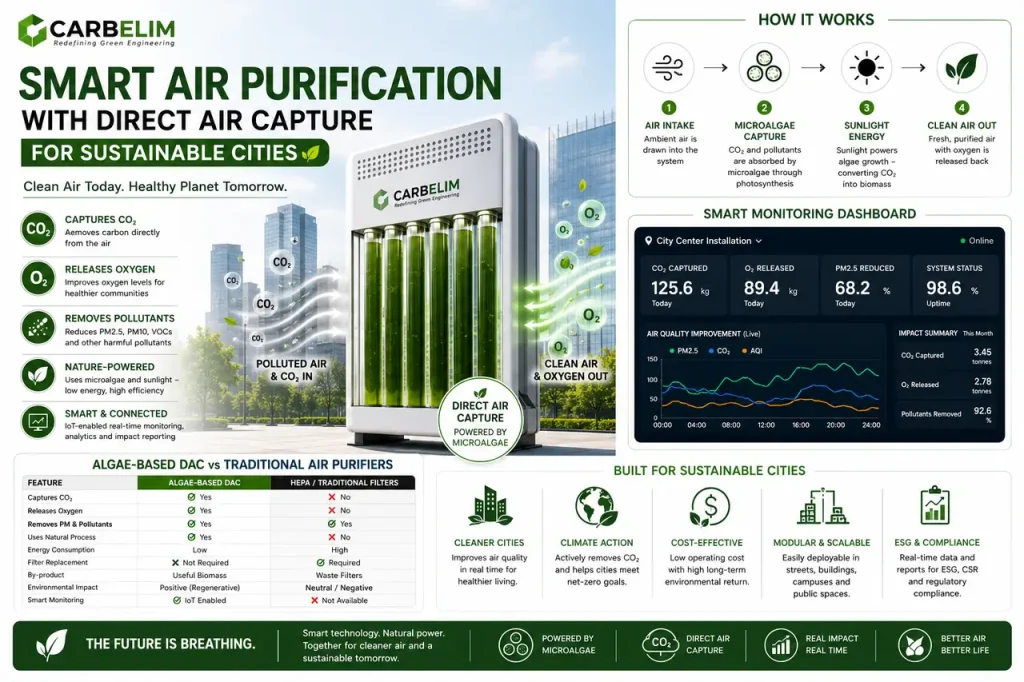
Most direct air capture systems follow a basic process:
- Air intake
Fans or passive airflow systems draw ambient air into a capture unit. - CO₂ separation
Chemical sorbents, solvents, membranes, mineralization systems, or biological processes bind or absorb CO₂. - Regeneration or conversion
The captured CO₂ is separated, concentrated, mineralized, stored, or converted into useful products. - Storage or utilization
CO₂ may be permanently stored underground, embedded into materials, used in carbon-negative products, or converted through biological carbon capture pathways.
Why Direct Air Capture Matters for Net Zero
Net zero does not mean zero emissions everywhere. It means reducing emissions as deeply as possible and balancing residual emissions with credible carbon removal. Direct air capture can support this by removing CO₂ that is already in the atmosphere, especially for sectors where full decarbonization is difficult.
However, DAC is still scaling. The IEA notes that direct air capture plants currently operate at small scale, while planned projects and net-zero scenarios require major growth by 2030.
For cities, this means direct air capture should not be positioned as a replacement for emissions reduction. It should be part of a broader net-zero infrastructure stack that includes electrification, renewable energy, public transport, green buildings, nature-based solutions, and advanced air purification.
What Is Smart Air Purification?
Smart air purification refers to air-cleaning systems that combine filtration, sensing, automation, and data intelligence to improve air quality in real time.
Unlike conventional air purifiers, smart air purification systems can be integrated with:
- IoT sensors
- AI-based air quality analytics
- PM2.5 and PM10 monitoring
- CO₂ and VOC tracking
- Urban heat and humidity data
- Building management systems
- Smart city dashboards
- ESG reporting tools
- Renewable energy systems
In a city context, smart air purification is not limited to indoor devices. It can include urban air purification systems deployed in public spaces, transit hubs, schools, hospitals, commercial buildings, airports, industrial corridors, and high-footfall urban zones.
How Smart Air Purification Systems Work
A high-performance smart air purification platform typically includes four layers.
1. Air Quality Sensing Layer
Sensors track pollutants such as:
- PM2.5
- PM10
- CO₂
- NO₂
- SO₂
- Ozone
- Volatile organic compounds
- Temperature and humidity
- Airflow and occupancy patterns
This enables real-time visibility into pollution hotspots.
2. Purification and Capture Layer
Depending on the use case, systems may combine:
- HEPA filtration
- Activated carbon filtration
- Electrostatic precipitation
- UV-C disinfection
- Photocatalytic oxidation
- Biofiltration
- Microalgae-based biological carbon capture
- Direct air capture modules
- Mineralization-based carbon sequestration
3. Intelligence and Automation Layer
AI and analytics can optimize system performance by adjusting airflow, capture intensity, maintenance cycles, and energy use.
For example, a smart city air purification network could increase filtration during rush hours, construction activity, wildfire smoke events, or high AQI episodes.
4. Measurement and Reporting Layer
For ESG leaders and infrastructure teams, measurement is critical. Smart systems can generate data for:
- Air quality improvement
- CO₂ capture estimates
- Energy performance
- Carbon reduction reporting
- ESG sustainability disclosures
- Public health impact dashboards
- Smart city sustainability KPIs
This turns clean air from an invisible benefit into a measurable infrastructure outcome.
Why Urban Air Pollution Is Increasing
Urban air pollution is driven by a combination of population growth, vehicle emissions, industrial activity, construction, fossil fuel combustion, poor waste management, and climate-amplified events such as heatwaves and wildfires.
The World Bank highlights that most outdoor air pollution globally comes from human activities across agriculture, urban development, transport, industry, and residential cooking and heating.
Key Drivers of Urban Air Pollution
- Transport emissions
Diesel vehicles, congestion, freight corridors, and two-wheelers contribute to particulate and nitrogen oxide pollution. - Construction dust
Rapid urban expansion increases PM10 and PM2.5 exposure. - Industrial clusters
Urban and peri-urban manufacturing zones add localized pollution loads. - Energy demand
Cooling, heating, data centers, and commercial buildings increase urban energy consumption. - Waste burning and landfill emissions
Poor waste systems can worsen both air pollution and greenhouse gas emissions. - Urban heat islands
Heat-trapping surfaces intensify energy demand and chemical reactions that worsen air quality. - Climate change feedback loops
Heat, drought, dust, and wildfire smoke increasingly affect urban air quality.
This is why urban air pollution solutions must combine emissions prevention, active air cleaning, carbon removal, and climate adaptation.
The Role of Climate-Tech Innovation in Sustainable Cities
Climate-tech innovation is shifting from standalone products to integrated urban systems.
The next generation of sustainable urban infrastructure will not be defined only by solar panels or electric buses. It will be defined by intelligent, measurable, interoperable systems that reduce emissions, improve health, and generate climate intelligence.
Climate-Tech Solutions Transforming Cities
- Smart air purification corridors
- Direct air capture hubs
- Carbon-negative building materials
- Microalgae-based carbon capture systems
- Green rooftops and vertical forests
- Smart mobility and EV infrastructure
- Digital MRV platforms
- AI-powered energy optimization
- Urban carbon accounting tools
- Climate-risk mapping platforms
UN-Habitat’s World Cities Report 2024 emphasizes that cities are both deeply exposed to climate impacts and major contributors to emissions, making urban climate action a critical lever for global mitigation and resilience.
For climate-tech investors, this creates a high-growth opportunity: solutions that convert environmental infrastructure into measurable economic, regulatory, and health value.
How Carbon Capture Technology Supports Net-Zero Goals
Carbon capture technology supports net-zero goals by reducing or removing CO₂ emissions that would otherwise remain in the atmosphere.
In cities, carbon capture can support three strategic objectives:
1. Reduce Operational Carbon
Carbon capture can be integrated into waste-to-energy plants, industrial facilities, district heating systems, and commercial infrastructure.
2. Remove Residual Carbon
Direct air capture and carbon removal technology can help address residual emissions from aviation, heavy industry, logistics, and legacy emissions.
3. Enable Carbon-Negative Urban Infrastructure
Captured carbon can be mineralized into construction materials, stored permanently, or converted into useful carbon-based products.
The IPCC has also been developing methodology work around carbon dioxide removal and carbon capture, utilization, and storage, reflecting the growing importance of robust accounting for these technologies.
For ESG teams, the key is credibility. Carbon capture must be measurable, additional, durable, and supported by transparent monitoring, reporting, and verification.
Biological Carbon Capture: A Nature-Aligned Pathway
While many direct air capture systems use chemical sorbents or solvents, biological carbon capture offers a complementary pathway.
Microalgae are especially promising because they use photosynthesis to absorb CO₂ and convert it into biomass. Research reviews highlight microalgae’s potential for carbon sequestration, carbon utilization, circular bioeconomy models, and AI-enabled cultivation systems.
Why Biological Carbon Capture Is Relevant for Cities
Biological systems can potentially support:
- CO₂ capture
- Air quality improvement
- Biomass generation
- Biofertilizer production
- Urban cooling
- Circular economy models
- Green public infrastructure
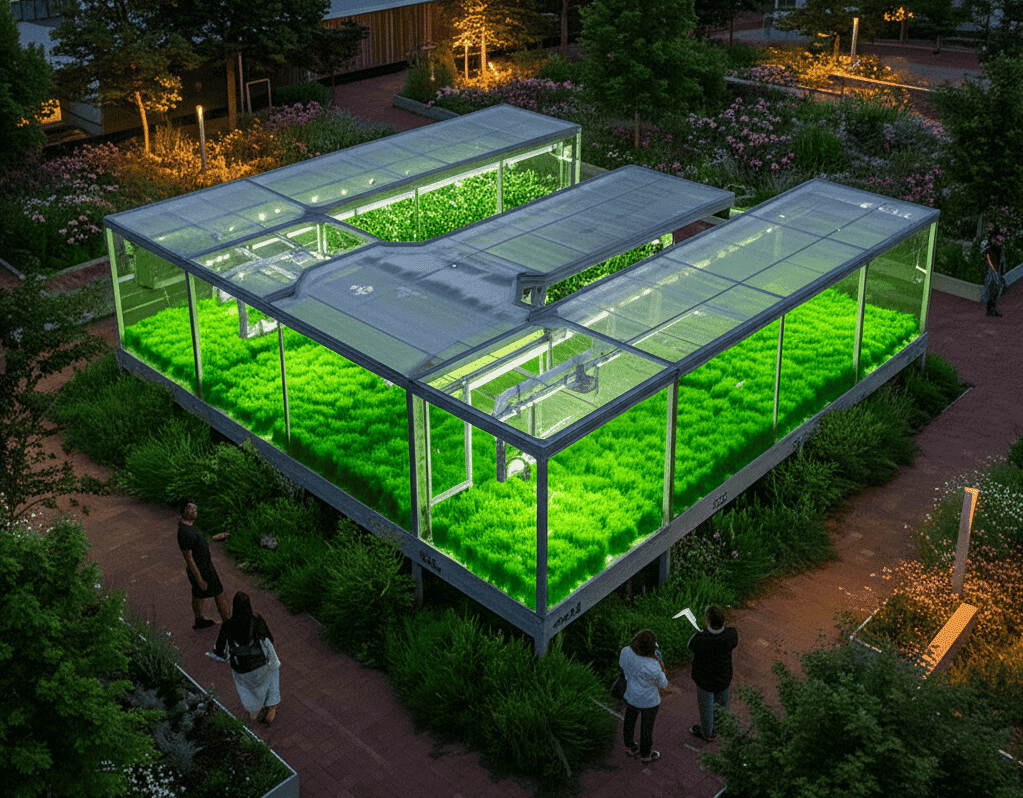
Recent research has explored microalgae-integrated urban systems, including building enclosures and urban furniture-like photobioreactors for CO₂ capture, biomass generation, and environmental enhancement.
This creates a compelling future vision: clean air infrastructure that behaves more like living infrastructure than mechanical equipment alone.
Smart City Applications for Clean Air Infrastructure
Smart city sustainability requires infrastructure that is connected, responsive, and measurable. Smart air purification with direct air capture can be deployed across multiple urban settings.
1. Transit Hubs and Metro Stations
High-footfall transport nodes can benefit from air purification systems that reduce particulate exposure and improve commuter experience.
Use cases include:
- Metro platforms
- Bus terminals
- Railway stations
- Airport lounges
- EV charging hubs
- Underground parking zones
2. Commercial Buildings and Corporate Campuses
ESG-focused companies can integrate clean air technology into offices, malls, hospitals, hotels, and innovation campuses.
Benefits include:
- Healthier indoor environments
- Employee wellbeing
- ESG sustainability reporting
- Green building differentiation
- Reduced carbon footprint
3. Schools, Hospitals, and Public Institutions
Sensitive populations need cleaner air. Smart air purification can support public health resilience in schools, clinics, hospitals, government buildings, and elderly care facilities.
4. Smart Roads and Pollution Corridors
Urban air purification systems can be deployed near traffic-heavy zones where exposure levels are high.
Examples include:
- Bus depots
- Traffic junctions
- Logistics hubs
- Industrial access roads
- Construction-heavy corridors
5. Green Buildings and Net-Zero Districts
Future net-zero districts can integrate carbon capture technology into buildings, facades, rooftops, courtyards, and shared public infrastructure.
6. Climate-Resilient Public Spaces
Parks, plazas, pedestrian corridors, and waterfronts can combine green infrastructure with sensor-driven air purification for improved liveability.
Smart Air Purification + Direct Air Capture: Why the Combination Matters
Smart air purification and direct air capture solve different but connected problems.
| Technology | Primary Function | Urban Benefit |
|---|---|---|
| Smart air purification | Removes pollutants such as PM, VOCs, and harmful gases | Improves local air quality and public health |
| Direct air capture | Removes CO₂ from ambient air | Supports carbon removal and net-zero goals |
| Biological carbon capture | Uses living systems such as microalgae to absorb CO₂ | Enables circular, nature-aligned carbon sequestration |
| Digital MRV | Measures and verifies performance | Enables ESG and policy-grade reporting |
The combined value proposition is powerful: cleaner air today and lower atmospheric carbon tomorrow.
Benefits for ESG Leaders, Urban Planners, and Investors
For ESG Professionals
Smart clean air systems can support:
- Scope 1, 2, and 3 reduction narratives
- Workplace health and safety goals
- Climate risk mitigation
- ESG disclosure credibility
- Net-zero transition planning
For Urban Planners
Clean air infrastructure can strengthen:
- Public health outcomes
- Climate resilience
- Green zoning
- Transit-oriented development
- Sustainable urban infrastructure design
For Investors
This space offers exposure to multiple growth themes:
- Climate-tech innovation
- Carbon removal technology
- Smart city infrastructure
- Health-focused real estate
- ESG compliance
- Data-driven environmental services
For Governments
Public agencies can use smart air purification and direct air capture pilots to:
- Improve urban liveability
- Meet air quality goals
- Build climate-resilient infrastructure
- Support green jobs
- Demonstrate measurable climate action
Future Trends in Smart Air Purification and Direct Air Capture
1. AI-Optimized Air Quality Networks
Cities will move from static pollution monitoring to predictive air quality management. AI systems will forecast pollution events and automatically activate distributed purification assets.
2. Carbon Capture as Urban Infrastructure
Direct air capture may evolve from isolated industrial plants into modular infrastructure embedded across districts, campuses, transport systems, and commercial hubs.
3. Biological Carbon Capture in Architecture
Microalgae-integrated facades, photobioreactors, and bio-based urban installations may become part of climate-responsive architecture.
4. Clean Air as an ESG Asset Class
Investors may increasingly evaluate clean air technology as part of sustainable real estate, green infrastructure, and climate adaptation portfolios.
5. Digital MRV for Urban Carbon Removal
Measurement, reporting, and verification will become central. Cities and companies will need trusted data to prove carbon removal, air quality improvement, and climate impact.
6. Hybrid Green Infrastructure
The future will not be mechanical versus natural. It will be hybrid: trees, wetlands, green roofs, biofilters, direct air capture, smart sensors, and AI-enabled systems working together.
7. Public Health-Driven Smart Cities
Clean air will become a competitive metric for cities seeking talent, investment, tourism, and climate finance.
Challenges to Scale
Smart air purification and direct air capture are promising, but responsible deployment must address real constraints.
Key Challenges
- High energy demand for some DAC systems
- Cost of deployment and maintenance
- Need for renewable energy integration
- Verification of carbon removal claims
- Permanent storage availability
- Urban permitting and infrastructure integration
- Avoiding greenwashing
- Ensuring equitable deployment across communities
The strategic takeaway: cities should deploy these technologies as part of an integrated climate action roadmap, not as standalone optics.
Strategic Framework for Cities and Companies
A practical roadmap for implementation:
- Map pollution hotspots
Use sensor networks and satellite data to identify high-exposure zones. - Prioritize vulnerable locations
Focus on schools, hospitals, transit corridors, and dense commercial districts. - Deploy modular pilots
Start with measurable pilot projects before citywide rollout. - Integrate renewable energy
Pair air purification and DAC systems with solar, storage, and low-carbon power. - Add digital MRV
Track air quality, CO₂ capture, energy use, and maintenance performance. - Build public-private partnerships
Involve governments, startups, real estate owners, ESG teams, and investors. - Scale through policy and procurement
Use green procurement, climate finance, and smart city budgets to accelerate adoption.
The Future of Sustainable Urban Development
The future sustainable city will not be defined only by how efficiently it moves people or how tall its buildings rise. It will be defined by how intelligently it protects life.
A truly sustainable city will:
- Clean the air people breathe.
- Remove carbon from the atmosphere.
- Reduce emissions at source.
- Generate transparent ESG data.
- Use biology, engineering, and AI together.
- Protect vulnerable communities.
- Turn infrastructure into climate resilience.
Smart air purification with direct air capture represents a new category of urban climate infrastructure — one that connects clean air, carbon removal, public health, and net-zero development.
For climate-tech leaders, this is not just an environmental opportunity. It is a market-making opportunity.
For cities, it is a resilience imperative.
For investors, it is a signal of where sustainable infrastructure is heading next.
FAQ: Smart Air Purification and Direct Air Capture
What is direct air capture?
Direct air capture is a carbon removal technology that extracts CO₂ directly from ambient air. The captured CO₂ can be stored permanently or used in products, fuels, materials, or biological systems.
How is direct air capture different from carbon capture?
Traditional carbon capture usually captures CO₂ from point sources such as factories or power plants. Direct air capture removes CO₂ from the open atmosphere.
What is smart air purification?
Smart air purification uses sensors, filtration, automation, and data analytics to improve air quality in real time. It can be integrated into buildings, transit systems, public spaces, and smart city platforms.
Can smart air purification remove carbon dioxide?
Some systems can reduce CO₂ concentrations, but carbon dioxide removal at climate-relevant levels typically requires dedicated direct air capture, biological carbon capture, mineralization, or other carbon removal technology.
Why is clean air technology important for sustainable cities?
Clean air technology improves public health, supports ESG sustainability goals, reduces pollution exposure, strengthens climate resilience, and helps cities transition toward net-zero infrastructure.
Is biological carbon capture scalable?
Biological carbon capture, including microalgae-based systems, is an emerging field with strong potential. Scaling depends on system design, land or surface availability, productivity, lifecycle performance, and integration with circular economy models.
How can investors evaluate clean air technology startups?
Investors should assess technology readiness, measurable impact, unit economics, energy use, MRV capability, regulatory alignment, deployment model, customer demand, and scalability.
What is the future of smart city sustainability?
The future of smart city sustainability will combine clean energy, low-carbon mobility, green buildings, digital MRV, nature-based solutions, smart air purification, and carbon removal infrastructure.
Cities cannot reach a cleaner, healthier, net-zero future with passive infrastructure alone.
The next wave of sustainable urban development will require active systems that clean air, capture carbon, generate climate intelligence, and deliver measurable ESG impact.
If your organization is exploring smart city sustainability, carbon capture technology, or clean air infrastructure, now is the time to pilot scalable solutions that turn climate ambition into measurable urban transformation.