Introduction: The Invisible Factor Behind Workplace Performance
Organizations spend billions each year optimizing workplace productivity. Companies invest in advanced technology, ergonomic office design, employee training programs, and collaboration platforms to improve performance. Yet one of the most critical factors affecting employee productivity remains invisible and largely ignored: indoor air quality, particularly carbon dioxide (CO₂) levels.
Every day, employees spend approximately 90% of their time indoors, especially in office environments. While modern workplaces often maintain comfortable temperatures and lighting, the chemical composition of indoor air is rarely monitored with the same level of attention.
Carbon dioxide levels in offices can gradually rise throughout the day as employees breathe and ventilation systems struggle to maintain fresh air circulation. While these increases may not be immediately noticeable, they can have profound effects on cognitive performance, concentration, decision-making, and overall productivity.
This relationship between oxygen availability and brain function creates a measurable economic outcome for organizations. When air quality improves, employees think more clearly, work more efficiently, and make better decisions.
This concept is increasingly being referred to as the ROI of oxygen.
For organizations looking to optimize productivity and workplace wellbeing, understanding the relationship between indoor CO₂ levels and performance is becoming essential.
For more insights on sustainable infrastructure innovations, explore the Carbelim insights section.
Understanding Indoor Carbon Dioxide in Office Environments
What Is Carbon Dioxide?
Carbon dioxide (CO₂) is a naturally occurring gas produced during respiration. Every person exhales CO₂ as a byproduct of metabolism. In outdoor environments, atmospheric circulation quickly disperses these emissions.
However, inside enclosed buildings, CO₂ can accumulate rapidly when ventilation is insufficient.
Modern office buildings are often designed with energy efficiency in mind. Sealed windows, insulation, and controlled ventilation systems reduce energy consumption but also limit natural air exchange.
As a result, CO₂ levels in offices frequently rise during the workday, especially in densely populated spaces.
Why CO₂ Levels Increase in Offices
Several factors contribute to rising CO₂ levels in modern workplaces:
High Occupancy Density
Open office layouts may house dozens or hundreds of employees within a single floor. Each person continuously exhales CO₂, contributing to overall indoor concentrations.
Limited Fresh Air Intake
Many HVAC systems prioritize temperature regulation rather than fresh air circulation.
Enclosed Meeting Spaces
Conference rooms and training areas often experience the highest CO₂ spikes due to concentrated occupancy.
Long Operating Hours
Extended working hours allow CO₂ levels to remain elevated for longer periods.
Energy-Efficient Building Designs
While sustainable architecture improves energy efficiency, it may reduce natural airflow.
These factors combine to create environments where CO₂ levels regularly exceed optimal thresholds.
You can explore related discussions on sustainable climate infrastructure on the Carbelim blog.
Recommended CO₂ Levels for Healthy Workspaces
Indoor air quality professionals use parts per million (ppm) to measure carbon dioxide concentration.
The table below outlines commonly accepted CO₂ thresholds for indoor environments.
Indoor CO₂ Levels and Air Quality
| CO₂ Level | Indoor Air Quality | Workplace Impact |
| 400–450 ppm | Outdoor baseline | Ideal reference level |
| 600–800 ppm | Excellent indoor air quality | Optimal productivity |
| 800–1000 ppm | Acceptable air quality | Comfortable working environment |
| 1000–1500 ppm | Poor ventilation | Reduced concentration |
| 1500–2000 ppm | High CO₂ exposure | Decision-making decline |
| 2000+ ppm | Very poor air quality | Cognitive impairment |
Many office environments reach 1200–1500 ppm by the afternoon, particularly in crowded meeting rooms.
At these levels, employees may experience reduced focus and mental fatigue.
The Science of Oxygen and Cognitive Performance
Why Oxygen Matters for Brain Function
The human brain consumes approximately 20% of the body’s oxygen supply, despite representing only about 2% of body weight.
Oxygen supports critical neurological functions including:
- Memory formation
- Problem solving
- Analytical thinking
- Decision making
- Information processing
When CO₂ levels rise indoors, oxygen availability effectively decreases, which can subtly influence brain performance.
Even small changes in oxygen availability can impact cognitive efficiency.
Research on CO₂ and Decision-Making
Multiple studies in environmental science and workplace performance have shown that elevated CO₂ levels can negatively affect decision-making and strategic thinking.
Common cognitive effects include:
- Slower response times
- Reduced problem-solving ability
- Lower concentration levels
- Increased fatigue
- Decreased creative thinking
For industries that rely heavily on cognitive performance, such as technology, finance, consulting, and research, these effects can significantly impact productivity.
The Financial Impact of Poor Indoor Air Quality
Organizations often underestimate how much environmental factors influence financial performance.
Small reductions in productivity can translate into significant economic losses when applied across an entire workforce.
Example Productivity Calculation
| Metric | Value |
| Employees | 200 |
| Average salary | $70,000 |
| Total payroll | $14,000,000 |
| Productivity improvement from better air quality | 8% |
| Estimated productivity gain | $1,120,000 annually |
Even modest improvements in air quality can therefore produce substantial financial returns.
This is why many organizations are beginning to treat indoor air quality as a business performance variable rather than simply a facilities management issue.
For more insights into environmental innovation, visit Carbelim climate technology insights.
Meeting Rooms: The Largest CO₂ Hotspots
Among all workplace environments, meeting rooms are the most vulnerable to CO₂ accumulation.
Meeting rooms typically have:
- Enclosed spaces
- Limited ventilation
- High occupancy
- Long meeting durations
As a result, CO₂ levels can rise rapidly.
CO₂ Buildup in Meeting Rooms
| Occupants | CO₂ After 30 Minutes | CO₂ After 60 Minutes |
| 2 people | 700 ppm | 850 ppm |
| 4 people | 900 ppm | 1200 ppm |
| 6 people | 1100 ppm | 1500 ppm |
| 8 people | 1300 ppm | 1800 ppm |
| 10 people | 1500 ppm | 2200 ppm |
Within just one hour, many meeting rooms exceed recommended air quality limits.
Ironically, these are the environments where critical decisions are made.
Health Impacts of Elevated Indoor CO₂
While CO₂ levels in offices rarely reach dangerous levels, prolonged exposure to elevated concentrations can produce noticeable symptoms.
Common effects include:
- Headaches
- Fatigue
- Reduced concentration
- Drowsiness
- Decreased mental clarity
These symptoms may reduce employee engagement and productivity.
Sick Building Syndrome
In environments with poor ventilation, employees may experience a condition known as Sick Building Syndrome (SBS).
Symptoms often include:
- Eye irritation
- Respiratory discomfort
- Difficulty concentrating
- Persistent fatigue
These symptoms typically improve when individuals leave the building environment.
Improving indoor air quality can significantly reduce these issues.
Why Air Purifiers Cannot Remove CO₂
Many workplaces attempt to improve air quality by installing air purifiers.
However, most air purifiers rely on HEPA filters, which remove airborne particles such as:
- Dust
- Pollen
- Allergens
- PM2.5 pollution
HEPA filtration does not remove carbon dioxide, because CO₂ is a gas rather than a particle.
This means offices may still experience high CO₂ levels even when air purifiers are installed.
Ventilation and carbon management strategies are therefore essential.
The Role of Smart Air Monitoring Systems
Organizations are increasingly deploying CO₂ monitoring sensors to better understand indoor environmental conditions.
These sensors provide real-time insights into air quality.
Benefits of CO₂ Monitoring
| Benefit | Description |
| Real-time air quality tracking | Immediate detection of CO₂ buildup |
| Improved ventilation management | Optimized HVAC performance |
| Healthier workspaces | Reduced cognitive fatigue |
| Energy optimization | Efficient ventilation use |
Smart buildings increasingly integrate air quality monitoring into their building management systems.
Nature-Inspired Solutions for Carbon Management
Nature has managed atmospheric carbon dioxide levels for billions of years through photosynthesis.
Plants and microalgae absorb CO₂ and release oxygen.
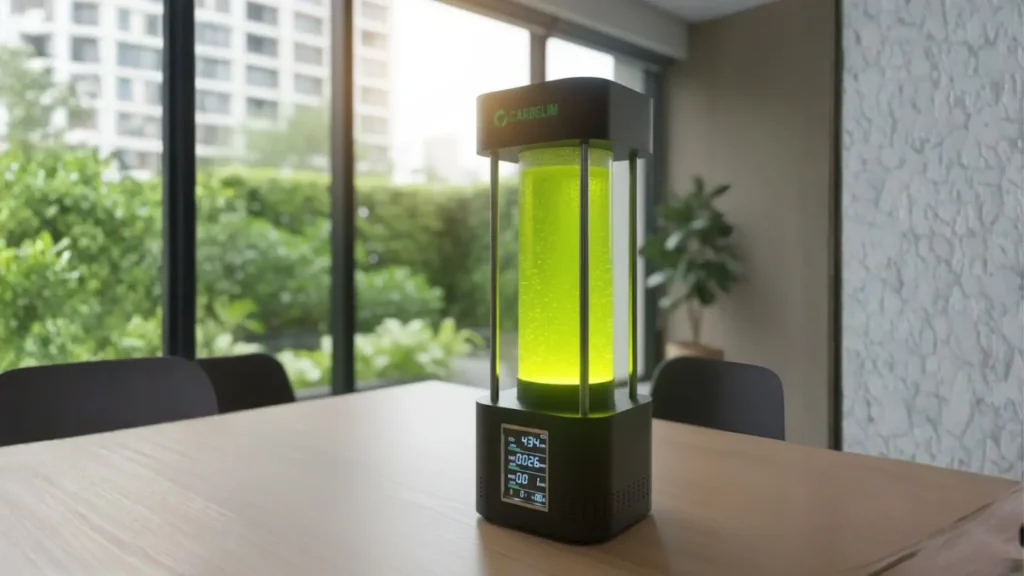
Innovative technologies are beginning to incorporate biological carbon capture systems into infrastructure applications.
These systems allow buildings to actively manage CO₂ levels using natural processes.
Companies such as Carbelim are exploring advanced infrastructure solutions that integrate carbon capture with urban technology systems.
These innovations may transform how buildings manage air quality in the future.
Air Quality and ESG Strategy
Environmental, Social, and Governance (ESG) initiatives are becoming a major focus for corporations worldwide.
Improving indoor air quality supports multiple ESG objectives:
Environmental
Reducing CO₂ accumulation aligns with carbon management goals.
Social
Healthier workspaces improve employee wellbeing.
Governance
Air quality monitoring provides measurable environmental data.
Organizations that prioritize air quality demonstrate a commitment to sustainable and responsible business practices.
Designing High-Performance Workplaces
Companies looking to improve workplace productivity should integrate air quality management into office design.
Strategies for Improving Indoor Air Quality
- Increase fresh air ventilation
- Install CO₂ monitoring systems
- Optimize HVAC performance
- Limit overcrowding in meeting rooms
- Integrate biological carbon capture technologies
These strategies help create environments where employees can perform at their best.
The Future of Workplace Air Management
As workplace design evolves, environmental intelligence will become increasingly important.
Future workplaces may incorporate:
- AI-driven ventilation systems
- Carbon-capturing infrastructure
- Smart environmental analytics
- Real-time air quality dashboards
These technologies will enable organizations to create adaptive workspaces that respond dynamically to environmental conditions.
Conclusion: Clean Air as a Business Investment
Indoor air quality has a powerful influence on employee productivity, cognitive performance, and workplace wellbeing.
Elevated CO₂ levels silently reduce concentration, impair decision-making, and decrease overall efficiency.
However, organizations that invest in air quality improvements can unlock measurable productivity gains and financial returns.
Understanding the ROI of oxygen allows companies to view clean air not as a cost but as a strategic business asset.
As workplaces continue to evolve, the companies that prioritize healthy indoor environments will gain a competitive advantage.
Clean air enables clearer thinking, better collaboration, and stronger performance.
In the modern workplace, oxygen is more than a biological necessity—it is a driver of economic success.
For more insights on climate innovation and sustainable infrastructure, explore the Carbelim blog and research insights.