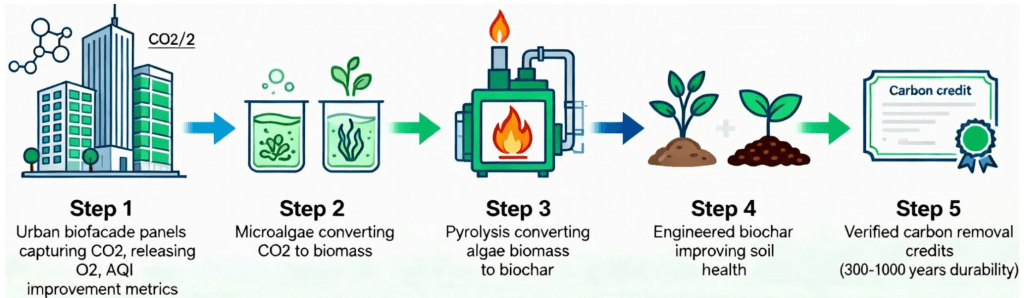
Algae absorb carbon dioxide through photosynthesis, a fundamental biological process that converts CO₂ into organic matter while releasing oxygen. This natural mechanism plays a critical role in the global carbon cycle and makes algae one of the most efficient carbon-absorbing organisms on Earth.
This article explains how algae absorb carbon dioxide at a cellular level, why they are more efficient than many land plants, and how this process contributes to environmental balance and climate regulation.
The Role of Carbon Dioxide in the Natural Carbon Cycle
Carbon dioxide is a natural component of Earth’s atmosphere and an essential input for photosynthesis. In natural ecosystems, CO₂ circulates continuously between the atmosphere, oceans, plants, microorganisms, and living organisms through biological and chemical processes.
Photosynthetic organisms — including plants, algae, and cyanobacteria — regulate atmospheric CO₂ by converting it into biomass. Among these organisms, algae play a uniquely important role due to their rapid growth rates and high photosynthetic efficiency.
What Is Photosynthesis in Algae?
Photosynthesis in algae is the process by which algae use light energy to convert carbon dioxide and water into organic compounds such as carbohydrates. This process occurs inside specialized cellular structures called chloroplasts.
The simplified photosynthesis reaction is:
Carbon dioxide + Water + Light energy → Organic biomass + Oxygen
Through this reaction, algae remove CO₂ from their surrounding environment and release oxygen as a natural byproduct.
How Algae Absorb Carbon Dioxide
Algae absorb carbon dioxide primarily through diffusion across their cell membranes. Because algae often live in aquatic or moist environments, dissolved CO₂ or bicarbonate ions move easily into the cell, where they are used during photosynthesis.
Key Steps in Algal Carbon Absorption
1. CO₂ Uptake
Carbon dioxide diffuses into algal cells from the surrounding air or water.
2. Light Absorption
Pigments such as chlorophyll capture light energy, initiating the photosynthetic process.
3. Carbon Fixation
Using enzymes like RuBisCO, algae convert CO₂ into organic carbon compounds during the Calvin cycle.
4. Biomass Formation
The fixed carbon becomes part of algal biomass, supporting growth and reproduction.
5. Oxygen Release
Oxygen is released as a byproduct of water splitting during the light-dependent reactions.
This process continues as long as light, carbon dioxide, and nutrients are available.
Why Algae Are Highly Efficient at Carbon Absorption
Algae are among the most efficient photosynthetic organisms due to several biological advantages.
High Surface-Area-to-Volume Ratio
Algae cells are small and simple, allowing rapid gas exchange and efficient CO₂ uptake.
Fast Growth Rates
Many microalgae species grow much faster than terrestrial plants, enabling continuous carbon fixation.
Continuous Photosynthesis
Under suitable conditions, algae can photosynthesize for extended periods without seasonal dormancy.
Adaptability
Algae can thrive in diverse environments, from freshwater and oceans to controlled systems.
These characteristics allow algae to absorb large amounts of carbon dioxide relative to their size.
Algae vs Terrestrial Plants in Carbon Absorption
While land plants play a major role in carbon sequestration, algae often outperform them on a per-area basis.
- Algae grow faster than most plants
- Algae can fix carbon continuously under stable conditions
- Algae do not require soil
- Algae can utilize dissolved CO₂ efficiently
For these reasons, algae contribute significantly to carbon cycling in aquatic ecosystems and engineered biological systems.
Environmental Importance of Algal Photosynthesis
The ability of algae to absorb carbon dioxide has far-reaching environmental benefits.
Climate Regulation
By removing CO₂ from the atmosphere, algae help moderate greenhouse gas concentrations.
Oxygen Production
Algae contribute a substantial portion of the oxygen present in Earth’s atmosphere.
Carbon Storage
Fixed carbon remains stored in algal biomass until it reenters the carbon cycle.
Ecosystem Stability
Algae form the foundation of aquatic food webs and support biodiversity.
Algae and the Future of Carbon Management
As global carbon emissions continue to rise, biological carbon absorption processes are gaining renewed attention. Algal photosynthesis represents a natural, scalable mechanism for carbon conversion that operates without chemical additives or complex mechanical systems.
Understanding how algae absorb carbon dioxide through photosynthesis provides valuable insight into how biological processes can complement technological approaches to carbon reduction and environmental sustainability.
Learn how this natural photosynthetic process is applied in real-world systems through microalgae air purification.
Frequently Asked Questions
What makes algae effective at absorbing carbon dioxide?
Algae combine fast growth rates, efficient photosynthesis, and high carbon fixation capacity, allowing them to absorb CO₂ efficiently.
Do algae absorb more CO₂ than plants?
On a per-area and per-time basis, many algae species can absorb carbon dioxide faster than terrestrial plants.
Is photosynthesis in algae different from plants?
The core process is similar, but algae often operate more efficiently due to their cellular structure and environmental adaptability.
What happens to the carbon absorbed by algae?
The carbon becomes part of algal biomass and remains stored until it reenters the carbon cycle through natural processes.
Conclusion
Algae absorb carbon dioxide through photosynthesis, a powerful biological process that converts CO₂ into organic matter while releasing oxygen. This mechanism supports life on Earth, regulates the carbon cycle, and highlights the remarkable efficiency of algae as natural carbon-absorbing organisms.
By understanding this process at a biological level, we gain insight into how nature manages carbon — and how these principles can inspire sustainable solutions for the future.