Introduction: The End of “Passive” Sustainability
For the last decade, the construction industry has been playing defense. We have focused on “doing less harm”—using less energy, wasting less water, and reducing embodied carbon. But in 2026, with the Global Carbon Tax (GCT) in full effect and the climate crisis accelerating, “less harm” is no longer a viable strategy. We need buildings that do “more good.”
We are witnessing the dawn of Metabolic Architecture. Just as a tree breathes, filters air, and cools its environment, our buildings must now perform these same biological functions. The days of static concrete and passive glass are over.
Enter the Carbon Bio-Façade (CBF™).
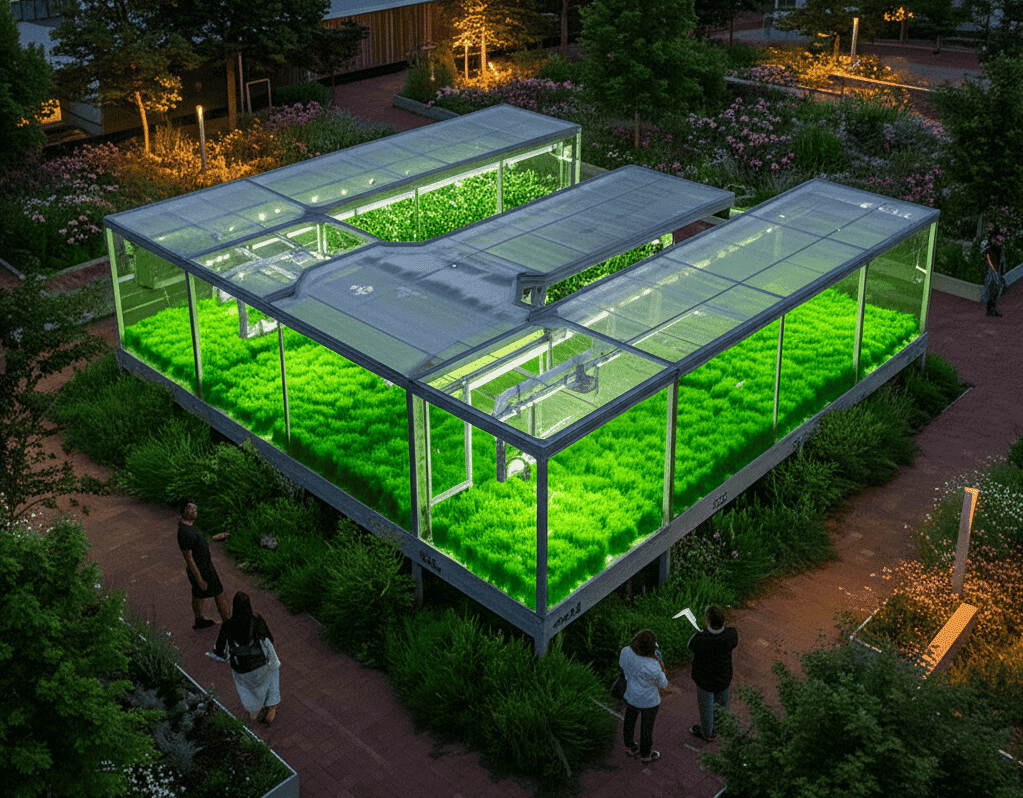
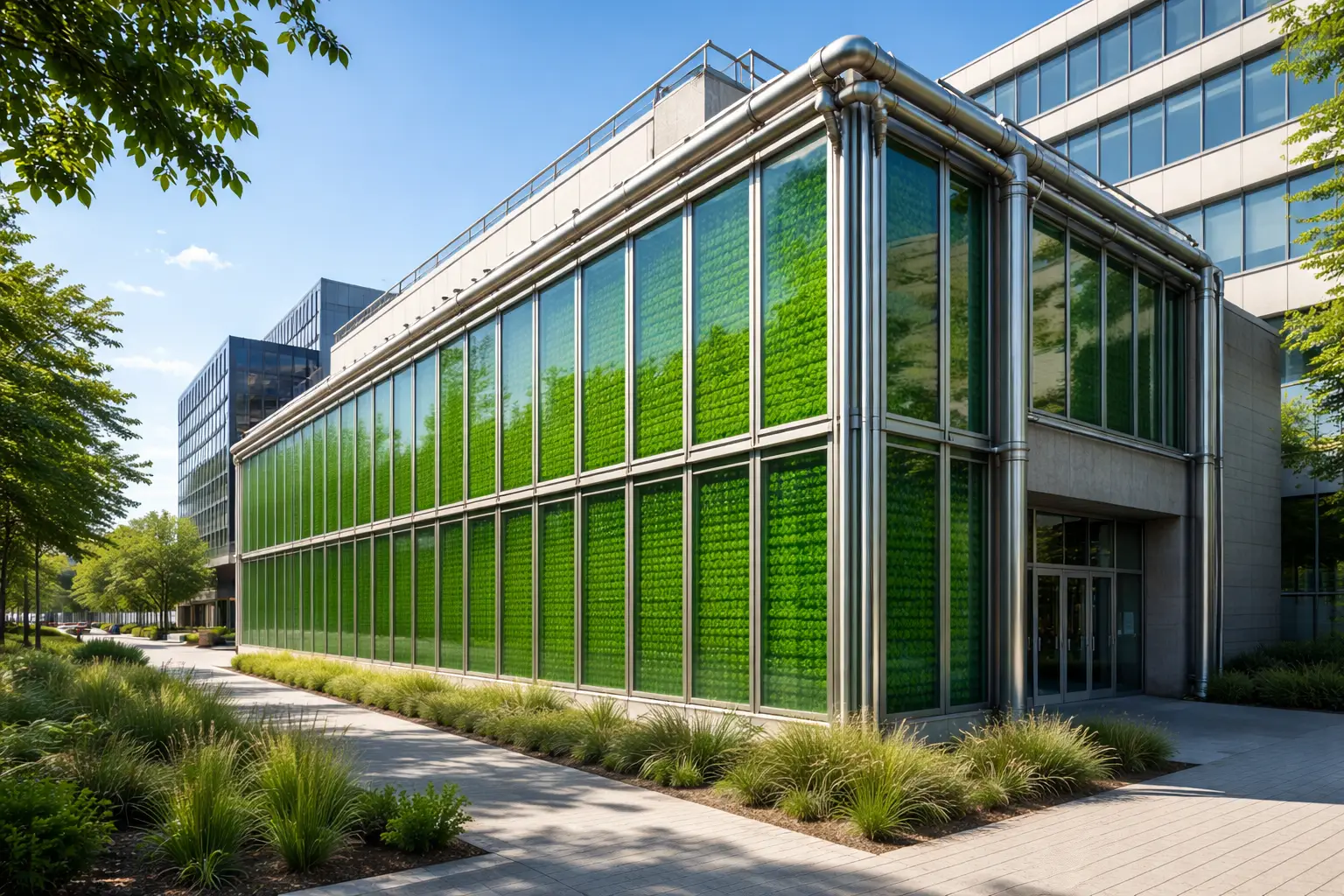
At Carbelim, we have moved beyond the aesthetic “Green Walls” of the early 2020s—which were often just decorative, high-maintenance ivy. We are engineering the “lungs of the city.” By integrating industrial-grade microalgae photobioreactors directly into the building envelope, we are turning real estate assets into active carbon capture machines.
This comprehensive guide will walk you through the science, the engineering, the economics, and the future of algae-based architecture.
Chapter 1: The Biology of Efficiency
Why Microalgae? (And Why Trees Can’t Compete)
To understand why we use algae, we have to look at the math of photosynthesis. A standard terrestrial tree is beautiful, but inefficient. It spends huge amounts of energy fighting gravity—building heavy trunks, deep roots, and complex branches. Only a small fraction of its energy goes into capturing $CO_2$.
Microalgae are different. They are single-celled organisms that float in water. They don’t need roots or trunks. As a result, nearly 100% of their surface area is dedicated to photosynthesis.
The 36x Factor
Research from our labs (and validated by global studies) shows that microalgae can capture carbon up to 36 times faster than terrestrial plants on a per-acre basis.
- Trees: A hectare of mature forest captures roughly 2–6 tons of $CO_2$ per year.
- Carbelim Algae: A hectare of our Bio-Façade surface area can sequester over 150 tons of $CO_2$ annually.
In a dense urban environment like Mumbai, New York, or London, where land is priced at a premium, you cannot plant a forest. But you can wrap a skyscraper in one.
The “Super-Strains” of 2026
Not all algae are created equal. Carbelim uses specific, resilient strains of Chlorella and Scenedesmus. These aren’t just pond scum; they are biological workhorses bred for:
- Thermal Tolerance: They can survive the 45°C summers of India and the Middle East without “crashing.”
- Low-Light Sensitivity: They continue to photosynthesize even on cloudy days or in the shadows cast by other buildings.
- Pollutant Digestion: These strains actually feed on Nitrogen Oxides ($NO_x$) and Sulfur Oxides ($SO_x$), the primary components of car exhaust.
Chapter 2: The Engineering of the “Living Skin”
How the Carbon Bio-Façade (CBF™) Works
Integrating a liquid biological system into a high-rise building sounds risky to traditional engineers. What about leaks? What about weight? Carbelim has solved these issues through Biomimetic Engineering.
Our CBF™ panels function like a triple-glazed window, but with a purpose.
- The Cavity: Between the glass layers sits a thin cavity (usually 20mm–50mm) filled with the algae culture medium.
- The Circulation: This is not stagnant water. A low-energy pump system creates a continuous “laminar flow.” This turbulence ensures that every algae cell gets its turn in the sun and prevents biofilm buildup (algae sticking to the glass).
- The “Lung” Unit: At the base of the building (or on mechanical floors), a central processing unit adds $CO_2$ (captured from the building’s HVAC exhaust) and nutrients to the water, while harvesting the oxygen produced.
Thermal Buffering: The Hidden Energy Saver
The most immediate ROI for a developer isn’t carbon—it’s electricity.
Water has a high specific heat capacity. By wrapping a building in a layer of water (the algae panels), you create a massive thermal buffer.
- Summer: The algae absorb the solar radiation for photosynthesis, preventing that heat from entering the building. This reduces the load on air conditioning by up to 25%.
- Winter: The liquid layer acts as insulation, trapping heat inside.
This essentially turns the building’s skin into a dynamic, living thermostat.
Chapter 3: The Air Quality Crisis & Health Impacts
Beyond Sick Building Syndrome
In 2026, the Air Quality Index (AQI) is a standard metric for property valuation. Tenants—especially in the tech and finance sectors—are demanding “WELL Certified” spaces. They know that high $CO_2$ levels (above 1000 ppm) cause cognitive decline, fatigue, and “Sick Building Syndrome.”
Standard HVAC systems merely recycle internal air or filter out dust. They do not remove $CO_2$ or add Oxygen.
The Carbelim “Fresh Air” Advantage
Our algae-based air purifiers actively scrub the air.
- Oxygen Generation: A 10,000 sq. ft. Bio-Façade produces enough oxygen for 400 occupants daily.
- VOC Removal: Volatile Organic Compounds (from carpets, paint, and furniture) are absorbed by the water medium and broken down by the algae.
- Particulate Matter: The liquid curtain acts as a trap for PM2.5 and PM10, which are later filtered out in the plant room.
This is Direct Air Capture (DAC), but localized where people actually breathe.
Chapter 4: The Economics of Algae (ROI & Carbon Credits)
Turning a Liability into an Asset
Historically, a building’s facade is a “sunk cost.” It sits there, depreciates, and requires cleaning. The CBF™ changes this paradigm by turning the facade into a Revenue Generating Asset.
1. The Carbon Credit Boom (CDR)
As of 2026, the price of high-quality Carbon Dioxide Removal (CDR) credits has skyrocketed. Corporations like Microsoft and Stripe are paying premiums ($200 – $600 per ton) for permanent removal, not just “avoidance.”
- The Carbelim Process: We measure the algae growth. We harvest the biomass. We convert it to Biochar (more on this in Chapter 6). This biochar locks the carbon away for 500+ years.
- The Result: Your building generates verified, gold-standard CDR credits that can be sold on the voluntary carbon market.
2. Green Financing & Premiums
Banks are now offering “Sustainability-Linked Loans” with lower interest rates for buildings that meet Net-Zero criteria.
- LEED v5 Points: Installing a Bio-Façade creates massive point gains in “Energy & Atmosphere,” “Innovation,” and “Indoor Environmental Quality,” practically guaranteeing Platinum status.
- Tenant Premium: Data shows that “Green Premium” rents are 10-15% higher in Class-A sustainable buildings.
Chapter 5: Installation, Retrofitting, and Scalability
“Can I put this on my existing building?”
This is the most common question we get. The answer is Yes.
Retrofitting (Brownfield Projects)
We have designed a “Bolt-On” version of the CBF™. This is a lightweight aluminum frame system that can be attached to the existing curtain wall or concrete shell of older buildings.
- Case Use: An aging IT park in Bangalore or a 1990s office block in Dubai can be revitalized. The facelift not only modernizes the look but instantly upgrades the building’s energy rating.
New Construction (Greenfield Projects)
For new builds, the CBF™ replaces the traditional glass facade entirely.
- Design Freedom: The panels can be flat, curved, or angled.
- Transparency: You can control the density of the algae. Do you want a dense green shade for the south-facing wall? Or a semi-transparent, light-green tint for the north side? The “Green-ness” is programmable.
Chapter 6: The Circular Economy (The Biomass Cycle)
No Waste, Only Feedstock
In a mechanical air filter, the dust-filled filter is thrown into a landfill. In a Carbelim system, the “waste” is the most valuable part.
Once the algae have saturated with carbon, they are harvested. This algal biomass is a rich biological resource.
- Biochar: Through pyrolysis (heating without oxygen), we turn the biomass into a charcoal-like substance. This is used as a soil amendment to help farmers retain water, or mixed into concrete to make “Carbon-Negative Concrete.”
- Bio-Fertilizers: The nitrogen and phosphorus captured from the air are returned to the soil, replacing synthetic chemical fertilizers.
- Bio-Plastics: The lipids (oils) in the algae can be extracted to create biodegradable packaging materials.
By installing a Bio-Façade, a real estate developer essentially becomes a supplier of sustainable raw materials.
Chapter 7: The Role of AI and IoT (Internet of Things)
The “Smart” in Smart City
You cannot manage what you cannot measure. Every Carbelim installation comes with a neural network of sensors.
The Dashboard
Building managers get a real-time view of:
- Sequestration Rates: “Your building captured 45kg of CO2 today.”
- Health Metrics: Real-time AQI readings of Indoor vs. Outdoor air.
- Predictive Maintenance: The AI predicts when the algae need nutrients or when a harvest cycle should trigger, based on weather forecasts and sunlight intensity.
This data is crucial for ESG Reporting. When your stakeholders ask for your carbon footprint, you don’t give them estimates. You give them hard, sensor-verified data.
Chapter 8: Future Outlook (2026 – 2030)
The Rise of the “Forest City”
We are currently working on District Cooling & Cleaning projects. Imagine not just one building, but a whole city block connected by algae tubes. The $CO_2$ from a local power plant or data center is piped into the facades of nearby residential towers. The residential towers produce oxygen and biomass. The biomass fuels the city’s buses.
This is the concept of the Circular City.
By 2030, regulations in the EU and parts of Asia will likely mandate active carbon capture on large structures. Early adopters who install Bio-Façades now are future-proofing their assets against these inevitable regulatory shifts.
Conclusion: A Call to Action for Visionaries
The technology is no longer science fiction. It is operating right now, incubated at IIT Madras and recognized by Forbes.
As an architect or developer, you have a choice. You can build another glass box that heats up the planet, consumes energy, and depreciates. Or, you can build a living, breathing entity that pays for itself, cleans the air, and leaves a legacy.
Carbelim is ready to help you build the latter.
Ready to transform your infrastructure?
- Contact our Engineering Team: Schedule a Feasibility Study
- View the Tech Specs: Microalgae Photobioreactor Details
- Read the Research: Algae vs. HEPA Filters
Frequently Asked Questions (FAQ)
Q1: Does the water in the facade turn green and block the view?
- A: The density of the algae is controlled by the AI. It can be kept translucent (like tinted glass) or made dense for shading purposes. It creates a beautiful, dappled light effect inside, similar to sitting under a tree canopy.
Q2: What happens if the power goes out?
- A: The system has gravity-fed backups and battery storage. The algae can survive for days without active circulation, entering a dormant state until flow is restored.
Q3: Is it heavy?
- A: The system adds approximately 40-50kg per square meter (filled). This is comparable to heavy triple-glazing or stone cladding and is easily accommodated by standard structural designs.
Q4: How much does it cost compared to standard glass?
- A: The CAPEX is roughly 20-30% higher than a standard high-performance curtain wall. However, when factoring in energy savings (OPEX) and carbon credit revenue, the Payback Period is typically 4–6 years.
Q5: Can this be used in cold climates?
- A: Yes. The triple-glazing acts as insulation. In extreme cold, we use waste heat from the building’s HVAC to keep the algae culture at an optimal 20°C.