In the high-stakes world of corporate real estate and facility management, a silent crisis is undermining profitability. It isn’t a supply chain disruption or a market crash—it is the very air your workforce breathes.
For decades, the standard for commercial buildings has been “energy efficiency at all costs.” We sealed our office towers to save on heating and cooling, effectively wrapping our employees in plastic bags. The unintended consequence is Sick Building Syndrome (SBS), a condition where the indoor environment actively degrades the health and cognitive performance of its occupants.
As we move through 2026, the conversation is shifting. The smartest companies are no longer just asking, “How do we save energy?” They are asking, “How do we turn our buildings into assets that generate health and carbon credits?”
This comprehensive guide explores the financial reality of SBS, the limitations of traditional HVAC, and how Carbelim’s algae-based biotechnology is redefining the future of sustainable infrastructure.
Part 1: The “Productivity Tax” – Why CO2 is a Business Risk
Defining the Invisible Enemy
Sick Building Syndrome is often dismissed as a minor HR nuisance—a few complaints about headaches or dry eyes. However, the data tells a different story. SBS is characterized by acute health and comfort effects that appear to be linked to time spent in a building.
The primary driver is not just dust or allergens; it is Carbon Dioxide (CO₂).
In a standard conference room, CO₂ levels can spike from a healthy 400 ppm (outdoor baseline) to over 1,500 ppm in just 45 minutes.
The Cognitive Cliff
For a B2B decision-maker, the health argument is compelling, but the financial argument is undeniable. Research from the Harvard T.H. Chan School of Public Health demonstrates that when indoor CO₂ levels reach 1,400 ppm, cognitive function scores drop by 50%.
Consider the implications for your business:
- Strategic Decision Making: Severely impaired.
- Information Usage: Significantly slowed.
- Crisis Response: Dulled.
If your highly paid executives are operating at 50% capacity every afternoon due to poor air quality, you are paying a massive “Productivity Tax.” This is where Carbelim’s mission becomes critical—we don’t just clean air; we restore the cognitive potential of your workforce.
Part 2: The Failure of Mechanical HVAC in the ESG Era
The Limitation of HEPA
For the last 50 years, the solution to indoor air quality (IAQ) has been mechanical filtration (HEPA). While effective at trapping particulate matter (PM2.5, dust, pollen), filters have a fatal flaw: They cannot capture gases.
A HEPA filter can trap a dust mite, but it lets CO₂, VOCs (Volatile Organic Compounds), and other gaseous pollutants pass right through. To lower CO₂, traditional HVAC systems must suck in outdoor air. This requires massive amounts of energy to heat or cool that new air, driving up your operational expenditure (OpEx) and your carbon footprint.
The “Filter Paradox”
Furthermore, mechanical filters are a linear waste problem. They clog, require replacement, and end up in landfills. In an era where corporations are striving for “Zero Waste” certifications, relying on disposable filters is a strategic error.
This is why the market is pivoting toward Biomimicry—innovation inspired by nature. We need systems that function like a forest, not a vacuum cleaner. We need to understand how algae absorb carbon dioxide through photosynthesis to see why biology is the superior engineer.
Part 3: The Biological Solution – Algae as the “Smart Engine”
At Carbelim, we have harnessed the world’s oldest and most efficient organism: Microalgae. Algae are responsible for 50% of the oxygen we breathe, yet they occupy a fraction of the space of terrestrial plants.
400x More Efficient Than Trees
When we compare an Algae Air Purifier vs. HEPA Filter, the difference is fundamental. Algae do not “trap” pollutants; they consume them.
- Input: CO₂, VOCs, NOx, SOx.
- Process: Photosynthesis (powered by ambient or artificial light).
- Output: Fresh Oxygen + Biomass.
This is a circular system. The “waste” (pollution) becomes “fuel” for growth. For a facility manager, this means a system that gets more efficient as the air gets dirtier, rather than clogging up.
Technology Spotlight: The Photobioreactor
The heart of our technology is the Microalgae Photobioreactor. This isn’t just a tank of green water; it is a sophisticated, bio-intelligent system optimized for maximum gas exchange. By controlling light spectra and fluid dynamics, we accelerate the algae’s natural appetite for carbon, allowing a small unit to do the work of a hectare of forest.
Part 4: Strategic Applications for B2B Real Estate
Integrating biotech into your building isn’t just about putting a device in the corner. It is about architectural integration. Here is how Carbelim solutions fit into the B2B ecosystem:
1. The Lobby Statement: AirForest™
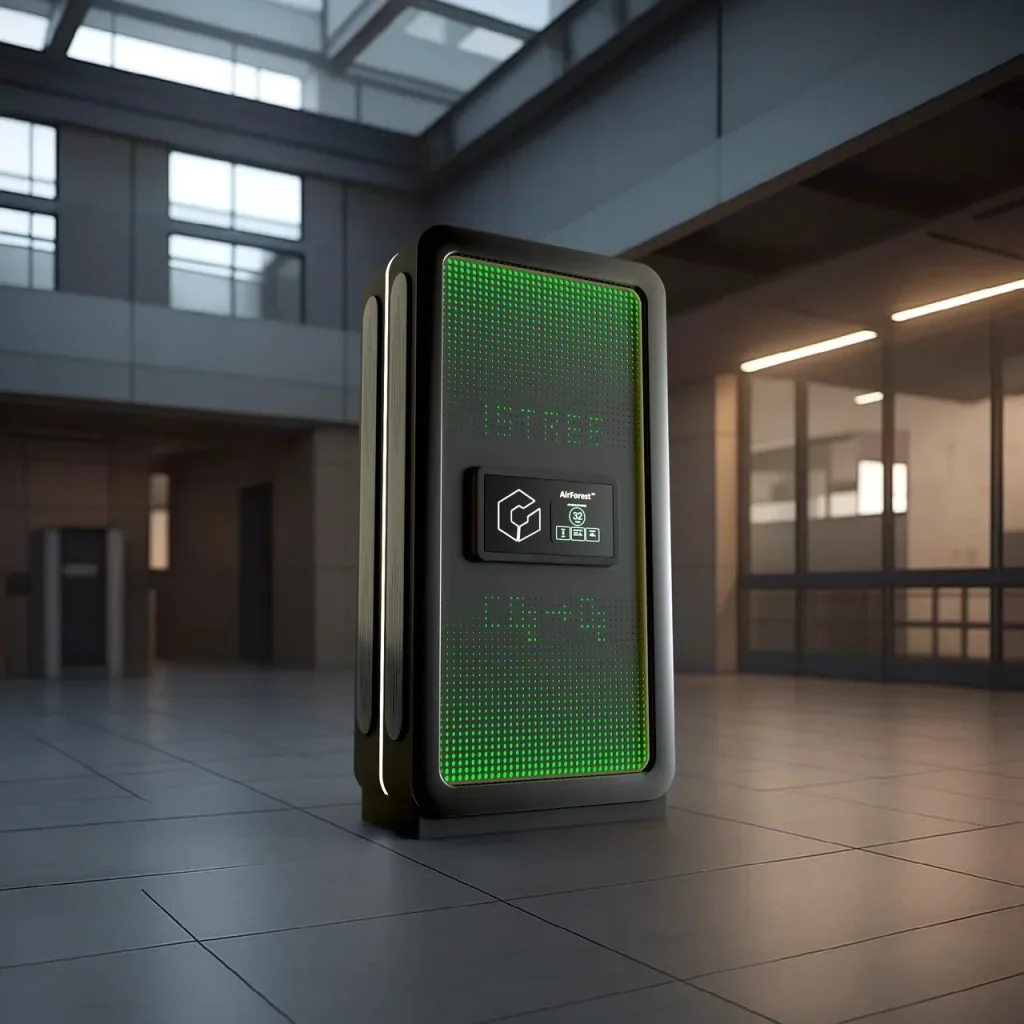
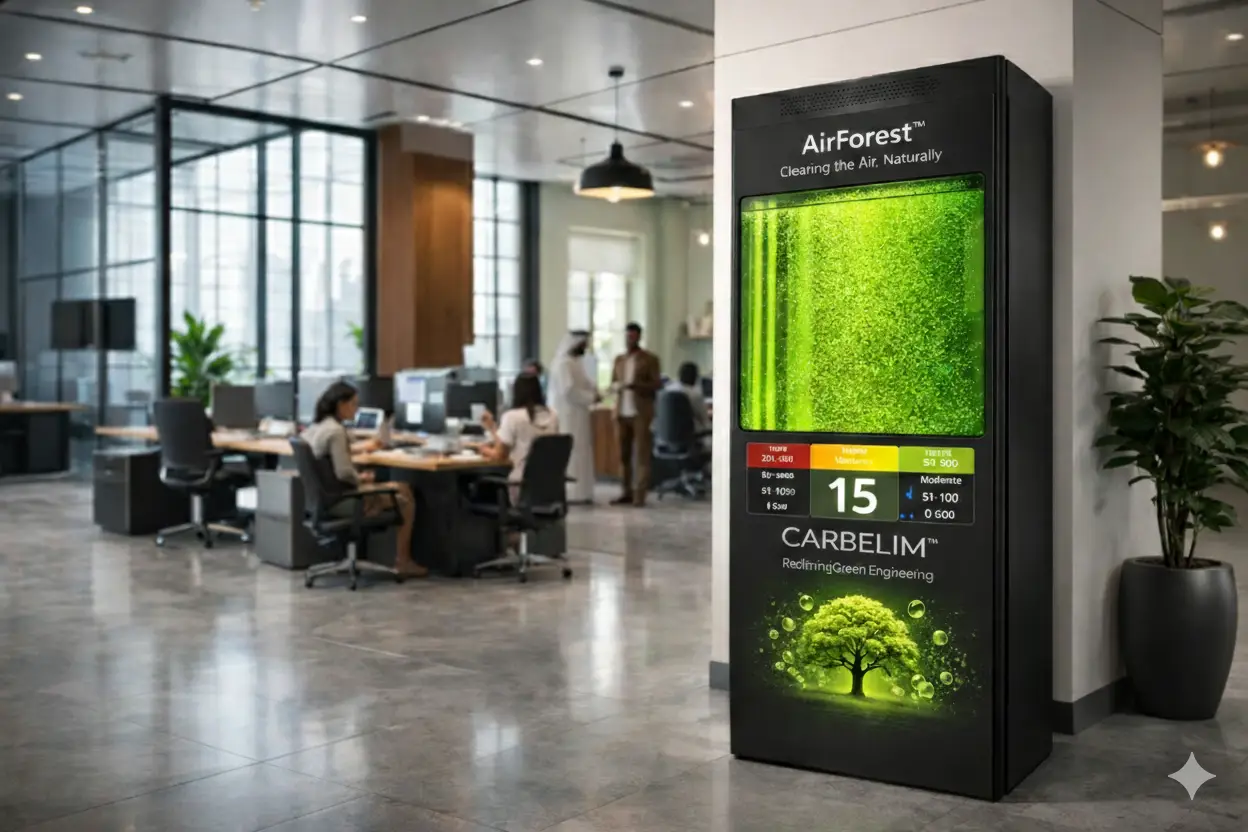
First impressions matter. The AirForest™ serves as a visual and functional centerpiece for corporate lobbies. It signals to clients and talent that your company prioritizes sustainability and health. Beyond aesthetics, it actively scrubs the air of street-level pollution before it circulates to upper floors.
2. The Meeting Room Guardian: PureAir Tower™
For high-density zones—boardrooms, call centers, and cafeterias—the PureAir Tower™ offers a plug-and-play solution.
- Use Case: A 2-hour strategy meeting with 10 executives.
- Result: Instead of the room becoming stuffy and the team becoming lethargic, the PureAir Tower actively converts the exhaled CO₂ back into oxygen, maintaining peak mental acuity throughout the session.
3. The Structural Revolution: Biomimetic Facades (CBF™)
For developers and architects planning new builds or deep retrofits, the Carbelim Biomimetic Facade (CBF™) is the ultimate differentiator.
- The Concept: Replace inert glass or concrete cladding with transparent, algae-filled panels.
- The Benefit: The facade acts as a thermal insulator (reducing cooling costs by up to 30%) while capturing carbon from the surrounding city air. It turns the building envelope into a living, breathing skin.
Part 5: ESG Strategy – Turning Air Quality into Compliance
In 2026, Environmental, Social, and Governance (ESG) reporting is no longer optional for large enterprises. It is a mandate.
Solving the “Scope 3” Problem
Most companies have handled their Scope 1 (direct) and Scope 2 (energy) emissions. The challenge now is Scope 3—the indirect emissions, including those from leased assets and employee commuting.
By installing Carbelim’s systems, you are actively deploying Carbon Capture Technology within your real estate footprint. This measurable carbon reduction can be reported in your annual ESG statements, demonstrating a proactive approach to decarbonization.
LEED and WELL Certification
Top-tier tenants demand certified buildings. Algae integration directly contributes points toward:
- LEED (Leadership in Energy and Environmental Design): Points for Innovation, Indoor Environmental Quality, and Energy Performance.
- WELL Building Standard: Specifically the “Air” and “Mind” concepts (Biophilia).
- BREEAM: Innovation credits for novel technology.
Achieving Platinum or Gold status significantly increases the asset value of a property. A building with Carbelim technology commands higher rents because it is demonstrably healthier and greener.
Part 6: Industrial Scale – The CCUS Opportunity
For our industrial partners, the challenge is even greater. Factories and data centers produce massive localized carbon emissions. Here, we scale up our technology to Industrial CCUS (Carbon Capture, Utilization, and Storage).
Unlike massive geological storage projects that cost billions, Carbelim offers decentralized capture. We can retrofit algae reactors directly onto flue gas stacks or ventilation outlets.
- The Utilization Twist: The resulting algae biomass isn’t waste. It can be harvested and converted into biofuels, bioplastics, or biochar.
- The Circular Economy: This creates a revenue stream from pollution, turning a cost center into a profit center.
Part 7: Future-Proofing Your Real Estate Portfolio
The regulatory landscape is tightening. Cities like New York (Local Law 97) and London are already imposing fines on buildings that exceed carbon limits. This trend will go global by 2027.
Retrofit vs. Rebuild
Tearing down old buildings releases immense embodied carbon. The sustainable choice is to retrofit. Carbelim’s systems are designed for this exact scenario. Our Direct Air Capture (DAC) units can be retrofitted into existing HVAC plenums or installed as standalone units without ripping out walls.
The “Climate-Resilient” Workplace
Climate change brings more than just heat; it brings smoke from wildfires and higher urban pollution levels. Standard filters clog instantly under these conditions. Algae systems, however, thrive on the extra carbon. By installing bio-reactive air purification, you are “future-proofing” your building against the worsening air quality of the coming decade.
Conclusion: The Business Case for Biology
The era of the “sterile” office is over. The high-performance workplace of the future is a living ecosystem.
For the CFO, Carbelim represents Risk Mitigation (regulatory compliance) and ROI (energy savings and productivity).
For the HR Director, it represents Talent Retention and Well-being.
For the Sustainability Officer, it is the Silver Bullet for Net-Zero targets.
Sick Building Syndrome is a choice. You can choose to continue filtering stale air, or you can choose to regenerate it.
Ready to transform your infrastructure?
Explore how our Microalgae Photobioreactors can be customized for your facility, or contact our engineering team to discuss a pilot program for your headquarters.
Don’t just build better. Build alive.
FAQs
Q: What is the difference between a Green Wall and the AirForest™?
A: A traditional green wall uses plants (moss, ferns) which are beautiful but have low metabolic rates. The AirForest™ uses microalgae, which are up to 400 times more efficient at carbon capture per square meter.
Q: Can algae facades really lower cooling costs?
A: Yes. The Carbelim Biomimetic Facade provides “biological shading.” The algae culture grows denser when the sun is strongest, providing automatic shading that reduces solar heat gain, lowering the load on your air conditioning.
Q: Is this technology suitable for industrial applications?
A: Absolutely. Our Industrial CCUS solutions are designed to handle high concentrations of flue gas, making them ideal for manufacturing and power generation facilities looking to lower their carbon tax liability.