Introduction: Cities Were Never Designed for Breathing : PureAir Tower™
Modern cities are extraordinary engines of economic growth, innovation, and human collaboration. Yet beneath their glass skylines and concrete corridors lies a critical design flaw: cities were built for movement and commerce, not for clean air.
As global urbanization accelerates—with nearly 70% of the world’s population expected to live in cities by 2050—urban air pollution has quietly evolved into one of the most severe public health and climate challenges of our time. Dense construction, rising vehicle numbers, and limited airflow have created what scientists refer to as urban street canyons, where polluted air becomes trapped at human breathing height.
In these zones, concentrations of carbon dioxide (CO₂), nitrogen oxides (NOx), and fine particulate matter (PM2.5) routinely exceed safe limits. The impact is not abstract. Poor outdoor air quality is now directly linked to respiratory illness, cardiovascular disease, reduced cognitive performance, and declining workplace productivity.
According to the World Health Organization, almost the entire global population breathes air that fails to meet recommended safety standards.
For decades, cities have relied on passive mitigation strategies—vehicle regulations, emission caps, tree planting, and indoor air filtration. While necessary, these approaches are no longer sufficient on their own. They slow the damage, but they do not actively reverse it.
At Carbelim, we believe the future of cities depends on moving beyond mitigation toward regenerative air infrastructure—systems that actively clean, restore, and enrich urban air.
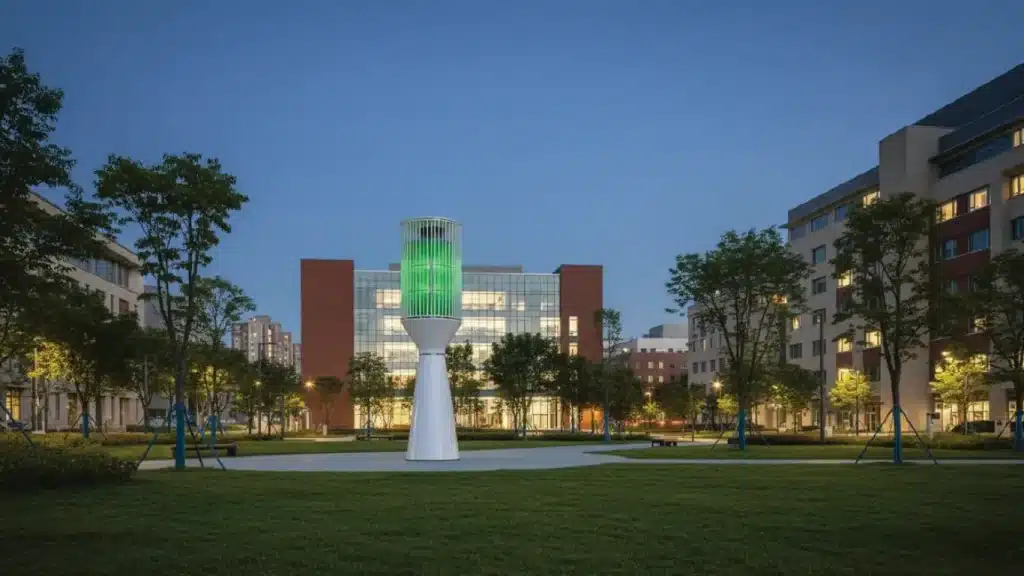
This belief led to the development of the PureAir Tower™, an outdoor, biological air purification system designed to function as a living urban lung. Unlike conventional filters, the PureAir Tower does not merely trap pollution—it biologically transforms it.
In this comprehensive guide, we explore why traditional solutions are no longer enough, how the PureAir Tower works, and why it represents a critical upgrade in outdoor air quality infrastructure for smart cities, transit hubs, and corporate campuses.
These conditions are most severe in dense metropolitan areas, where high traffic volumes and limited airflow cause pollution to concentrate directly at human breathing height.
Why Traditional Urban Air Solutions Are Failing
The Limits of Trees in High-Density Cities
Trees remain essential to urban life. They reduce heat islands, improve mental well-being, and support biodiversity. However, when it comes to addressing modern pollution loads, trees alone face two hard limits: space and time.
In dense city centers, land availability is severely constrained. Creating meaningful green cover requires hectares of space that most cities simply do not have. Even when trees are planted, their air-cleaning capacity develops slowly. A sapling may take 15 to 20 years to reach peak carbon sequestration potential.
In rapidly expanding cities, air quality degradation often accelerates faster than natural green infrastructure can scale or mature.
Urban air pollution, however, is an immediate crisis.
Passive Systems Cannot Match Emission Density
Trees and conventional green spaces operate passively. Their performance depends on weather, seasons, and natural growth cycles. In areas with high pollution density—such as traffic junctions, bus depots, logistics hubs, and industrial corridors—pollutant concentrations can overwhelm vegetation, reducing its effectiveness.
Mechanical air filters, on the other hand, are designed primarily for indoor environments. Outdoors, they struggle with scale, energy efficiency, and waste generation.
This growing gap between pollution intensity and cleaning capacity is why cities now require active, biological air purification systems.
The PureAir Tower™: A New Class of Urban Infrastructure
The PureAir Tower™ was developed to address the fundamental limitations of both trees and mechanical filters.
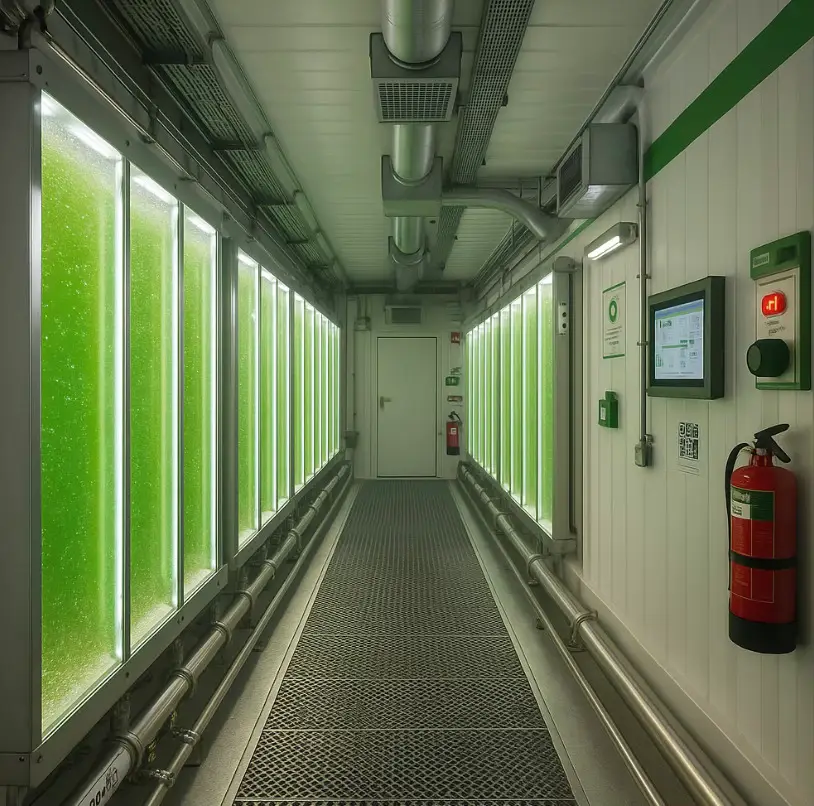
Rather than mimicking a filter, the PureAir Tower functions as a biomimetic photobioreactor, inspired by the most powerful carbon-capturing organisms on Earth: microalgae.
Microalgae were responsible for creating much of the oxygen-rich atmosphere we depend on today. They are exceptionally efficient at absorbing CO₂ and other pollutants—far more efficient per unit area than terrestrial plants.
By harnessing this biological efficiency in a controlled, outdoor system, the PureAir Tower delivers forest-level air purification in a fraction of the space.
The “15 Trees” Benchmark Explained
One of the most frequently asked questions is how the PureAir Tower compares to trees.
Based on operational performance, a single PureAir Tower™ delivers an air-cleaning impact equivalent to more than 15 mature trees, while occupying only a few square meters of ground space.
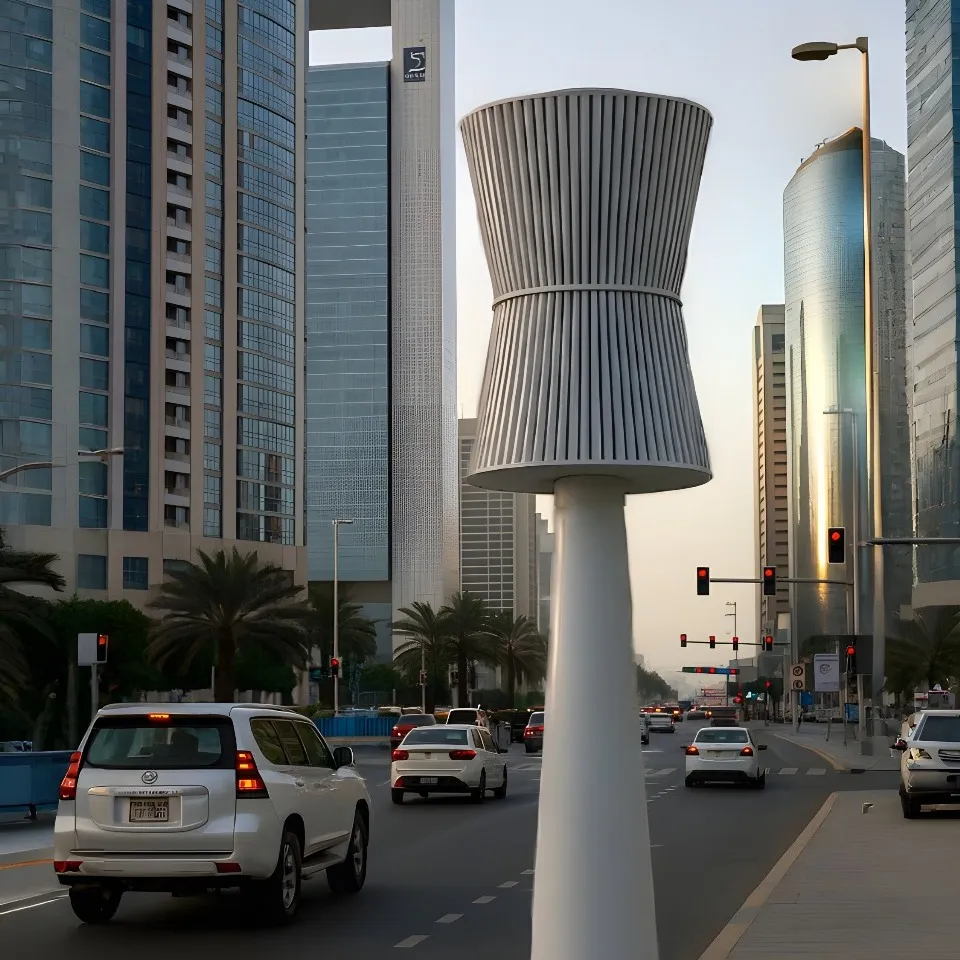
This makes it possible to deploy meaningful air purification in locations where traditional green infrastructure is impossible—sidewalks, plazas, transport hubs, and corporate entry zones.
Importantly, the PureAir Tower is not designed to replace trees. It is designed to augment urban greenery, filling the performance gap where space and pollution density limit nature’s ability to cope alone.
How the PureAir Tower™ Works: A Biological Process, Not a Filter
Unlike HEPA filters or electrostatic systems, the PureAir Tower does not trap pollutants and discard them as waste. Instead, it uses biology to convert pollution into oxygen and biomass.
Step-by-Step Air Regeneration
1. Active Air Intake
Polluted outdoor air is continuously drawn into the system at street level—where human exposure is highest.
2. Pollutant Absorption
The air passes through a liquid medium enriched with specialized microalgae strains. Gases such as CO₂, NOx, and SOx dissolve into the water and are absorbed by the algae.
3. Photosynthetic Conversion
Using natural sunlight, supplemented by low-energy LEDs for consistent operation, the algae consume these compounds as nutrients.
4. Oxygen Release
The biological process releases fresh oxygen (O₂) back into the surrounding environment, improving localized air quality in real time.
This process allows the PureAir Tower to operate continuously without generating hazardous filter waste.
Targeting the Most Harmful Urban Pollutants
Urban air pollution is a complex mixture of gases and particles. The PureAir Tower is engineered to address the most dangerous components:
- Carbon Dioxide (CO₂): A primary driver of climate change and outdoor air stagnation
- Nitrogen Oxides (NOx): Emitted by vehicles and combustion engines, linked to respiratory inflammation
- Sulfur Oxides (SOx): Common in industrial zones and fuel combustion
- Particulate Matter (PM2.5 and PM10): Microscopic particles that penetrate deep into lung tissue
- Volatile Organic Compounds (VOCs): Released from fuels, asphalt, and industrial materials
The system’s liquid medium acts as a biological wet scrubber, while algae metabolize gaseous pollutants instead of merely capturing them.
Measurable Environmental Impact
For cities and corporations, sustainability must be measurable, reportable, and verifiable.
Each PureAir Tower™ delivers data-backed performance metrics suitable for ESG reporting and smart city dashboards.
Annual Performance Per Unit
- 340 kg of CO₂ captured annually
- 1.5 million liters of oxygen generated
- Up to 99% localized pollutant reduction, depending on site conditions
To contextualize this, the oxygen output from a single tower can support the annual breathing needs of hundreds of people within its immediate zone of influence.
Real-Time Monitoring with the PureAir Network™
Every PureAir Tower connects to the PureAir Network™, Carbelim’s IoT-enabled monitoring platform.
This system enables real-time tracking of:
- Local Air Quality Index (AQI)
- Volume of air purified
- Cumulative carbon captured
- System health and performance trends
By making air quality visible, the PureAir Network transforms sustainability from an abstract concept into a publicly observable outcome.
Circular Economy: Turning Pollution into Resources
One of the major drawbacks of conventional air filtration systems is waste generation. Used filters become hazardous waste and end up in landfills.
The PureAir Tower follows a circular economy model.
As microalgae consume pollutants, they grow—creating nutrient-rich algal biomass.
Biomass Utilization Pathways
- Biochar production for long-term carbon sequestration
- Organic fertilizers for urban landscaping and agriculture
- Bio-based materials for sustainable manufacturing
In this way, cities move from pollution management to resource generation.
Strategic Deployment Zones for Maximum Impact
The PureAir Tower delivers the highest return on investment in areas of high pollution exposure and human density.
Public Transit Hubs
Bus terminals, railway stations, and taxi stands concentrate emissions at breathing height. Deploying PureAir Towers directly protects daily commuters.
Corporate Campuses
Clean outdoor air improves cognitive performance, employee well-being, and productivity—while reinforcing corporate ESG commitments.
Smart City Plazas
Purified air transforms public spaces into destinations, supporting placemaking and community engagement.
Integrated Building Systems
When combined with biomimetic facade solutions, towers treat air at street level while buildings address pollution at elevation—creating a vertical clean-air envelope.
Why the PureAir Tower™ Represents the Future of Cities
The next decade will define whether cities merely reduce harm—or actively restore their environment.
The PureAir Tower™ represents a shift from sustainability to regenerative urban design. It proves that technology and biology can work together to repair the urban atmosphere at scale.
For city planners, developers, and corporate leaders, clean air is no longer a luxury—it is critical infrastructure.
The future of breathable cities is not theoretical.
It is already here.
👉 Explore Carbelim’s Solutions
About Carbelim
Carbelim is a climate technology company developing biological clean air and carbon capture solutions using microalgae-based systems. Its technologies are designed for urban environments, campuses, and public infrastructure where conventional air quality solutions alone are insufficient. Carbelim
Frequently Asked Questions (FAQs) About the PureAir Tower™
1. What is the PureAir Tower™?
The PureAir Tower™ is an outdoor biological air purification system designed to improve urban air quality at street level. It uses microalgae to capture carbon dioxide (CO₂), nitrogen oxides (NOx), and other pollutants, while releasing clean oxygen (O₂) back into the surrounding environment.
2. How does the PureAir Tower™ work?
The PureAir Tower™ actively draws polluted air into a liquid medium containing specialized microalgae. These microorganisms absorb harmful gases through photosynthesis, converting pollution into oxygen and biomass. This biological process continuously regenerates outdoor air without disposable filters.
3. How is the PureAir Tower™ different from traditional air filters?
Traditional air filters trap pollutants and require frequent replacement, generating waste. The PureAir Tower™ does not use mechanical filters. Instead, it biologically converts pollutants into oxygen and reusable biomass, making it suitable for continuous outdoor operation.
4. How many trees does one PureAir Tower™ replace?
A single PureAir Tower™ provides the air-cleaning impact of more than 15 mature trees, while occupying only a few square meters of space. This makes it highly effective for dense urban environments where large-scale tree planting is not feasible.
5. What pollutants does the PureAir Tower™ remove?
The PureAir Tower™ targets major urban air pollutants, including carbon dioxide (CO₂), nitrogen oxides (NOx), sulfur oxides (SOx), fine particulate matter (PM2.5 and PM10), and volatile organic compounds (VOCs).
6. How much CO₂ does the PureAir Tower™ capture annually?
On average, one PureAir Tower™ captures approximately 340 kilograms of carbon dioxide per year, depending on location and pollution levels. This captured carbon contributes directly to long-term carbon removal efforts.
7. Where should the PureAir Tower™ be installed for maximum impact?
The PureAir Tower™ is most effective in high-pollution, high-exposure areas such as public transit hubs, traffic intersections, corporate campuses, pedestrian plazas, and outside commercial or institutional buildings.
8. How does the PureAir Tower™ support ESG and net-zero goals?
The PureAir Tower™ provides measurable data on air purification, oxygen generation, and carbon capture. These metrics can be used in ESG reporting, sustainability disclosures, and smart city dashboards, helping organizations progress toward net-zero and climate-positive targets.