Introduction
The algae oxygen generator is revolutionizing how we think about indoor air quality and carbon dioxide removal. As urban spaces become more congested and air pollution worsens, traditional air purification methods are proving insufficient to tackle rising CO₂ levels. That’s where nature-based solutions step in, offering a sustainable way to breathe cleaner, healthier air.
In this guide, you’ll discover how algae-based technology captures carbon dioxide, produces oxygen, and transforms indoor environments. We’ll explore the science behind these systems, their real-world applications, and why they’re becoming essential for sustainable buildings and urban infrastructure.
Key Takeaways
- Algae oxygen generators use living microorganisms to capture CO₂ and release fresh oxygen through natural photosynthesis, providing a sustainable alternative to mechanical air purifiers.
- These systems remove up to 150 times more CO₂ per square meter than traditional plants while requiring minimal maintenance and energy consumption.
- Modern algae purifiers can be integrated into building facades, indoor spaces, and urban infrastructure, making them ideal for offices, homes, and public areas.
What Is an Algae Oxygen Generator and How Does It Work?
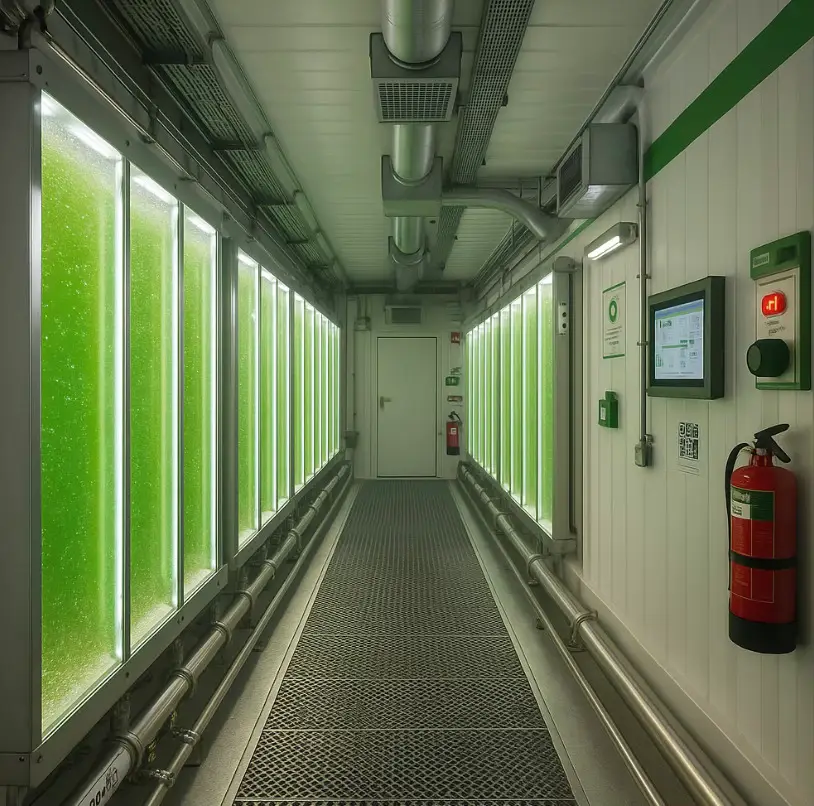
An algae oxygen generator is a bio-technological system that uses microalgae to absorb carbon dioxide from the air and convert it into oxygen through photosynthesis, functioning as a natural air purification system.
The core principle behind an algae oxygen generator lies in nature’s most efficient carbon capture mechanism: photosynthesis. Microalgae, particularly species like Chlorella and Spirulina, are cultivated in controlled photobioreactors that optimize their growth conditions. These microscopic organisms absorb CO₂ from surrounding air and, using light energy, transform it into oxygen and biomass. The process is remarkably efficient—algae can capture carbon at rates up to 50 times faster than terrestrial plants.
What makes these systems particularly innovative is their compact design and scalability. Unlike traditional green walls that require extensive space, an algae based air purifier can be integrated into building facades, installed as standalone units, or even incorporated into furniture. The closed-loop systems circulate air through algae-filled chambers, where the microorganisms actively scrub CO₂ while releasing oxygen. This continuous process creates a healthier indoor environment without the need for energy-intensive mechanical filters or chemical treatments.
The beauty of this technology is its dual function: it doesn’t just filter existing air; it actively improves it by removing harmful greenhouse gases and replacing them with fresh oxygen. For anyone wondering how to reduce CO₂ in the house, algae-based systems offer a nature-inspired solution that works 24/7, requiring only light and occasional nutrient replenishment.
The Science Behind Algae-Based CO₂ Removal
Microalgae remove CO₂ through photosynthesis at exceptional rates, absorbing carbon dioxide concentrations up to 400 times higher than ambient air levels while producing pure oxygen as a byproduct.
Understanding the biological mechanism reveals why algae oxygen generators outperform conventional air purification methods. During photosynthesis, algae cells contain chloroplasts that capture light energy and use it to split water molecules. The hydrogen is then combined with absorbed CO₂ to create glucose for growth, while oxygen is released as a waste product. This process occurs at the cellular level billions of times per second across trillions of algae cells within the system.
Research from environmental biotechnology studies shows that one kilogram of algae can absorb approximately 1.8 kilograms of CO₂ daily. When concentrated in a microalgae photobioreactor, this translates to removing 10-50 times more CO₂ per square meter than a traditional indoor plant. The efficiency stems from algae’s simple cellular structure, which allows rapid gas exchange directly through their cell walls without the complex vascular systems that slow down CO₂ absorption in higher plants.
The algae purifier remove CO₂ process also generates valuable biomass. As the algae multiply, they can be harvested and processed into biofuels, animal feed, nutritional supplements like spirulina, or even bioplastics. This creates a circular economy where the air purification system produces useful byproducts, making it both environmentally and economically sustainable. Temperature, pH levels, light intensity, and nutrient availability are carefully monitored to maintain optimal CO₂ capture rates throughout the year.
7 Ways Algae Oxygen Generators Transform Indoor Air Quality
From continuous CO₂ reduction to humidity regulation, algae oxygen generators provide multiple air quality benefits that create healthier, more productive indoor environments for homes and workplaces.
1. Active Carbon Dioxide Removal
Unlike passive filters, an algae oxygen generator actively consumes CO₂ from indoor air. Studies from the International Journal of Environmental Science show that elevated indoor CO₂ levels above 1,000 ppm can impair cognitive function and cause drowsiness. Algae systems maintain optimal CO₂ levels between 400-600 ppm by continuously absorbing carbon dioxide, keeping occupants alert and focused throughout the day.
2. Continuous Oxygen Production
Each square meter of active algae culture produces approximately 10-15 liters of oxygen daily. This natural oxygen generation creates fresher air without the staleness associated with sealed, air-conditioned buildings. The oxygen enrichment is particularly beneficial in densely occupied spaces like conference rooms, classrooms, and open-plan offices.
3. Zero Chemical Emissions
Traditional air purifiers often use chemical filters, ozone generators, or UV treatments that can produce harmful byproducts. The algae based air purifier operates purely through biological processes, eliminating concerns about chemical off-gassing or ozone exposure that can irritate respiratory systems.
4. Natural Humidity Regulation
Microalgae cultures naturally regulate indoor humidity through transpiration. As water evaporates from the system, it adds moisture to dry indoor environments during winter months while the algae biomass absorbs excess humidity in summer. This passive humidity control reduces the need for separate humidifiers or dehumidifiers.
5. Particulate Matter Filtration
Beyond gas exchange, algae systems trap fine particulate matter (PM2.5 and PM10) as air circulates through the culture medium. The sticky biofilm formed by algae colonies captures airborne particles, dust, and allergens, removing them from breathing zones without generating the static electricity that makes traditional filters less effective over time.
6. Volatile Organic Compound Absorption
Algae metabolize various volatile organic compounds (VOCs) emitted by furniture, paint, and cleaning products. Research published in the Journal of Hazardous Materials demonstrates that certain algae strains can degrade formaldehyde, benzene, and toluene—common indoor air pollutants that contribute to sick building syndrome.
7. Sustainable Energy Efficiency
Operating an algae oxygen generator requires minimal electrical input compared to traditional HVAC systems. LED lighting and gentle water circulation consume less than 50 watts for a system serving a 500 square foot space. This represents energy savings of up to 80% compared to conventional air purification and ventilation systems.
Real-World Applications: Where Algae Oxygen Generators Make the Biggest Impact
Algae oxygen generators are being deployed across residential buildings, commercial offices, healthcare facilities, and educational institutions, with scalable solutions ranging from desktop units to building-integrated systems.
The versatility of algae-based air purification has led to diverse applications across multiple sectors. In residential settings, compact algae oxygen generators serve as both functional air purifiers and living décor elements. Homeowners install wall-mounted photobioreactors in living rooms, bedrooms, and home offices where poor ventilation typically causes CO₂ buildup. These units are particularly valuable in energy-efficient homes with tight building envelopes that limit fresh air exchange.
Commercial office buildings are increasingly incorporating building-integrated algae facade systems that serve dual purposes: carbon capture and architectural aesthetics. Companies like Carbelim have developed the Biomimetic Facade™ technology, which transforms ordinary building exteriors into active carbon capture surfaces. These installations can reduce a building’s carbon footprint by 20-40% while creating distinctive green architecture that improves brand perception and employee wellbeing.
Healthcare facilities have adopted algae air purification to maintain superior air quality in patient rooms, waiting areas, and recovery wards. Hospitals deal with heightened sensitivity to air quality, and the natural, chemical-free purification provided by algae systems aligns with health-focused environments. The continuous oxygen generation proves especially beneficial in neonatal units and respiratory care departments.
Educational institutions are installing algae oxygen generators in classrooms to combat the well-documented problem of elevated CO₂ affecting student concentration. A study from Harvard’s T.H. Chan School of Public Health found that improving classroom air quality through CO₂ reduction increased test scores by an average of 15%. Schools are also using these systems as living laboratories, allowing students to observe photosynthesis and carbon cycles firsthand.
Urban planners are now exploring algae integration into public transportation hubs, underground metro stations, and parking garages—spaces notorious for poor air quality. The compact, modular nature of modern algae oxygen generators makes them ideal for retrofitting existing infrastructure without major renovations.
Comparing Algae Oxygen Generators to Traditional Air Purification Methods
When evaluated on CO₂ removal, energy efficiency, maintenance requirements, and long-term sustainability, algae oxygen generators outperform HEPA filters, activated carbon systems, and mechanical ventilation in most indoor applications.
Traditional air purification relies on passive filtration—air passes through mechanical or chemical filters that trap particles and absorb gases. While effective for particulate removal, these systems don’t address CO₂ accumulation, which is often the primary cause of indoor air quality complaints. HEPA filters capture 99.97% of particles 0.3 microns or larger but require frequent replacement and consume significant energy to push air through dense filter media.
Activated carbon filters can absorb some VOCs and odors but become saturated quickly and must be replaced every 3-6 months, generating ongoing costs and waste. Neither system produces oxygen or reduces carbon dioxide levels. Mechanical ventilation systems exchange indoor air with outdoor air, but in urban areas where outdoor air quality is poor, this simply trades one set of pollutants for another.
The carbon capture and utilization approach offered by algae systems provides a fundamentally different solution. Rather than merely filtering existing air, algae actively transform its composition. A comparative analysis shows:
- CO₂ Reduction: Algae systems reduce indoor CO₂ by 30-50%, while traditional purifiers have no impact on CO₂ levels
- Oxygen Production: Algae generate 5-10 liters of O₂ per square meter daily, whereas standard purifiers produce zero
- Energy Consumption: Algae systems use 40-50 watts continuously, compared to 100-300 watts for equivalent HEPA units
- Maintenance Frequency: Algae require nutrient replenishment every 2-3 months versus filter replacements every 1-3 months
- Operational Lifespan: Photobioreactors last 10-15 years, while purifier units typically need replacement every 5-7 years
- Environmental Impact: Algae systems are carbon-negative and produce useful biomass, while traditional purifiers generate filter waste that ends in landfills
The initial investment for an algae oxygen generator ranges from $500-2,000 depending on capacity, compared to $200-800 for conventional purifiers. However, the total cost of ownership over five years favors algae systems due to lower energy consumption, reduced maintenance, and the potential to monetize harvested biomass. Additionally, the aesthetic appeal and conversation value of a living, glowing algae system adds intangible benefits that sterile plastic purifiers cannot match.
Installation and Maintenance: What You Need to Know
Setting up an algae oxygen generator requires minimal technical expertise, with most systems being plug-and-play units that need only periodic nutrient additions and occasional algae harvesting to maintain peak performance.
Modern algae oxygen generators are designed for user-friendliness. Installation typically involves selecting an appropriate location with access to natural or artificial light, mounting or placing the unit, adding the algae culture and growth medium, and connecting to a power source for LED lighting and circulation pumps. The entire setup process takes 30-60 minutes for most residential and small commercial units.
Optimal placement considers light availability, temperature stability, and proximity to the areas needing air purification. South-facing walls receive the most natural light, reducing reliance on supplemental LED illumination. However, units placed away from windows can operate effectively on LED arrays specifically tuned to the light spectrum algae use most efficiently for photosynthesis. Avoid locations near heating vents or in direct sunlight where temperature fluctuations might stress the algae culture.
Routine maintenance is straightforward and less demanding than traditional plant care. Every 2-3 months, users add a measured amount of nutrient solution containing nitrogen, phosphorus, and trace minerals essential for algae growth. The system’s monitoring sensors typically alert users when nutrient levels drop below optimal ranges. Water levels should be checked weekly and topped off as needed to compensate for evaporation.
Algae harvesting occurs every 4-8 weeks, depending on growth rates. This involves removing a portion of the algae biomass to prevent overcrowding, which can reduce photosynthetic efficiency. Many systems include simple siphon mechanisms or drain valves that make harvesting quick and mess-free. The harvested algae can be composted, used as fertilizer, or even consumed if food-grade species like Spirulina were cultured.
Cleaning the transparent reactor panels ensures maximum light penetration. A quick wipe with a soft cloth every few weeks removes any biofilm or water spots. Unlike aquariums, algae photobioreactors don’t require complex water chemistry balancing or deal with fish waste, making them considerably easier to maintain.
Troubleshooting is rare but straightforward. If algae growth slows, check light levels, nutrient concentrations, and temperature. Discoloration usually indicates nutrient imbalance or contamination, which is resolved by partially replacing the culture medium. Most manufacturers provide detailed guides and responsive customer support to address any concerns.
The Future of Algae Technology in Urban Sustainability
Emerging innovations in algae biotechnology promise integration with smart building systems, enhanced carbon credit generation, and scalable deployment that could make algae oxygen generators standard features in future sustainable architecture.
The trajectory of algae-based air purification points toward increasingly sophisticated and interconnected systems. Current research focuses on developing algae strains optimized for specific pollutants, creating designer organisms that target particular VOCs or heavy metals in addition to CO₂. Genetic selection and adaptive cultivation are producing hardier strains that tolerate wider temperature ranges and varying light conditions, expanding deployment possibilities.
Integration with smart building management systems represents the next evolution. Internet-connected algae oxygen generators can communicate with HVAC controls, adjusting ventilation rates based on real-time CO₂ capture performance. Sensors monitor algae health, growth rates, and air quality metrics, providing building managers with comprehensive environmental data. Predictive algorithms optimize light cycles and nutrient delivery, maximizing efficiency while minimizing resource consumption.
The carbon credit market is beginning to recognize biological carbon capture systems. Buildings equipped with certified algae installations may qualify for carbon offset credits, creating additional revenue streams. As carbon accounting becomes mandatory in more jurisdictions, the documentation capabilities of monitored algae systems will prove valuable for compliance reporting and sustainability certifications like LEED and WELL Building Standard.
Architectural integration is becoming more creative. Beyond facade systems, designers are experimenting with algae-filled glass blocks, transparent algae panels as interior partitions, and even algae-based lighting that provides illumination while purifying air. These innovations blur the line between functional infrastructure and artistic installation, making sustainability visually compelling.
Scaling up from individual buildings to district-level deployment could transform urban air quality. Imagine city blocks where every building incorporates algae systems, creating interconnected green networks that measurably reduce neighborhood carbon footprints. Pilot projects in Copenhagen and Singapore are testing this concept, with early results showing promising reductions in local CO₂ concentrations.
The convergence of algae technology with other sustainable systems—rainwater harvesting, solar panels, waste heat recovery—creates synergistic buildings that approach carbon neutrality. Captured rainwater can nourish algae cultures, while excess heat from electronics or lighting systems can maintain optimal growth temperatures. Solar panels power the LED arrays during cloudy days, creating fully autonomous air purification with zero grid electricity consumption.
Cost-Benefit Analysis: Is an Algae Oxygen Generator Worth the Investment?
While upfront costs for algae oxygen generators exceed traditional air purifiers, the long-term financial benefits from energy savings, health improvements, and potential carbon credits make them economically attractive for both residential and commercial applications.
Evaluating the financial viability requires looking beyond initial purchase prices to total lifecycle costs and benefits. A residential algae oxygen generator sized for a 1,000 square foot home typically costs $800-1,500 installed. A comparable HEPA air purifier costs $300-600, creating an apparent price disadvantage. However, the analysis shifts dramatically when considering operational expenses.
Annual energy costs for algae systems average $30-50, compared to $80-150 for HEPA units running continuously. Algae systems require $40-60 in nutrients annually, while HEPA filters cost $60-120 for replacement filters. Over a 10-year period, the algae system’s total cost of ownership is $1,300-2,000, while the HEPA approach reaches $1,700-2,700—and that’s before accounting for the HEPA unit likely needing replacement after 5-7 years.
Commercial applications show even stronger economics. A medium-sized office building installing building-integrated algae facade systems might invest $50,000-100,000. This infrastructure reduces HVAC load by 15-25%, translating to annual energy savings of $8,000-15,000. The payback period of 5-8 years compares favorably to other building efficiency upgrades. Additionally, the carbon capture can generate verified carbon credits worth $2,000-5,000 annually in markets where carbon pricing exists.
Health-related cost avoidances add substantial but harder-to-quantify value. Studies correlate improved indoor air quality with reduced sick days, higher productivity, and better cognitive performance. For knowledge workers earning $75,000-100,000 annually, even a 2-3% productivity improvement from better air quality represents $1,500-3,000 in annual value per employee. Multiply this across a 50-person office, and the business case becomes compelling.
Property value appreciation provides another financial benefit. Buildings with innovative sustainability features command premium rents and sale prices. Commercial buildings with certified green systems see rent premiums of 3-8% and occupancy rates 2-4 percentage points higher than conventional buildings. Residential properties with documented air quality systems can capture similar premiums in environmentally conscious markets.
Insurance companies are beginning to recognize buildings with superior air quality systems. Some insurers offer reduced premiums for commercial properties that demonstrate proactive environmental health measures, as these buildings tend to have fewer liability claims related to indoor air quality issues.
Conclusion
The algae oxygen generator represents a paradigm shift in how we approach indoor air quality. By harnessing nature’s most efficient carbon capture system, these bio-tech solutions don’t just filter air—they actively transform it, removing CO₂ and producing oxygen in a sustainable, energy-efficient process. As we’ve explored, the technology offers compelling advantages over traditional purification methods through lower operational costs, superior environmental performance, and unique health benefits.
From residential applications to large-scale building integration, algae-based systems are proving their worth across diverse settings. The initial investment delivers long-term value through reduced energy consumption, minimal maintenance, and the potential for carbon credit generation. More importantly, these systems contribute to the broader goal of urban sustainability, turning buildings from carbon emitters into active carbon sinks.
As climate concerns intensify and indoor air quality becomes increasingly recognized as a health priority, algae oxygen generators will transition from innovative novelty to essential infrastructure. The question isn’t whether this technology will become mainstream, but how quickly we can scale deployment to transform our built environment into healthier, more sustainable spaces.
Ready to breathe cleaner air while reducing your carbon footprint? Explore how Carbelim’s innovative algae-based solutions can transform your space into a healthier, more sustainable environment. Contact our team today to learn more about our cutting-edge carbon capture technologies.
What is an algae oxygen generator?
An algae oxygen generator is a bio-tech system that uses living microalgae to capture carbon dioxide from indoor air and convert it into oxygen through photosynthesis. These systems provide natural air purification while producing fresh oxygen continuously.
How much CO₂ can algae oxygen generators remove?
Algae systems can remove 10-50 times more CO₂ per square meter than traditional plants. One kilogram of algae absorbs approximately 1.8 kilograms of carbon dioxide daily, reducing indoor CO₂ levels by 30-50% in typical residential or office environments.
Are algae-based air purifiers better than HEPA filters?
Algae purifiers excel at CO₂ removal and oxygen production, while HEPA filters focus on particulate filtration. For comprehensive air quality improvement, algae-based systems offer advantages in energy efficiency, sustainability, and active air transformation that HEPA systems cannot match.
How to reduce CO₂ in the house using algae technology?
Install a properly sized algae oxygen generator in high-occupancy areas like living rooms or home offices. Position the unit where it receives adequate light, ensure proper maintenance with regular nutrient additions, and allow the system to operate continuously for optimal CO₂ reduction.
How much maintenance do algae oxygen generators require?
Maintenance is minimal—add nutrient solution every 2-3 months, check water levels weekly, and harvest excess algae every 4-8 weeks. The process is simpler than maintaining aquariums or traditional plants, requiring approximately 15 minutes monthly of attention.
Can algae oxygen generators work in low-light conditions?
Yes, modern systems include LED lighting optimized for algae photosynthesis. While natural light enhances performance, integrated LED arrays allow systems to function effectively in windowless rooms or low-light environments, maintaining consistent CO₂ capture and oxygen production year-round.
What are the energy costs of running an algae air purifier?
Algae systems consume 40-50 watts continuously, costing approximately $30-50 annually in electricity. This represents 60-70% lower energy consumption compared to traditional HEPA purifiers, while providing superior CO₂ removal and oxygen generation benefits.
How long does an algae oxygen generator last?
Quality photobioreactor systems have operational lifespans of 10-15 years with proper maintenance. The algae culture itself is continuously renewed through natural reproduction, eliminating the need for expensive filter replacements required by conventional air purifiers every few months.
Can algae oxygen generators be integrated into building facades?
Absolutely. Biomimetic facade systems integrate algae photobioreactors directly into building exteriors, creating carbon-capturing architectural features. These installations reduce building carbon footprints by 20-40% while providing distinctive green architecture and improving occupant wellbeing.
Are algae oxygen generators safe for homes with children and pets?
Yes, they are completely safe. Algae oxygen generators use non-toxic microalgae in sealed systems with no chemical emissions or harmful byproducts. Unlike some air purifiers that produce ozone or use chemical filters, algae systems operate through natural biological processes safe for all occupants.